Zofran Dosage For Cats: Calculator, Chart & Safe Guide
Your veterinarian may prescribe Zofran® (ondansetron) for your cat if it is having trouble with nausea or repeated vomiting to control these symptoms. Although not a cat-specific drug, Zofran dosage for cats is a drug commonly used “off label” in cats to treat nausea associated with kidney disease, pancreatitis, gastrointestinal disease, chemotherapy, and post-surgical recovery. It acts by blocking receptors known as 5-HT3 (serotonin), which are responsible for the messages which cause nausea and vomiting.
It is important to get the right dose of Zofran for cats, as the dose may vary based on your cat’s overall health, liver function, medical condition, and body weight as well as the form of the medication your veterinarian prescribes. Too little can be less effective in treating nausea; too much can lead to drug interactions or side effects. Ondansetron for cats is being used extra-label in veterinary medicine; therefore, it should be used only under veterinary supervision.
This comprehensive guide will detail all aspects of Zofran dosage for cats by weight, providing a weight based dosing calculator, dosing chart, common veterinary uses, safety information on administration, potential side effects, precautions, signs of overdose, frequently asked questions and more, and when to reach out to your vet.
‘This leaflet will help you to understand how Zofran is used safely and effectively as part of a treatment plan directed by your vet whether your cat suffers from occasional bouts of nausea or a chronic illness.
Zofran® (Ondansetron) Dosage Calculator for Cats
Calculate precise Ondansetron dosage guidelines based on patient weight and clinical condition.
Calculated Dosage Results
Clinical Notes & Administration Guidelines:
© medscat.com
What is Zofran (Ondansetron) for Cats?
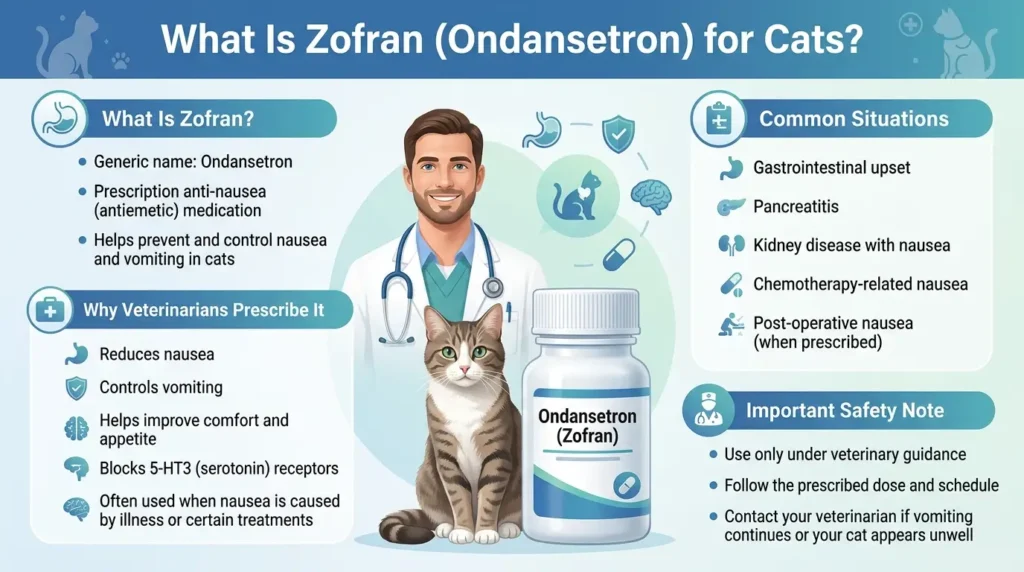
Ondansetron is a human anti-nausea drug also known by the brand name Zofran and is prescribed by veterinarians to cats for anti-nausea. It is a member of a group of drugs known as 5-HT3 receptor antagonists, which act by blocking the effects of a chemical called serotonin that is involved in the vomiting reflex in the gut and the “vomiting center” of the brain.
Zofran (Ondansetron) isn’t FDA-approved for veterinary use, but that doesn’t mean it’s experimental or unsafe. Under the so-called “extra-label” or “cascade” system, veterinarians routinely prescribe human drugs for pets when no specific drug for the animal is available, or when a human drug is more appropriate for the clinical situation. Either way, a valid prescription and a relationship with your vet is required.
Cats may be prescribed ondansetron for the following reasons:
- Chemotherapy-induced nausea
- Pancreatitis
- Kidney disease–related nausea
- Severe gastrointestinal illness or infections
- Failure of vomiting to respond to other antiemetics (e.g. maropitant/Cerenia)
- Every so often, pre-anesthetic anti-nausea measures
How Is Ondansetron Given to Pets?
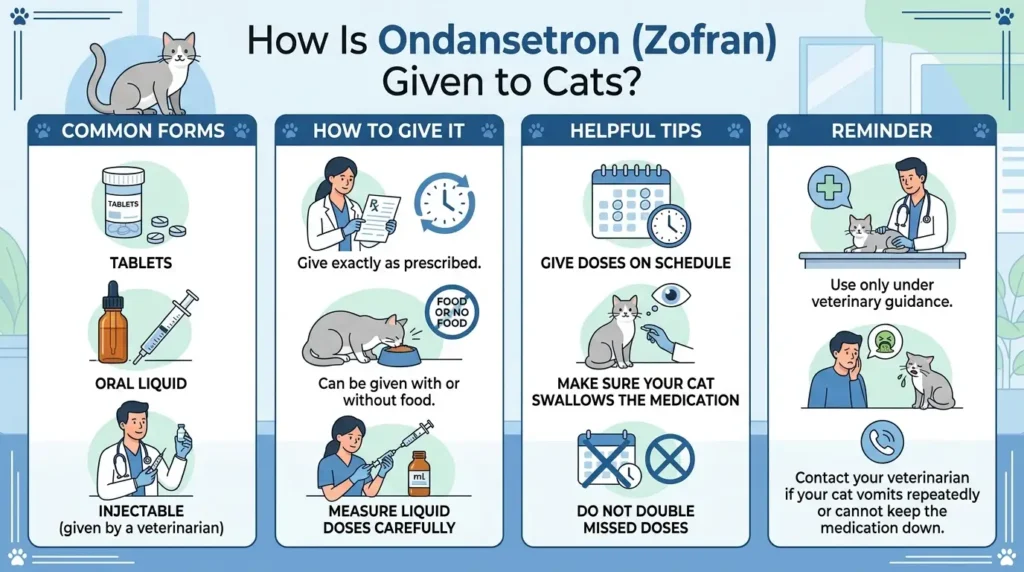
Ondansetron dose is given by mouth as a tablet or liquid, and can be given with or without food — if your pet vomits on an empty stomach, try giving future doses with food or a treat.
If taking orally disintegrating tablets: Ensure hands are completely dry before handling, then place the tablet on the tongue of your pet, it will disintegrate, and will be swallowed with their saliva.
If giving liquid ondansetron: Use an oral syringe, medicine cup, or dosing spoon to measure the dose; household spoons or cups are not accurate enough.
Ondansetron can also be injected as a liquid into a vein, muscle or under the skin in a hospital.
The medicine is very effective, and usually starts to work within 1–2 hours and symptoms improve shortly after.
Never administer the medication in any other way than what your veterinarian prescribed, as detailed on the prescription label.
Why There’s No Single “Correct” Zofran Dose for Every Cat
You’ve likely seen various websites refer to different figures, such as 0.11 mg/lb, 0.5 mg/kg and up to 1 mg/kg. It is not sloppy reporting, it is the actual clinical variation.
The correct dose varies according to the various factors listed below and, as such, is referred to as a range in veterinary literature such as the BSAVA Small Animal Formulary and Plumb’s Veterinary Drug Handbook.
- Indication why it is sick. Treatment for chemotherapy-induced nausea is more aggressive than routine vomiting and may require the upper end of the range.
- The path through which a drug is given to a patient. Oral tablets, oral liquid and injectable preparations (SC, IM, IV) are not dosed the same.
- Liver and kidney function. Ondansetron is metabolized in the liver, and may require a lower dosage or an extended time interval for cats suffering from liver disease.
- Other medications. Ondansetron may interact with drugs that also have an effect on heart rhythm, or drugs that affect serotonin levels.
- Body condition and age are the two factors. Caution is exercised when dosing very young, senior or underweight cats.
That is the reason why a generic ‘enter your cat’s weight, get a number’ calculator can be misleading as it will not see any of the above.
Zofran Dosage For Cats Chart
Here is the reference dosage table for Ondansetron (Zofran) in cats, compiled strictly from the provided clinical data.
| Indication / Clinical Protocol | Recommended Dosage | Administration Route | Frequency | Notes & Guidance |
| Standard Dosage (Plumb’s Manual) | 0.5 mg/kg | Intravenous (IV) | Every 12 hours (twice daily) | Plumb’s Veterinary Drug Manual recommendation; intended for administration by a specialist in a clinical setting. |
| Severe Vomiting | 0.1 – 1.0 mg/kg | Intravenous (IV) Infusion | Every 6 to 12 hours (as needed) | Administered as an IV infusion in a hospital/clinical setting. |
| Severe Pancreatitis (Vomiting Control) | 0.1 – 1.0 mg/kg | Oral (PO) or IV Injection | Every 12 to 24 hours | For home oral care, veterinarians may prescribe human formulations or custom-compounded doses/liquids. |
| General Antiemetic | 0.1 – 0.2 mg/kg | Oral (PO) | Every 12 to 24 hours | Administered by mouth. Uses human versions (oral disintegrating tablets/liquids) or custom-compounded oral liquids. |
Key Clinical Notes & Formulations
- Routes of Administration: Most published dosages recommend intravenous (IV) injections administered by a veterinary specialist in a clinical setting.
- Home/Oral Administration: When sent home for oral administration, options include:
- Human Formulations: Orally disintegrating tablets or oral liquid solutions. (Note: Brand-name Zofran is discontinued, but generic ondansetron is available).
- Compounded Formulations: Custom-compounded specific mg doses or flavored oral liquids prepared by a compounding pharmacy.
- Important Disclaimer: This table is for informational reference only and does not replace professional veterinary advice, diagnosis, or treatment. Always consult a veterinarian for precise dosing instructions for an individual patient.
How to Actually Get an Accurate Dose for Your Cat
- Obtain it from the prescribing vet in writing. Have them specify the mg dose, the dose interval, and for how long.
- Check what to do if cat regurgitates the dose. Some veterinarians say re-dose and some say to wait for the next dose.
- Inquire about the strength of your tablet/liquid medication. A 4 mg tablet and an 8 mg tablet would need to be split very differently, and it is not easy to accurately cut tablets at home.
- If your cat suffers from liver, kidney, or heart disease, make sure to confirm the plan. Both alter the dose and the supervision required for your cat.
- NEVER use leftover human Zofran, or a dose from a different pet’s prescription — YOUR cat’s prescription is for YOUR cat.
Zofran Dosage Side Effects For Cats
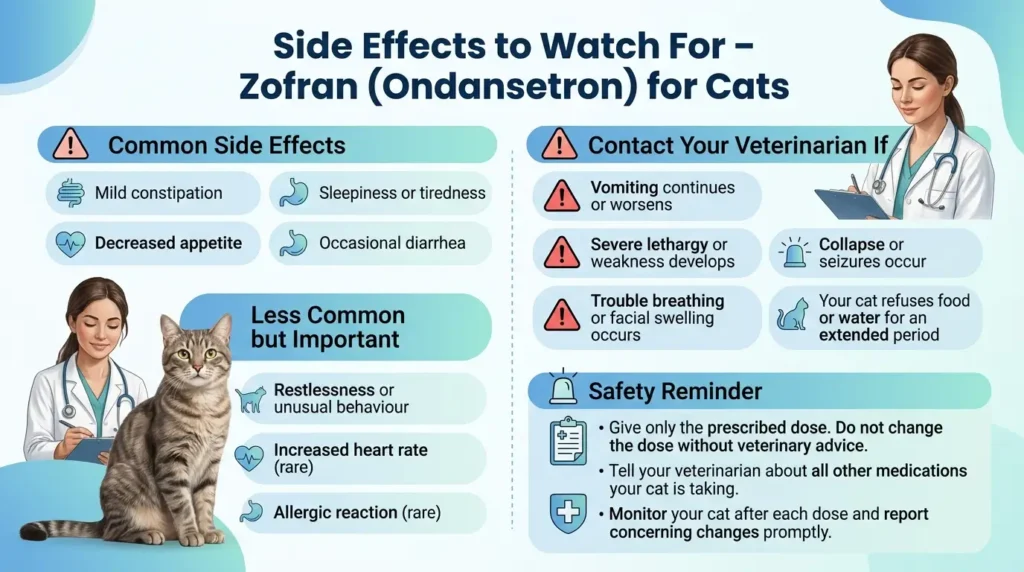
Ondansetron is generally well-tolerated by most cats. There are a few side effects that are reported, albeit not too common:
Mild, more common:
- Mild constipation
- Drowsiness or decreased activity.
- Brief head shaking
Rare, more serious — contact your vet if you see:
- Fainting or collapse
- Abnormally slow, rapid or irregular heart rate
- Severe lethargy or weakness.
- Not getting better, even with the medicine, keeps throwing up
Ondansetron Risk Factors:
Ondansetron should NOT be used in pets that are allergic to it.
Note for use in pets that:
- Have a gastrointestinal blockage
- Have certain abnormal heart rhythms
- Experience abnormal electrolyte levels (high or low)
- Have liver disease
- Have a blood pressure of 160/100 or above (to avoid worsening the condition)
- Using medications that alter the levels of serotonin (such as antidepressants)
Genetic sensitivity: Dogs that are genetically sensitive to certain drugs – such as collies, sheepdogs, and collie or sheepdog cross-breeds – have a genetic mutation (MDR1) that makes them less tolerant of certain medications, and ondansetron should be used with caution in MDR1-positive dogs.
Cats can also have a similar mutation in their ABCB1 gene, but it is thought that it is much less common; these cats might also be more sensitive to some drugs.
Note: Certain medications can not be used in animal competitions, if your animal is taking ondansetron, please review the rules and regulations for the competition.
Signs of a Possible Overdose
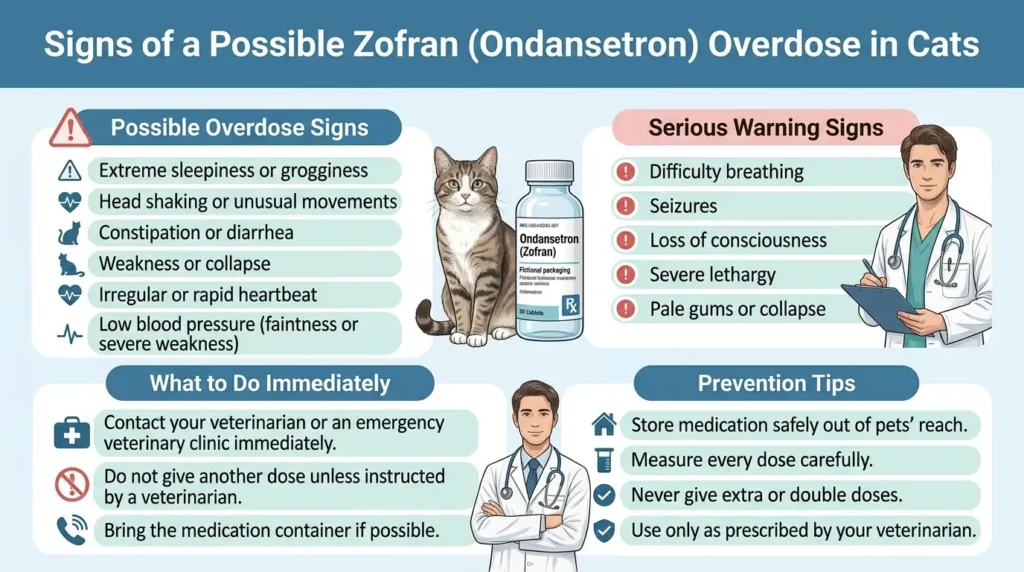
Overdose in cats is reported to occur with excessive amounts, such as giving whole tablets when only a quarter was prescribed, and includes symptoms such as constipation, diarrhea, grogginess, and head shaking, and, in more serious cases, abnormally high liver enzyme levels, abnormal heart rhythm and abnormally low blood pressure.
It’s important to reach out to your veterinarian or emergency animal hospital immediately if your cat is suspected of having overdosed on ondansetron — before symptoms manifest themselves. Have the tablet strength and approximate amount given ready to tell them.
Zofran vs. Other Cat Antiemetics
| Drug | Brand name | How it works | Common use case |
|---|---|---|---|
| Ondansetron | Zofran | Blocks serotonin (5-HT3) signals | Severe/refractory nausea, chemo, pancreatitis |
| Maropitant | Cerenia | Blocks NK-1 substance P receptor | Broad-spectrum antiemetic, motion sickness, general vomiting |
| Metoclopramide | Reglan | Dopamine antagonist, promotes GI motility | Mild vomiting, GI motility issues |
Ondansetron medication is sometimes used in combination with maropitant for cats who vomit that do not respond to one drug alone because they act on different pathways.
Myth vs. Fact
Myth: “If a dose is safe for man, it’s merely a smaller dose for the cat.
Fact: A lot of drugs to humans are different in cats. The doses are set up for feline pharmacology, and not just a reduction of a human tablet.
Myth: “A generic online calculator is good as a vet’s dose, but it is based on weight.
Fact: It’s not just about the weight. The safe dose will vary depending on the underlying disease, route and organ function — this is why reputable veterinary sources do not publish a single “plug in the weight” dose.
Myth: “Zofran drug for cats is an approved drug for cats and is standardized similar to a vaccine.
Fact: Extra-label/Off-label use in veterinary medicine, and legal and common, but that also means that dosing is determined based on clinical judgement and published ranges and not an FDA set feline label.
You May Also Like to Read:
- Ivermectin Dosage For Cats: Calculator, Chart & Safe Guide
- Trazodone Dosage For Cats: Chart, Calculators & Safe Guide
FAQs
For what is Zofran used in cats?
Medication used to treat nausea and vomiting when they are severe, especially when caused by chemotherapy or pancreatitis, kidney disease, or gastrointestinal disease that is resistant to other anti-nausea drugs.
How much Zofran can I give my cat?
Just what your veterinarian has prescribed for your cat. The literature for vets shows a variation in published dose rates of about 0.1–1 mg/kg which is far too large to extrapolate to a safe home dose.
Is Zofran safe for cats?
Yes, if prescribed and dosed by a veterinarian. It is regarded as one of the better tolerated and effective antiemetics available in feline medicine and side-effects are relatively rare.
Is it ok to feed my cat human Zofran tablets?
Only under the direction of a veterinarian and with the strength and quantity that the veterinarian recommends. Human tablets are frequently used in veterinary treatment (this is normal, legal extra-label use) — but again, it is the treatment decision and dose that must be made by your vet.
How fast does Zofran medicine work in cats?
It’s said to begin to relieve nausea symptoms in approximately 1 to 2 hours after being taken.
If my cat vomits immediately after it is fed, what do I do?
Consult your veterinarian for their advice — different advice may be given on whether to re-dose or wait for the next scheduled dose.
What are the common side effects?
The most common ones are mild constipation, quieter behaviour/sleepiness and occasional head shaking.
How do you know if your cat has overdosed on Zofran?
Symptoms may include constipation, diarrhea, drowsiness, head shaking, and in severe cases, irregular heartbeat or low blood pressure. Call your veterinarian or an emergency veterinary clinic right away if you think your pet may have an overdose.
What is the difference between Zofran and Cerenia?
No, both are antiemetic but act at different sites – ondansetron blocks serotonin receptors and maropitant (Cerenia) blocks a different one (NK-1/substance P). Both are sometimes used simultaneously by veterinarians for intractable vomiting.
Does Zofran dosage work for the kittens?
This is a question to ask your veterinarian — the considerations for pediatrics are different than for adults, and this guide doesn’t address kitten specific dosing.
Final Thoughts
Zofran (ondansetron) for cats is one of the more reliable ways that vets have to put stomach upset and vomiting under control in cats — but the dosage that works best for your cat is not simply based on weight.
The only safe course of action is to take your cat’s dosage, form, and schedule from the veterinarian who has handled your pet; find out what to do if a dose is missed or vomited back up; and learn the signs of an overdose, to act quickly if something doesn’t seem right.
If you have any questions, it is always best to just give your vet a quick call rather than working it out from a general chart, if you can.
Similar Posts
Dramamine Dosage For Cats: Calculator, Chart & Safe Guide
Dramamine Dosage For Cats: Calculator, Chart & Safe Guide If your cat has ever made car rides a drooling, yowling, vomit-producing ordeal, you’ve likely used the search term Dramamine dosage for cats at some point. It’s a legitimate inquiry: Dramamine is in the majority of medicine cabinets, and vets do recommend it for cats, occasionally….
Clomicalm Dosage For Cats: Calculator, Chart & Safe Guide
Clomicalm Dosage For Cats: Calculator, Chart & Safe Guide When you’re faced with a tiny pill and an anxious cat, determining the correct Clomicalm dosage for cats can be stressful. The short answer: most cats will be dosed at about 0.3 to 1.0 mg of clomipramine per kg of body weight once a day, but…
Meclizine Dosage For Cats: Calculator, Chart & Safe Guide
Meclizine Dosage For Cats: Calculator, Chart & Safe Guide If your cat gets carsick, is dizzy due to an inner-ear disorder or you just want to double check a dose you’ve been prescribed by your vet, the short answer is that there is no per-pound Meclizine dosage for cats, the standard dose is 12.5 mg…
Trazodone Dosage For Cats: Chart, Calculators & Safety Guide
Trazodone Dosage For Cats: Chart, Calculators & Safety Guide Trazodone Dosage For Cats is among the most sought out cat owners planning to take a cat through a stressful experience like a visit to the vet, traveling, grooming, and post-surgery recovery. Though trazodone is usually administered by a veterinarian to decrease anxiety and to achieve…
Cerenia Dosage For Cats: Calculator, Chart & Safe Guide
Cerenia Dosage For Cats: Calculator, Chart & Safe Guide You just received your cat’s Cerenia prescription, and you are looking for a way to double check the number written on the label. The calculation is explained simply; a plain-english guide is provided so you can scan by weight, and important safety information is provided that…
Clonazepam Dosage For Cats: Calculator, Chart & Safe Guide
Clonazepam Dosage for Cats: Calculator, Chart & Safe Dosing Guide If your vet just prescribed your cat some clonazepam Dosage, you most likely have one burning question: how much do I give? This guide explains the exact dosage range vets use, how to determine your cat’s dosage and the safety details that are most important—such…