Ivermectin Dosage For Cats: Calculator, Chart & Safe Guide
The correct dosage of Ivermectin for Cats should always be determined by a veterinarian, as it varies depending on the type of parasite being treated, your cat’s weight, age and health status. Ivermectin Dosage For Cats is a prescription anti-parasitic drug to prevent heartworm disease and occasionally is prescribed off label for ear mites, mange, and some intestinal parasites. Although it is generally safe when used properly, there can be some serious neurological side effects with even small dosing errors.
This guide includes a dosage calculator developed with a vet and a chart for determining the correct dosage by weight, administration guidelines, potential side effects, warning signs of toxicity, and answers to common questions about using ivermectin.
If your veterinarian has prescribed Ivexx or another medication containing ivermectin for heartworm prevention or for the treatment of another parasitic disease, this article will help you understand how to use the drug safely (not in lieu of your veterinarian’s advice).
Ivermectin Dosage Calculator for Cats
Heartgard® heartworm prevention & Acarexx® ear mite treatment
For cats only. This calculator uses FDA-labeled dosing for Heartgard oral tablets and Acarexx otic suspension. It is a reference tool and does not replace veterinary advice — always confirm dosing with your veterinarian before treating your cat.
Recommended Dosage
Important notes
What Is Ivermectin, and Why Do Cats Get It?
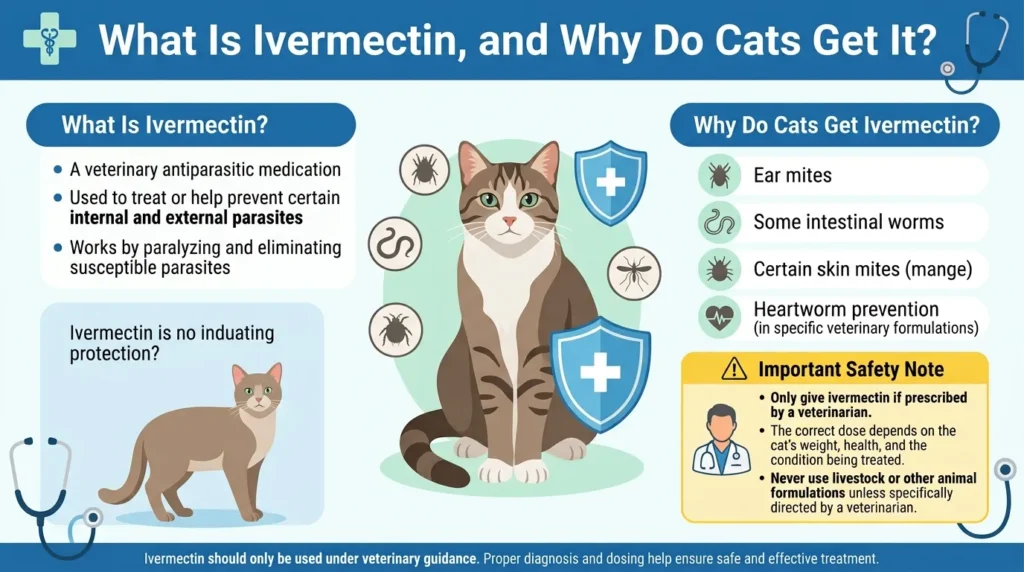
Ivermectin medicine is an anti-parasitic medication primarily indicated for preventing heartworm disease in cats, and treating some other parasites such as hookworms and ear mites. It does this by paralyzing and killing the parasites, but not (at the recommended dose) your cat’s nervous system.
Ivermectin is detected in two FDA-approved formulations in cats:
- Heartgard oral tablets — a monthly chewable to prevent heartworm and control hookworms.
- Acarexx otic suspension — a liquid that is applied inside the ear canal by a vet to treat ear mites.
Vets also prescribe ivermectin off-label (that is, at a different dose or for an alternate purpose than what’s stated on the FDA label) for other ailments such as scabies. As there is no public dosing chart for off-label use, this article follows the labeled use and makes it obvious where the off-label use begins.
The bottom line: There is no “one size fits all” ivermectin dose for cats. The correct amount will depend on the product, condition and weight of the individual cat.
Ivermectin Dosage for Cats
When your veterinarian prescribes a new medication for your cat, or you’re trying to confirm a dosage that you’re planning to administer, you want a direct answer: how much, how often and what’s too much.
The bottom line is, the approved amount of heartworm medication has to be a minimum of 12 micrograms per pound of bodyweight, and it must be given monthly with a tablet that is the correct size for your pet’s weight.
It varies depending on the brand and dosage of the tablet your veterinarian is using. Here’s the complete list, a calculator to help, and most important safety information.
Ivermectin Dosage Chart for Cats
Heartgard Oral Tablets (Heartworm & Hookworm Prevention)
Heartgard is labeled for cats over 6 weeks of age and available in two strengths of chewable tablets, based on weight:
| Cat’s Weight | Tablets per Month | Tablet Strength | Minimum Labeled Dose |
|---|---|---|---|
| Up to 5 lb (2.3 kg) | 1 tablet | 55 mcg ivermectin | 12 mcg/lb |
| 5–15 lb (2.3–6.8 kg) | 1 tablet | 165 mcg ivermectin | 12 mcg/lb |
A few things worth knowing about this chart:
- It is administered monthly, all year round (not just during “mosquito season”) so that your vet is continually protected and the heartworm life cycle has no opportunity to get a foothold.
- Ideally the first dose should be administered within 30 days of the first expected exposure to mosquitos for your cat this year, and the final dose should be administered no later than 30 days after the last expected exposure.
- Monthly Heartgard protects against hookworms as a bonus: you’re not just protecting against one parasite.
- The maximum weight on this chart is 15 lb. If your cat is larger, this particular labelled data won’t apply to your cat; you will need to consult your vet who may use a different size or extension of this particular one.
Quick fact: according to the drug’s manufacturer, side effects in clinical studies were uncommon, with the number of cats vomiting and/or having diarrhea in clinical studies with over 3000 doses being administered being well under 1% — and no real difference compared to cats receiving a placebo.
Acarexx Otic Suspension (Ear Mite Treatment)
Acarexx is a liquid formulation of ivermectin with a concentration of 0.01% which treats adult ear mites in cats and kittens over 4 weeks of age. This is a non-weight based dose, unlike Heartgard it’s the same amount regardless of size:
| Product | Dose | Frequency | Minimum Age |
|---|---|---|---|
| Acarexx otic suspension | 0.5 mL per affected ear | Usually a single dose; vet may repeat once if needed | 4 weeks |
This one is given directly by your vet into your ear canal – not something you dose out and give at home like Heartgard chewables.
How to Use an Ivermectin Dosage Calculator
A dosage calculator helps remove all the guesswork of finding the correct tablet for your cat’s exact weight. The following is a list of questions a good one will ask and the reasons for asking:
- Firstly Product: Heartgard tables and Acarexx suspension are totally different products and therefore, have different methods of dosage.
- Weight (lb or kg): it’s this that is used to determine tablet strength for Heartgard.
- Age: to indicate if your cat or kitten is too young for the labeled age: (6 weeks for Heartgard, 4 weeks for Acarexx).
A good calculator will also not guess beyond the range marked on the label (weight greater than 15 lb for Heartgard) but will extrapolate a value that was never tested. That’s exactly what our calculator does on this page: If you use it, it identifies out-of-range weights rather than making up a dose for them.
How to Give Your Cat Ivermectin Correctly
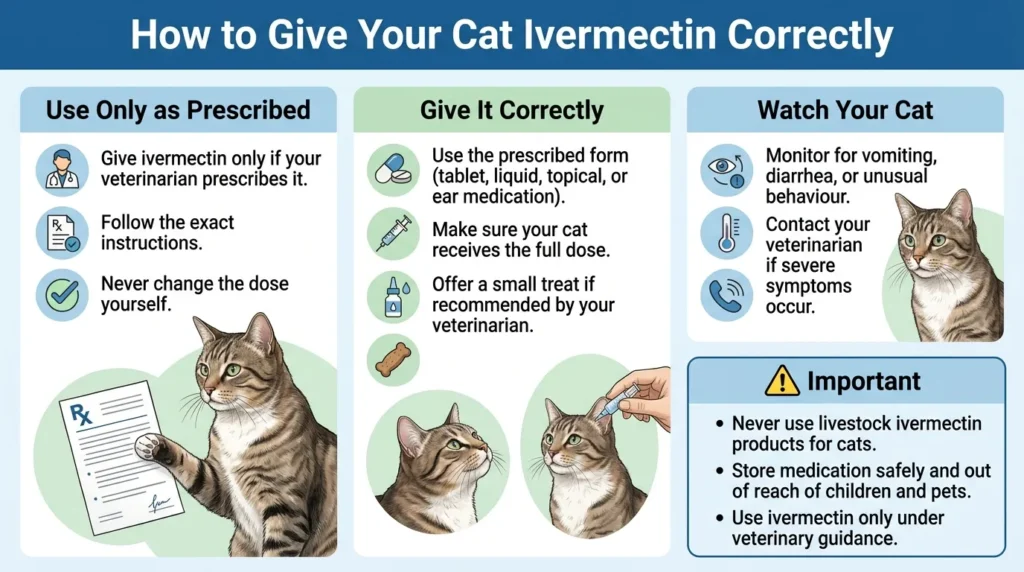
Cats will eat Heartgard as a treat because the tablets are beef flavored and chewable. Here are some helpful hints:
- Serve it on a spoon before it is served with food or mix it with a small portion of food.
- If your cat won’t eat it whole, you can break the tablet into pieces and give it directly.
- Supervise your cat for a few minutes after giving to ensure that he or she has swallowed the entire dose — cats are notorious “spitters of the pill. If it is not certain that the whole dose was swallowed, most advice is to give a new dose of the tablet instead of assuming an incomplete dose.
- Consistency is key to keep the heartworm prevention window closed — try to administer it on the same date each month.
Acarexx, on the other hand, is not something that you can give at home, but is something that your veterinarian gives during a checkup.
Is Ivermectin Safe for Cats?
Yes (at the labeled dose) — ivermectin dosage is safe for cats when used properly and has a wide margin of safety. Here’s one fact you’ll want to know: the genetic sensitivity to ivermectin known to exist in some breeds of dogs (related to the gene mutation for MDR1) has not been documented in domestic cats, which is one reason why this drug has such a good safety record when used at the label-recommended dose in felines.
That margin of safety is a small one at higher doses, however — and this is where most real-world issues arise.
Signs of Ivermectin Overdose
Cats do not digest the poison, it is a neurological effect. Reported signs include:
- Pupils that are dilated and vision disturbances (temporary blindness)
- Wobbliness, disorientation or lack of co-ordination (ataxia)
- Tremors
- Excessive drooling
- Lethargy or weakness
- Collapse, sometimes with convulsions or coma.
Signs may occur within two to 24 hours of overdose and toxicosis cases in the literature have also indicated that the kittens may be more sensitive than adult cats, which may be due to the immaturity of the blood-brain barrier.
Important: These signs are strongly associated with doses far greater than the labeled 12mcg/lb heartworm-prevention dose (which is the dose given in a Heartgard tablet), the kind of dose that would be achieved by an accidental exposure to livestock-formulated ivermectin (see below).
Ivermectin Side Effects in Cats
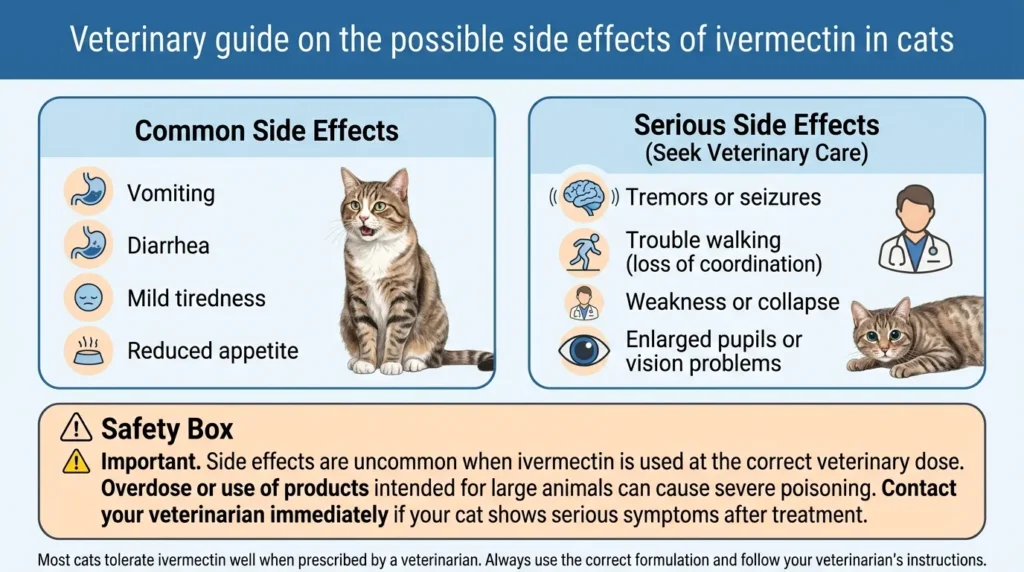
Cats have reacted very favorably to ivermectin at the concentrations recommended for heartworm prevention. Side effects were rare in the clinical trials:
- Vomiting: < 0.3% of cats
- Less than 0.2% of cats have diarrhea.
Side effects may be more likely to happen if you take doses that are higher than the recommended amount. If your cat exhibits any of the following symptoms, contact your vet right away.
- Serious neurological signs: stumbling etc., trembling, dilated pupils, drooling, or head pressing.
- Stomach upset (vomiting or diarrhea)
- Signs of shock – weakness, vomiting, diarrhea (may occur if the ivermectin is causing the death of many heartworms larvae in one go)
In case of suspected side effect, consult your vet for advice and inform the manufacturer, Boehringer Ingelheim Animal Health USA.
It is short-acting and usually ceases to be effective after 24 hours, although this may be extended in cats suffering from liver or kidney disease. For heartworm prevention only, it will last approximately 4 weeks per dose.
Ivermectin Risk Factors For Pets
Dogs under 6 weeks of age and dogs that have not had a recent negative heartworm test should not be given Ivermectin.
Some breeds of dogs are more sensitive to ivermectin than others, particularly collies, sheepdogs and collie or sheepdog cross breeds. Usually related to a genetic mutation (known as MDR1), that causes them to be unable to handle high doses of ivermectin and other drugs. When ivermectin dosage for cats is prescribed at recommended doses for heartworm prevention, though, it can be safely given to dogs with the MDR1 mutation.
Cats can also have a similar mutation, called ABCB1, which is thought to be very rare. Cats with the mutation can also be very sensitive to some drugs.
Your veterinarian will be able to tell you if it is safe to use ivermectin on your pet. Your veterinarian may consider genetic testing in dogs that are sensitive to and may require a higher treatment dosage.
Ivermectin Drug Interactions in Cats:
Prior to starting ivermectin, make sure to inform your veterinarian if your cat is on any other medications, vitamins, supplements, or herbal therapies.
Some medications may enhance the effects of ivermectin on the brain and should be avoided or discussed with your veterinarian, including:
- Ketoconazole
- Itraconazole (some antifungal drugs)
- Cyclosporine
- Erythromycin
- Amlodipine besylate
- Nifedipine
- Benzodiazepines
- Ketamine
Special attention should be paid to the use of spinosad, which should not be mixed with high doses of ivermectin (for mites) but is safe with low doses (heartworm prevention).
In general, ivermectin can be administered concurrently with other commonly used anti-parasitic medications, as well as vaccinations, antibiotics and steroids.
However, it is important to be honest with your veterinarian and disclose your cat’s entire medication and supplement history before beginning ivermectin therapy, to identify any potential interactions that could pose a risk to your cat.
What to Do If You Suspect an Overdose
As for ivermectin toxicity, there is no specific antidote; treatment is supportive care by a veterinarian (such as intravenous lipid therapy in some cases and intravenous fluids), which is why it isn’t a wait-and-see situation.
- Contact the vet or emergency animal hospital right away.
- Alternatively, ASPCA Animal Poison Control Center (888) 426-4435 is open 24 hours every day (a consultation fee may be charged).
- Do not attempt to make a person vomit or administer any home remedy without expert advice first.
Off Label Ivermectin Use in Cats
Ivermectin cat dosage is also used off label (off the FDA label) to treat other parasites, including scabies (mange). This could be an injection which is approved for use in farm animals but used at a cat-safe dosage by a veterinarian and a cat-safe monitoring protocol.
As the dose is contingent upon the specific case, and is not a set table available to the public, this article will not be speculating about numbers — that is your veterinarian’s decision.
Ivermectin for Cats vs. Livestock Ivermectin: Why the Difference Matters
The single largest source of ivermectin medicine for cats overdose in the real world is when the dewormer paste for livestock or injectable ivermectin (labelled for horses or cattle) is not formulated, concentrated or dosed for a 10 pound cat. What may be considered a ‘small’ dose of a product used for a 1000lbs animal can be a large overdose for a cat.
Ivermectin, if it’s being administered to your cat, should be from a product that is specifically labeled for use on cats (or prescribed off-label by your veterinarian at a cat-specific dose) and not a barn or farm-supply product measured by guesswork.
Myth vs. Fact: Ivermectin in Cats
| Myth | Fact |
|---|---|
| “Any ivermectin product works the same in any dose.” | Formulation and concentration vary enormously between products made for cats, dogs, and livestock. Dose and product must match the species and the label. |
| “More frequent dosing means better protection.” | Heartgard is designed for once-monthly dosing. Giving it more often doesn’t add protection — it only adds risk. |
| “Cats have the same ivermectin sensitivity issues as some dogs.” | The MDR1 gene sensitivity documented in some dog breeds hasn’t been shown in domestic cats. |
| “If my cat seems fine after an accidental double dose, it’s not a big deal.” | Some overdose signs take up to 24 hours to appear. “Seems fine” right after exposure isn’t the same as being in the clear. |
You May Also Like to Read:
- Trazodone Dosage For Cats: Chart, Calculators & Safe Guide
- Zofran Dosage For Cats: Calculator, Chart & Safe Guide
FAQs
What is the maximum amount of ivermectin medication to give a cat?
This is product dependent. If using FDA approved Heartgard tablets, cats under 5 lb receive 55 mcg tablet once a month and cats 5-15 lb receive 165 mcg tablet once a month (a minimum of 12 mcg per pound of cat). There is no such thing as a universal “ivermectin dose” for all products or uses.
Is it safe to use ivermectin on cats?
Ivermectin is quite safe for cats when given at the label dose of an approved product, such as Heartgard. The margin of error is very small for anything above the labeled dose, that’s why it is important to dose by weight.
How often can I dose my cat with ivermectin?
Once a month, year round on about the same date, for Heartgard heartworm prevention. Other products (such as Acarexx for ear mites) are administered in a completely different pattern — typically a single application by the veterinarian.
Is it OK to treat my cat with ivermectin for horses or cattle?
No. Livestock ivermectin products are not formulated for cats, and are one of the most common sources of ivermectin overdose in cats. Use only product that has been prescribed and dosed by veterinarian and is labeled for use on cats.
What is the youngest age that ivermectin can be used in cats?
Heartgard is listed for cats 6 weeks of age or more. Acarexx otic suspension is indicated for use in cats and kittens ≥ 4 weeks of age.
If my cat gets too much ivermectin, what will happen?
Overdose symptoms include neurological (dilation of pupils, wobbliness, tremors, drooling, weakness, and collapse or seizures). It may take up to 24 hours for signs to be evident. This will need veterinary attention ASAP and there is no home treatment.
Can Heartgard be used to treat other worms?
Yes. Monthly Heartgard not only prevents heartworm, but also kills and controls hookworms in cats.
Is Ivermectin dosage safe for kittens?
At or after the age indicated on the label for the product used (6 weeks for Heartgard, 4 weeks for Acarexx) and only under veterinary guidance — kittens may be more susceptible to an overdose than adult cats.
Are there any antidotes to ivermectin poisoning in cats?
No. Treatment is supportive care (IV fluids) under veterinary supervision – this means that suspected overdoses require veterinary attention, not home care.
What is different about Acarexx and Heartgard?
Heartgard is a weight based, once a month oral chewable heartworm and hookworm preventative. Acarexx is a liquid applied to the ear canal by a vet and is dosed based on volume (0.5 mL per ear) and NOT weight.
Is it a good idea to administer an Ivermectin treatment to my cat by myself?
A veterinarian should prescribe and administer off-label use of ivermectin for scabies as there is no standard, publicly labeled, at-home dose for this purpose.
Is Heartgard for Cats still available?
As of this writing, the manufacturer’s own product page has the Heartgard for Cats as an active product, but some third party pharmacies have reported problems with supply. Ask your veterinarian or pharmacy about availability as this could change.
Final Thoughts
The safest dosage of ivermectin for your cat is the one that corresponds with the specific product your veterinarian is administering your cat, and is based on your cat’s current weight — not what you may have heard about a friend’s cat or what’s left from their pet’s prescription or what you think you saw at the feed store for livestock.
Both Heartgard’s weight based chart and Acarexx’s fixed dose are easy to use once you have determined which is the right one for you. That’s when to call your veterinarian and not make an educated guess: if the kitten is younger than the minimum age listed, the weight is more than 15 lb or the overdose is suspected. Ivermectin dosage for cats, when used properly, is one of the safer products for controlling parasites in cats available today.
This article is intended for information only and should not be used as a substitute for individual veterinary advice. No one knows your cat better than your veterinarian, so always check with your pet’s doctor before administering any medication.