Cerenia Dosage For Cats: Calculator, Chart & Safe Guide
You just received your cat’s Cerenia prescription, and you are looking for a way to double check the number written on the label. The calculation is explained simply; a plain-english guide is provided so you can scan by weight, and important safety information is provided that every cat owner should know before administering this medication.
Cerenia Dosage Calculator for Cats
Estimate a reference dose based on your cat’s weight and the prescribed formulation.
Recommended Dosage
Important Notes
This calculator is for informational and reference purposes only. It does not replace professional veterinary guidance. Always confirm dosing, route of administration, and suitability with a licensed veterinarian before giving any medication to your cat.
Key takeaways
- Cerenia Dosage For Cats is approved by FDA for cats at the rate of 1 mg/kg (0.45 mg/lb) once a day for a maximum of 5 days.
- Cerenia tablets are not approved for use in cats, but are prescribed ‘off-label’ and typically at a similar dose of ~1 mg/kg.
- Cerenia for cats is prescription-only. The following chart is provided as a guide to familiarize yourself with your veterinarian’s instructions, and should not be used in place of your veterinarian’s advice.
- Do NOT adjust or repeat doses without medical supervision, particularly in liver disease, kittens under 16 weeks and cats that may have ingested a toxic substance.
What is Cerenia for Cats?
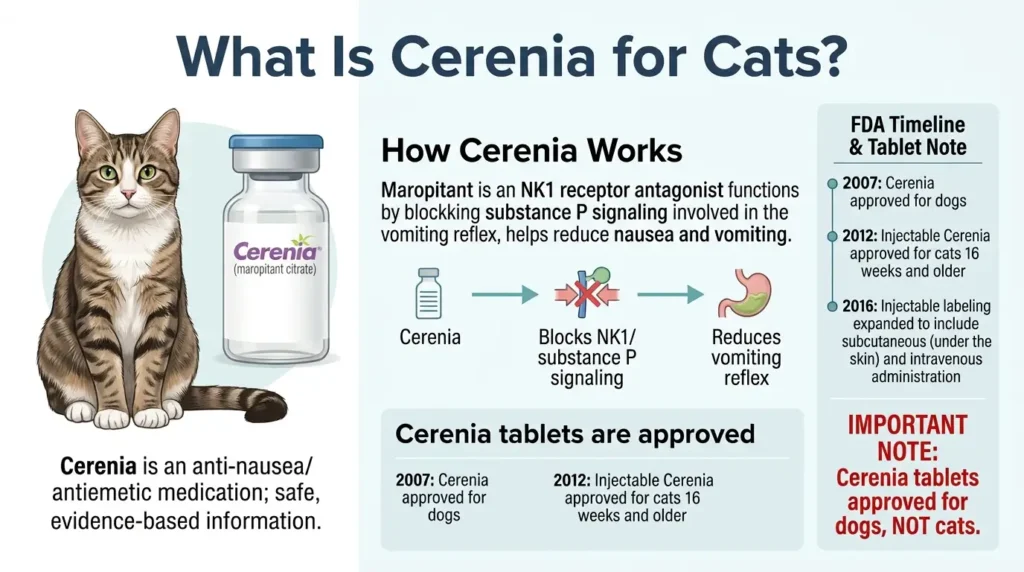
Maropitant citrate is a brand product called Cerenia that is manufactured by Zoetis, which is an anti-nausea (antiemetic) medication. It’s in a group of medications known as NK1 receptor antagonists. In simple terms, it prevents the chemical messenger “substance P” from reaching the vomiting center in your cat’s brain, so the message of nausea doesn’t really take hold and your cat is no longer sick or does not become sick.
Cerenia medication is not directly active on the digestive systems and it is not active on the nausea mechanism itself. It simply disupts the vomiting reflex, allowing your cat to get some rest, food and fluids while you address the underlying issue.
Cerenia medicine was approved by the FDA for use in dogs in 2007. The injectable form was approved in cats in 2012, for cats 4 months (16 weeks) of age or older and the label was expanded in 2016 to include both subcutaneous (under-the-skin) and intravenous injection. Unfortunately, Cerenia tablets are still only approved for dogs — more on that for cats below.
What Is Cerenia Used For in Cats?
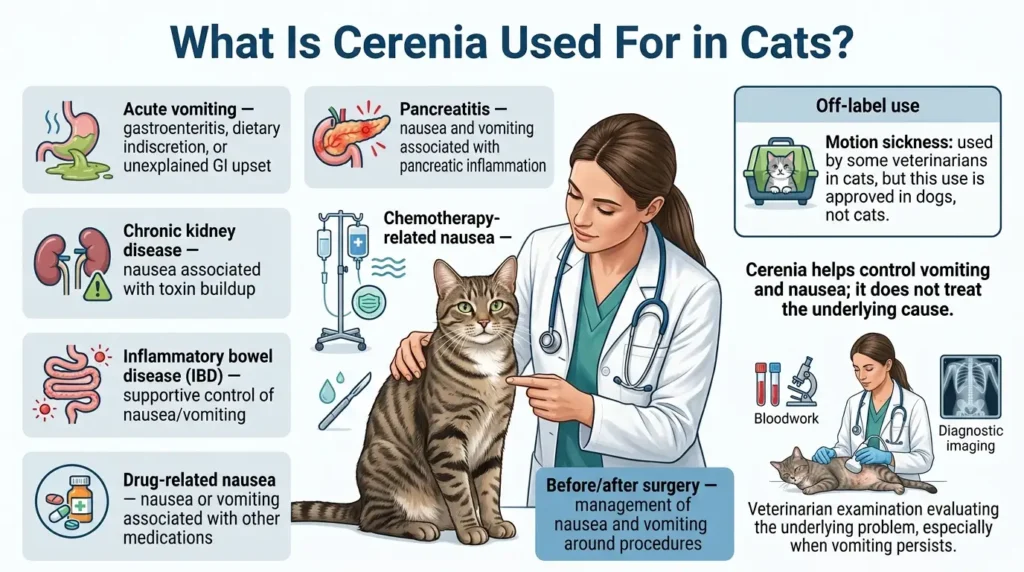
Cerenia dose is called upon in many situations by vets such as:
- Acute vomiting due to gastroenteritis, dietary indiscretion or unknown GI upset
- Nausea is a common problem in pancreatitis and can be severe.
- Inflammatory bowel disease (IBD)
- Chronic kidney disease, which is the build-up of toxins leading to persistent nausea and loss of appetite.
- Chemotherapy-related nausea in cats being treated for cancer
- A form of nausea, commonly administered before surgery and after surgery as well.
- Responses to other drugs.
Some veterinarians also use it off-label for motion sickness (it is approved for this use in dogs but not cats) and in some instances as a mild anesthetic sparing pain adjunct during surgery.
Cerenia will only address the vomit symptom, and your veterinarian may want to do other tests, such as bloodwork or imaging, to determine the cause of your cat’s nausea, particularly if the vomiting persists for more than a day or two.
Cerenia Dosage for Cats
This is the part most people are searching for, so let’s get straight to the numbers.
The core formula
The labeled dose of injectable Cerenia for cats is:
1 mg per kg of body weight (0.45 mg per lb), given once daily, for up to 5 consecutive days.This is equivalent to 0.1 mL/kg (or 0.045 mL/lb) of the 10 mg/mL solution. This is a dose that was researched and FDA approved for cats.
Oral Cerenia tablets are only licensed for use in dogs. If a veterinarian prescribes tablets for a cat, it is off-label (also known as “extra-label”) use; this is legal and common in veterinary medicine, and the exact dose is determined by the vet’s clinical judgment and not the FDA’s label.
In practice most veterinary surgeons use approximately the same 1mg/kg per day in cat tablets using the tablet size that is nearest to that or splitting a tablet.
Important: “Off-label” is not necessarily unsafe; it is simply that FDA has not formally evaluated this use. The dosage recommended by your vet may vary from the chart below due to the condition of your cat, his age, kidney and liver function, and other medications. Always take the dosage indicated on a prescription label in preference to any generic chart, such as this one.
Cerenia Dosage Chart For Cats By Weight
| Cat’s weight | Weight (kg) | Injectable dose (1 mg/kg) | Typical oral tablet approach* |
| 4 lb (small kitten, 16+ wks) | 1.8 kg | ~1.8 mg | Vet-directed only |
| 6 lb | 2.7 kg | ~2.7 mg | Vet-directed only |
| 8 lb | 3.6 kg | ~3.6 mg | ~¼ of a 16 mg tablet |
| 10 lb | 4.5 kg | ~4.5 mg | ~¼–½ of a 16 mg tablet |
| 12 lb (average adult cat) | 5.4 kg | ~5.4 mg | ~½ of a 16 mg tablet |
| 15 lb | 6.8 kg | ~6.8 mg | ~½ of a 16 mg tablet |
| 18 lb | 8.2 kg | ~8.2 mg | ~½–1 of a 16 mg tablet |
| 20 lb | 9.1 kg | ~9.1 mg | ~1 of a 16 mg tablet |
The dosage amounts for tablets are representative only and are based on typical off-label use by veterinary resources. Cerenia tablets are available in 16mg, 24mg, 60mg and 160mg sizes and can be split – only split a tablet or dose as directed by your veterinarian.
How to calculate the dose yourself
To sanity check the number on your prescription label:
- Find your cat’s weight in kilograms. If you only have pounds, divide by 2.2 (e.g., 11 lb ÷ 2.2 = 5 kg).
- Multiply by 1 mg. That’s the injectable dose in milligrams (5 kg × 1 mg/kg = 5 mg).
- Compare to the number on the label. If the difference between your vet’s prescribed dose and this dose seems significant, this is not necessarily a problem: your vet may be adapting the dosage to your liver disease, age or the condition for which Cerenia has been prescribed. Contact the clinic, do not adjust the dose.
Special dosing situations
- Liver disease: as Maropitant is metabolized by the liver, vets may consider decreasing the dosage by about 25-50% if the cat has liver disease.
- Kittens: Safety has not been determined in kittens less than 8 weeks of age and the FDA label is for cats 4 months of age (16 weeks). Avoid giving to a very young kitten unless specifically prescribed by your vet.
- Pregnant or nursing cats: Cerenia has not been studied in these cats, and is generally not used unless the potential benefit outweighs the potential risk, which is not known.
- Multiple days: FDA label states not to use injectables for more than 5 consecutive days. Tablets are sometimes used for longer for chronic conditions such as kidney disease, but this is on an individual basis and is monitored.
How Cerenia Is Given
Cerenia Dosage For Cats is usually administered by a veterinarian under the skin (subcutaneously) or, less frequently, intravenously. Cats may yelp, hiss or pull away, which is a normal reaction, as the discomfort at the injection site is the most commonly reported side effect, affecting approximately one out of every three cats. The sting is less if you refrigerate the solution before you inject it (as opposed to at room temperature).
Cerenia tablets are administered orally, once a day, with or without a morsel of food (food is not necessary, but may be helpful if your cat will eat it). However, do not place the tablet so deep in the food that your cat will swallow it without chewing through the coating as that may slow absorption. Topical contact with maropitant may lead to a skin reaction; wash hands after handling the tablets.
For missed doses: Take as soon as remembered, then back to normal schedule. Catch-up does not mean double up — this may increase the risk of side effects with no additional benefit.
How Fast Does Cerenia Work, and How Long Does It Last?
Injectable Cerenia begins to act in minutes, and up to an hour. Oral tablets require more time to begin working (1-2 hours). Either way, one dose is enough to control nausea for about 24 hours and so it is recommended only once a day.
Cerenia Side Effects in Cats
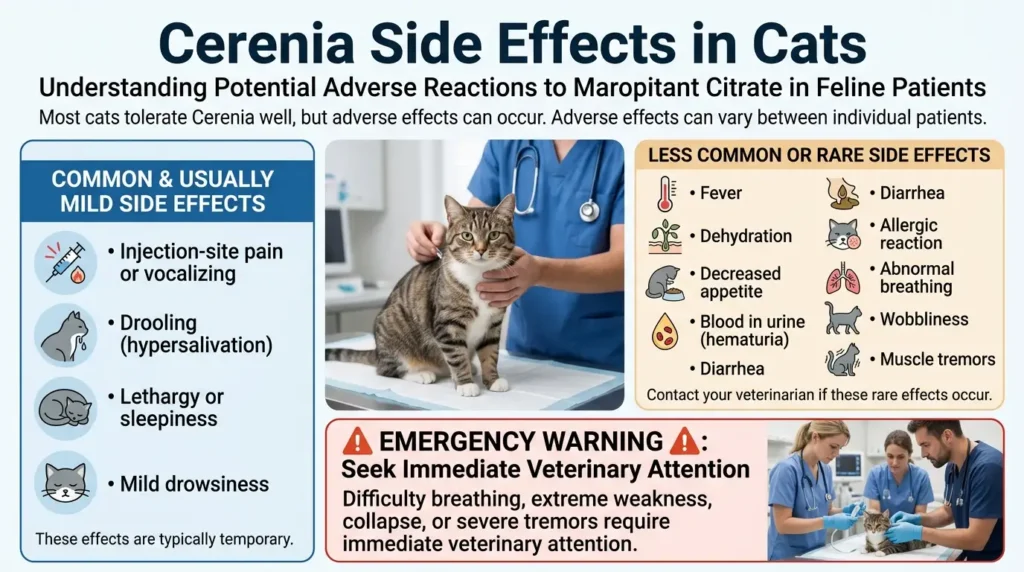
Cerenia is well tolerated by most cats. When side effects do happen, they’re usually mild and short-lived.
| Common (seen more often) | Less common / rare |
| Pain or vocalizing at the injection site | Fever |
| Drooling (hypersalivation) | Dehydration |
| Lethargy / sleepiness | Decreased appetite |
| Mild drowsiness | Blood in urine (hematuria) |
| Diarrhea | |
| Allergic reaction | |
| Abnormal breathing, wobbliness, muscle tremors (rare, more concerning) |
Should your cat exhibit the very rare, more severe symptoms of difficulty breathing, extreme weakness, collapse or tremors, this is considered an emergency; contact your veterinarian or the closest emergency animal care facility immediately.
Serious Risks and When Cerenia Should NOT Be Used
Cerenia isn’t right for every vomiting cat. Most veterinarians steer clear of it or use it with great caution in these cases:
- Obviously or suspected gastrointestinal obstruction (blockage) — masking of vomiting here can lead to a late diagnosis which requires surgery
- Suspected ingestion of toxins – (masking is an issue, too)
- Kittens younger than 8 weeks old
- Cats under observation, pregnant or nursing (not studied)
- Cats with heart or liver disease (use with caution and normally a reduced dosage)
- Prolonged vomiting (3+ days) without diagnosis
This is the reason Cerenia is prescription-only (and not something you can get off a shelf): A vet has to rule out the situations above before concluding that Cerenia is the right tool.
What Does a Cerenia Overdose Look Like?
In safety studies, the cats receiving up to 5 times the labeled dose for 2 weeks did not have any clinically or lab abnormalities — Cerenia’s margin of safety is high at the labeled dose. However, weakness and difficulty breathing are sometimes reported following accidental overdoses (e.g., if a cat is given a dose that is double the normal dose, or a large cat is dosed with a small cat’s dose).
If you think your cat overdosed on Cerenia or they are showing weakness, difficulty breathing or collapse after taking the dose, don’t wait to see if it’s OK—call your vet or emergency animal hospital right away. The ASPCA Animal Poison Control Center (888-426-4435) also can provide guidance on what to do next (advice may cost a fee).
Drug Interactions to Watch For
Discuss all medications, supplements and herbal remedies that you give your cat with your veterinarian. Cerenia cats dosage is bound to protein in the bloodstream to a high degree, and may interact with other drugs that are bound to proteins, such as:
- Chloramphenicol
- Erythromycin
- Itraconazole and ketoconazole (antifungals)
- Phenobarbital
- NSAIDs (e.g., meloxicam or robenacoxib)
These combinations are not necessarily prohibited, but your veterinarian might wish to monitor your cat more closely or take other measures when administering the combination.
How Much Does Cerenia Cost for Cats?
Prices may also differ with region and clinic but as a guideline:
- Oral tablet: approximately $5-$15 per tablet or $20-$60 per blister pack of four tablets as per tablet size prescribed.
- In-clinic injection: approximately $25-$50 per injection, in addition to the exam/visit fee.
When the vomiting is just one episode, the total cost is typically in the $30-$80 range. If your cat is going to take Cerenia for a long-term condition, such as kidney disease, you will need to consider the cost of ongoing use: check with your vet to see what the tablet size is for your cat and if there is a generic maropitant available in your area.
Cerenia vs. Other Anti-Nausea Options for Cats
| Option | How it works | Best for | Watch-outs |
| Cerenia (maropitant) | Blocks NK1 receptors centrally and in the gut | Most causes of acute nausea/vomiting; broad-spectrum | Injection-site pain; prescription only |
| Ondansetron (Zofran) | Blocks serotonin (5-HT3) receptors | Budget-friendly, sometimes used for longer-term nausea | Generally less potent for severe vomiting than Cerenia |
| Metoclopramide (Reglan) | Increases gut motility; mild antiemetic effect | Cases where sluggish gut motility is part of the problem | Less effective than Cerenia for pure nausea control; can cause neurologic side effects in some cats |
| Pepto-Bismol | Contains a salicylate (aspirin-like compound) | — | Not recommended for cats — cats metabolize salicylates poorly, raising toxicity risk |
| Dramamine (dimenhydrinate) | Antihistamine, sedating | Occasionally used for mild motion sickness | Significant sedation; less reliable than Cerenia |
All of these are non-interchangeable without veterinary advice—what is most suitable for your cat depends on what is causing him to be nauseous.
Myth vs. Fact
Myth: “Cerenia tablets are not approved for cats and therefore are not safe.
Fact: FDA approval and clinical safety are different things. Off-label prescribing: Not dangerous, just a common and accepted veterinary practice where the specific cat/tablet combination is not part of FDA’s formal review.
Myth: “If one dose helps, a bigger dose will work faster.
Fact: Cerenia is already maximally effective within an hour or two at the label dose. This is not increased by giving more – it only increases side effect risk.
Myth: “Cerenia cures the vomiting.
Fact: It simply puts the vomit reflex to sleep. The problem may reoccur or exacerbate while wearing a mask if the cause of the problem (obstruction, toxin, disease) is not corrected.
You May Aloso L:ike to Read:
- Sentry Fiproguard Plus Dosage For Cats: Calculator, Chart & Safe Guide
- Nitenpyram Dosage For Cats: Calculator, Chart & Safe Guide
FAQs
How much Cerenia can I give my cat?
The dose approved by FDA is 1 mg per kg of body weight (0.45 mg per lb) once a day. Always take the dose that your veterinarian prescribes as it may have been adjusted for your cat’s health.
Is Cerenia safe for kitties?
Yes for most cats as long as it is used accordingly. No serious effects were found up to 5 times the normal dose for 2 weeks. However, it is not suitable for all cats – veterinarians will not use it if they suspect that the cat has a problem with its guts, has swallowed something toxic, or is a very young kitten.
How often can you give a cat Cerenia?
Once every 24 hours. The injectable version is formulated for up to 5 days; extended use (typical of chronic diseases) is a veterinarian’s decision.
Can I give my cat too much of Cerenia?
Some cats have been known to experience weakness and difficulty breathing with an overdose. If you think there is an overdose, or if these symptoms occur, contact your veterinarian or emergency clinic immediately.
How long does it take for Cerenia to kick in a cat?
It is effective within minutes to 1–2 hours after a Cerenia tablet is given and within an hour after an injection of Cerenia is given. The effects take place for about 24 hours from either side.
Is it OK to give my cat Cerenia daily for a long time?
For chronic nausea (such as kidney disease), some vets allow chronic use (which is monitored and personalized), but this is not a medication that should be started or continued at the owner’s discretion.
Is the Cerenia dose the same for cats and dogs?
All species receive the same dose of the medicine to be injected (1 mg/kg). Tablet dosing is different: the FDA recommended dose for a dog is 2 mg/kg, for a cat it is usually around 1 mg/kg (not the same as the leftover dose of their dog’s medication).
Is it OK to cut a Cerenia tablet in half for my cat?
Tablets have a line to indicate that they are supposed to be broken, and veterinarians do it all the time on cats. May be divided only by the specific directions of your vet and the unused half must be stored properly (room temperature, away from light and moisture, and used within a couple of days).
Does Cerenia make cats sleepy?
A small percentage of cats have been reported to experience mild drowsiness or lethargy as a side effect.
Why does my vet need to do blood work to determine if I should use Cerenia?
Since Cerenia medication for cats does not correct the cause of vomiting, some veterinarians may prefer to first determine if a foreign body, toxicity, or organ disorder is at fault and would rather not begin the medication until that is ruled out to avoid any potential delays in diagnosis.
Is it safe to use Cerenia for cats that get carsick?
This is approved by the FDA for dogs, but not cats — some veterinarians prescribe it off label to prevent motion sickness in cats given 2 hours prior to travel.
Are Cerenia & Zofran the same drug?
Both are anti-emetics, but with different receptors (Cerenia blocks NK1/substance P; Zofran blocks serotonin receptors). Sometimes they are used in various circumstances or as substitutes for the other.
Can I get Cerenia for my cat at a vet’s office?
It is not available over the counter, but has to be prescribed by a veterinarian and dispensed by a veterinarian or by a pharmacy under a veterinarian’s prescription.
Final Thoughts
Cerenia Dosage For Cats is one of the most effective anti-nausea drugs available for cats and for most cats has rapid onset with few side effects. Yes the dosage is easy, 1 mg for every Kg of body weight once a day, but the nitty-gritty of dosage (liver changes, off label tablets, exclusion of some blockages first) is why it is a prescription drug and not something to dose from memory.
Know and confirm with your vet what is prescribed on the chart above, watch for the unusual, but serious signs, and consult your veterinary team when something does not sound right. This — a clear reference, plus a quick call when in doubt — is the safest course of action for any medication you choose to administer to your cat.