Methigel Dosage For Cats: Calculator, Chart & Safe Guide
If you’re standing in your kitchen with a tube of Methigel Dosage in one hand and a squirming cat in the other, you probably don’t want a science lecture — you want to know exactly how much to give, how often, and whether you’re about to make a mistake.
The quickest answer is: Cats are given ½ teaspoon of Methigel once a day, as directed by the manufacturer’s label. But if one has looked around, the sites will also be seen claiming “twice daily. This contradiction does matter and we’ll clear it up — as well as all the other info you need to make sure this product you’re using is safe.
Methigel Dosage Calculator For Cats
Calculate Methigel® dosage based on official veterinary directions.
Dosage Results
© medscat.com
Quick facts before we dive in:
| Active ingredient | DL-Methionine, 480 mg per teaspoon (6 g) |
| Standard cat dose | ½ teaspoon (240 mg DL-methionine), once daily, with food |
| Minimum age | 1 year |
| Main use | Acidifies urine to help control struvite crystals/stones and reduce urine odor |
| Sold as | Over-the-counter oral gel by Vetoquinol |
| FDA status | Not an FDA-approved veterinary drug; sold as a nutritional supplement |
What Is Methigel?
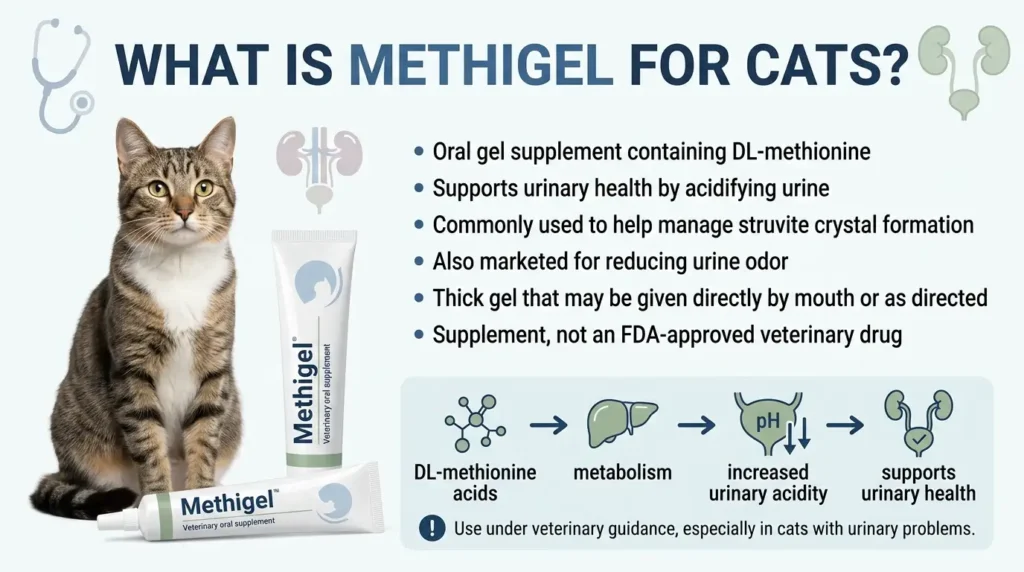
Methigel is a dog and cat oral gel supplement that is available over the counter from Vetoquinol. It contains only one active ingredient, DL-methionine, which the body then metabolizes to produce sulfuric acid, which passes through the urine. That process decreases, or acidifies, the pH of urine.
It’s sold as a urinary tract health supplement, and is most commonly used to help manage struvite crystal formation and to eliminate cat and dog urine odor. Most cats will lick directly off a fingertip, spoon or nose, and it is thick and has a molasses taste.
Part of the reason for the inconsistent dosing advice on the internet is that Methigel Dosage For Cats is not recognized by the FDA as a veterinary drug: DL-methionine products for pets exist in a gray area of “generally recognized as safe” supplements but are not regulated medications.
What Is Methigel Used For in Cats?
Vets recommend Methigel, or DL-methionine generally, to:
- Prevent or control the formation of struvite crystals and stones that are more likely to develop in less acidic (alkaline) urine
- Minimize cat urine odor reminiscent of ammonia.
- Maintain general pH balance in the urinary tract, especially in cats that form urinary crystals often.
Not used to treat urinary blockage, a UTI alone, or as an emergency medicine. If your cat is having trouble urinating, crying in the litter box, or if he can’t urinate, it’s a potential emergency (particularly in male cats) – don’t give the supplement, go straight to the vets.
How Does DL-Methionine Work?
DL-methionine dosage is essential amino acid. Metabolized to sulfate that binds with hydrogen ions in the kidneys, thus decreasing the pH of urine. Nudging the pH down can be useful in dissolving small struvite crystals and make it less favorable for the formation of new crystals, as struvite crystals form in alkaline urine.
This takes time to work and is a gradual change – you will need to take this for days to weeks before it will start to change urine pH, and it is best to periodically check urine pH using a urinalysis, not by guesswork.
Methigel Dosage for Cats: The Official Label Instructions
The instructions for cats on Vetoquinol’s own product label (confirmed by the current drug fact sheet) are:
Administration: For cats: 1/2 teaspoon per day.
Should NOT be used in animals under 1 year old.
Give with or after food for decreased incidence of gastrointestinal upset.
That’s all: ½ teaspoon (240 mg of DL-methionine) per day, without regard for your cat’s actual weight, and administered with or immediately after a meal.
Important: the “once daily vs. twice daily” confusion
However, if you have noticed that other sites place “½ – 1 teaspoon 2 times per day” for cats, you are not mistaken, since a number of retailer’s pages and pet-information pages do indicate this. However, it is directly opposing to the manufacturer’s label on Vetoquinol, and to Drugs.com’s veterinary drug reference which indicates once daily.
Our recommendation: stick to the directions that are listed on the tube you have, or as provided by your veterinarian in writing — not a generic web page. Label instructions can change over time from the manufacturer, or the vet might prescribe an off-label frequency for a particular medical reason. So it is important to remember that giving twice the labelled dose just in case is the way to get cat overdose.
Methigel Dosage Chart for Cats
| Cat Life Stage | Daily Dose | DL-Methionine (mg) | Frequency | Notes |
| Kitten (under 1 year) | Not recommended | — | — | Label explicitly excludes cats under 1 year |
| Adult cat, any weight | ½ teaspoon | ~240 mg | Once daily | Give with or after food |
| Cat on a vet-prescribed protocol | As directed by vet | Varies | As directed | Some vets adjust dose or frequency based on urine pH monitoring |
Why isn’t this dosed by weight? Methigel’s OTC label does not have a calculation in milligrams per kilogram, but rather a flat dose for all adult cats. Veterinarians sometimes dose prescription methionine tablets (such as Methio-Form®) at a rate of ~150-300mg/kg/day, but this is only for the prescription tablets, under veterinary supervision, and not for the OTC Methigel.
Use that formula to convert, or scale up/down, the Methigel dose yourself; consult with your veterinarian if you believe your cat may need more or less.
How to Give Methigel to a Cat
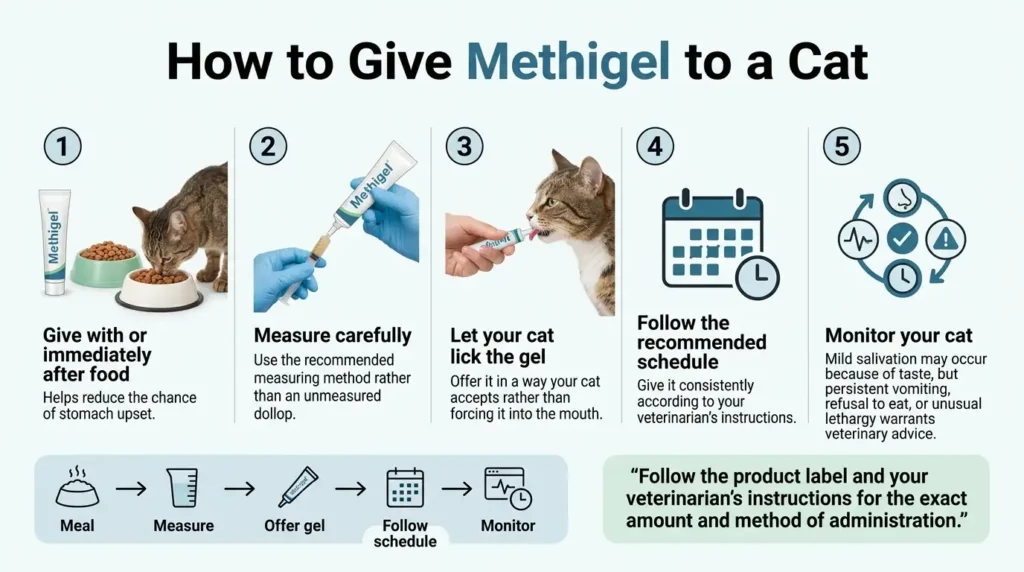
- Serve with or immediately after a meal. This is the largest single cause of stomach upset – take it with food, Methigel taken on an empty stomach is much more likely to cause vomiting or nausea.
- Do NOT use an eyeballed dollop, use a proper measuring spoon.
- Allow your cat to lick it off, don’t push it down. Vetoquinol particularly developed the gel to be palatable; apply a small amount to your cat’s nose, paw or to a front tooth/gum.
- Take at the same time each day to avoid forgetting dosages.
- Pay close attention to how your cat responds to the first few doses; it is normal to drool a little from the taste, but vomiting, not eating or becoming lethargic is not.
What If I Miss a Dose — or Give Too Much?
Missed dose: Give at time scheduled with food. Overdose risk is increased by “catching up” — doing so doesn’t help the acidifying effect, it’s more about being consistent day to day and not on a specific timing.
Accidental over-dosing (e.g., gave it and forgot, and a family member gave it again): Contact your veterinarian or an animal poison control center immediately and let him or her know how much and when it was administered. Methionine symptoms may take many hours to occur, so don’t wait for symptoms to appear before calling.
Methigel Side Effects in Cats
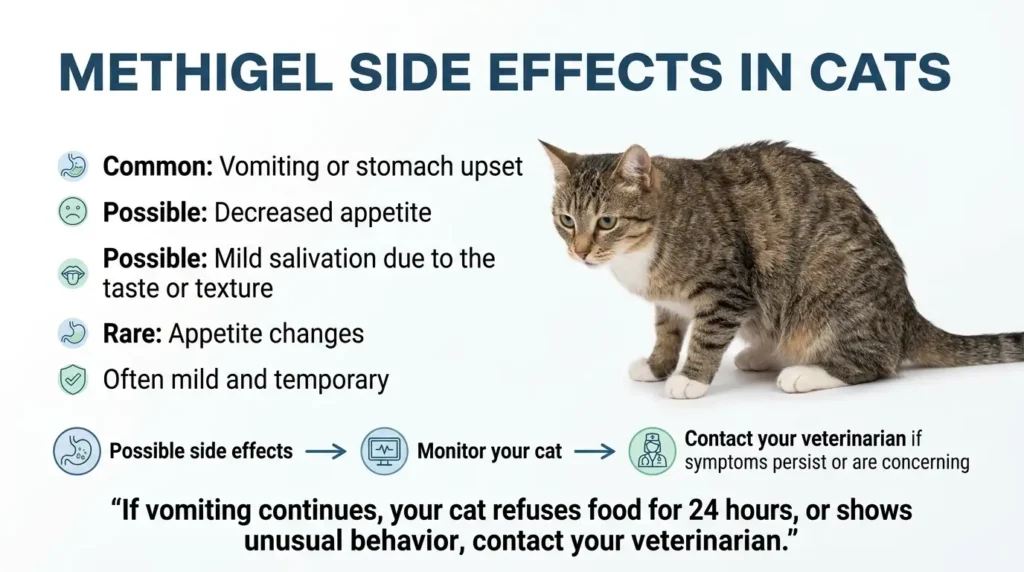
Methigel dose for cats is usually well tolerated at the labelled dose, however the following have been reported:
- Gastrointestinal upset (vomiting, decreased appetite) — most common, especially if given without food
- Light salivation to taste/feel
- Rare appetite changes
Usually they are not serious and will pass out without treatment, particularly after you begin to feed it with food. If your dog is still vomiting, is not eating for more than 24 hours, or shows any different behaviour, you should contact your vet.
Methigel Overdose in Cats: Signs & Why It’s Serious
This is the information about safety that is often overlooked in competing articles and is the most critical safety information on this page.
Cats are especially sensitive to high amounts of methionine. Veterinary studies have reported cases of Heinz body hemolytic anemia and methemoglobinemia (damaged red blood cells and hemoglobin that are unable to transport oxygen efficiently) in cats that have been fed excessive amounts of DL-methionine.
Cats that have received methionine at doses considerably higher than recommended have developed anemia within 1-3 weeks and in one reported case a cat died after being on a high dose of methionine for extended periods of time for urinary support.
If you notice any of these symptoms of methionine overdose or toxicity in your cat, it is an emergency:
- Loss of appetite
- Urine is red-brown or dark in color.
- Weakness or wobbliness (ataxia)
- Pale, blue or grayish gums (cyanosis) which is an indicator of low oxygen in the blood.
- Unusual quietness, lethargy
- Vomiting
- Excessive thirst and/or panting
If you notice any of these symptoms, or you know your cat received a much higher dose than the label recommends, contact your veterinarian, an emergency animal hospital or animal poison control center right away. Do not wait and see if it gets better on its own – symptoms for methionine toxicosis may be postponed by many hours after ingestion.
Who Should NOT Use Methigel
If your cat: (Refer to the product label and/or veterinary advice before using Methigel)
- Is under 1 year old
- Has very serious liver, kidney or pancreatic disease
- Is pregnant or nursing, or intended for breeding (safety hasn’t been established in these cats)
- Is already taking another urinary acidifying product or prescription urinary diet (acidifiers may be given together, but will be too acid — see below)
- Has a history of calcium oxalate bladder stones (acidification may make this type of stone worse; it is important that your veterinarian make the distinction before you begin)
Methigel and Calcium Oxalate Stones: The Balance Vets Actually Watch
This is a nuance most consumer pages skip entirely, and it matters.
Cat bladder stones are typically either one of two types: struvite – which forms when the urine is alkaline and is the type targeted by Methigel, or calcium oxalate – which is the opposite – it tends to form more readily as the urine becomes more acidic and the calcium excretion increases.
Studies on urinary chemistry in cats have demonstrated that acidification of the urine lowers the risk of struvite formation, but that if the urine is acidified excessively, or for too long, without monitoring, calcium oxalate stones can begin to form.
For you, this means you need to be aware of the type of crystal or stone your cat has (or is prone to) prior to beginning a urinary acidifier, which is determined by urinalysis; sometimes stone analysis after the removal of a stone is necessary. Dosing the cat with “just” Methigel, because he or she has calcium oxalate stones, or to be “just” on the safe side, is not the innocuous option it appears to be—it requires input from your veterinarian, not just a tube off of the pet shop shelf.
Methigel vs. Other Urinary Support Options for Cats
| Methigel (OTC gel) | Prescription DL-Methionine tablets | Prescription urinary diet | |
| Form | Oral gel | Tablet/chewable | Cat food |
| Requires vet prescription | No | Usually yes | Yes |
| Dosing basis | Fixed (½ tsp/day for cats) | Weight-based (mg/kg), vet-determined | Feeding guide by weight |
| Best for | Mild, vet-confirmed struvite risk; owners who want an easy add-on | Cats needing precise, monitored acidification | Long-term prevention and dissolution of struvite stones |
| Monitoring needed | Periodic urine pH checks recommended | Regular urine pH and bloodwork | Regular urinalysis/imaging per vet plan |
| Calcium oxalate risk if misused | Yes | Yes | Diet-dependent; prescription diets are formulated to balance this |
When it comes to prescription drugs, most vets will initially think of a prescription urinary diet to be used as a long-term option, and sometimes a supplement such as Methigel, for additional support, for cats with an active, diagnosed stone problem — not as a stand-alone drug.
Benefits of Methigel for Cats
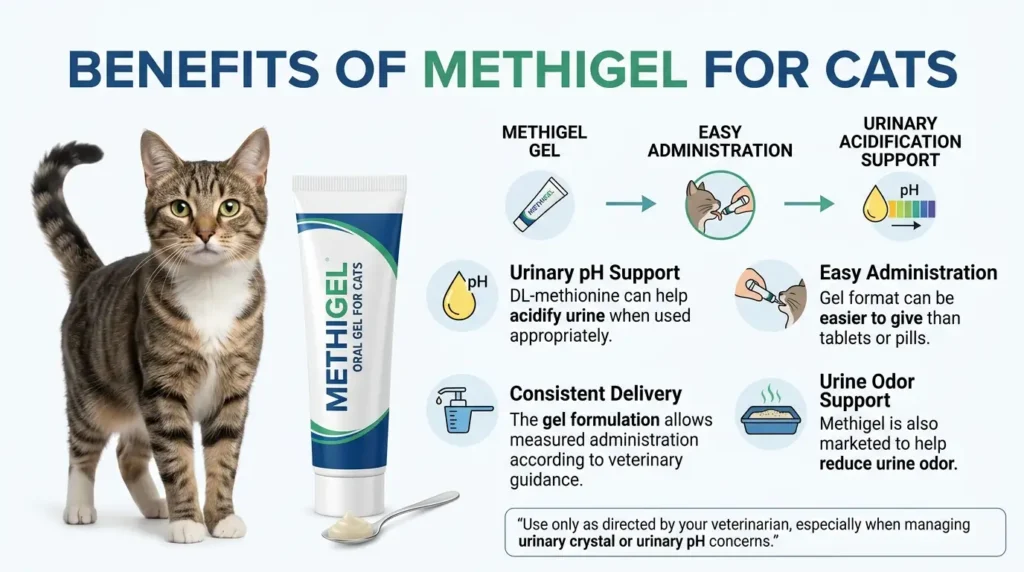
- An easy, tasty way to adjust pH in cat’s urine without changing the entire diet.
- Prescription not required for cats that have been treated by a veterinarian for acidification for struvite.
- Helps to minimize litter box odours as a side-effect
- Gel formula (no pilling) makes it easy to dose consistently.
Risks and Limitations
- May not be suitable for all cats or all urinary stones
- Always requires vet diagnosis first — must not be administered blindly, meaning without knowing type of stone/crystal that your cat has, or else there is a real danger involved.
- The side effects of methionine are noted to cause hemolytic anemia at high doses, and cats are more sensitive than dogs.
- It is not a “set it and forget it” product; effectiveness requires the user to take it daily and regularly check the pH level of the urine.
Myth vs. Fact
| Myth | Fact |
| “More Methigel means better urinary protection.” | Excess methionine is linked to hemolytic anemia in cats. More is not better — stick to the labeled or vet-prescribed dose. |
| “Methigel is a cure for bladder stones.” | It may help control struvite crystal formation, but it doesn’t dissolve or prevent all stone types, and it’s not a treatment for a urinary blockage. |
| “It’s fine to use without a vet visit if my cat seems fine.” | Cats can have crystals or stones with few visible symptoms, and using an acidifier without knowing the stone type can make things worse if it’s calcium oxalate. |
| “Twice-daily dosing is the standard for cats.” | The current manufacturer label and major drug references specify once daily for cats. Verify against your product’s actual label. |
Storage & Handling
Methigel Dosage For cats should be kept in a cool, dry place, away from children and other pets, tightly closed. Note the lot number and expiration date on the crimp of the tube. If your pet or cat ingests the tube and licks it to a degree that it becomes a problem, act as if it is an overdose and contact your veterinarian or an animal poison control center.
You May Also Like to Read:
- Spinosad Dosage For Cats: Calculator, Chart & Safe Guide
- Cerenia Dosage For Cats: Calculator, Chart & Safe Guide
FAQs
What is Methigel used for in cats?
Methigel is a DL-methionine supplement to acidify a cat’s urine and discourage the formation of struvite crystals, and may help to decrease the urine odor.
How much Methigel do I give my cat?
For cats 1 year or older take ½ teaspoon (approximately 240 mg of DL-methionine) once daily with or after meals as directed by the manufacturer’s label.
Do cats take methigel once or twice a day?
Current official product label is once a day. Some third party retail pages state that they list twice a day, this contradicts the manufacturer’s own rules, always follow the instructions on your actual tube or written directions from your vet.
Is it OK to give my cat Methigel daily for an extended period of time?
There are some cats that use it for a long time under veterinary supervision, but it is not a case of using it forever without a pH urine test and veterinary supervision.
Can I use Methigel Supplement on my kittens?
No. The label states it’s not for use in animals under 1 year of age.
Are there side effects to giving cats Methigel?
Yes — the most common are slight upset of the stomach and change of appetite, typically in connection with administration on an empty stomach. In rare instances, too much methionine has been associated with more severe problems such as hemolytic anemia.
How will you know if a cat has overdosed on Methigel?
Lack of appetite, dark or red-brown urine, weakness, pale or bluish gums, lethargy and vomiting. These can occur hours after eating — treat all of these as an emergency.
Does Methigel make cats anaemic?
Veterinary toxicology studies have shown that when doses are excessive and/or prolonged, cats can develop Heinz body hemolytic anemia due to excess methionine. This is uncommon at the dose indicated on the label but is a potential problem when the dose is overused.
Is Methigel a “Methionine Tablet,” such as Methio-Form?
The active ingredient is the same in both (DL-methionine), but Methigel is an over-the-counter gel with a fixed dose, while the prescription tablets will be dosed by body weight by a veterinarian.
Is it okay to use Methigel along with a prescription urinary diet?
Under veterinary supervision only. When combined indiscriminately these acidifying products can cause the urine to become too acidic and can predispose to the formation of calcium oxalate stones.
Can bladder stones be dissolved with the help of Methigel?
It may help with small stones that are made out of struvite over time, but is not a guaranteed dissolving treatment and will not work at all on calcium oxalate stones. Old stones will require veterinary assessment.
If my cat doesn’t eat Methigel, what do I do?
Put a little on their front tooth, paw or nose to get them to lick. If your cat will not use it consistently, consult with your veterinarian about other ways to support your cat’s urinary needs.
Is it safe to give Methigel to pregnant or nursing cats?
Safe use has not been determined in pregnant or breeding animals, so this should only be done with direct veterinary supervision, if at all, as stated on the label.
Where is it easy to get Methigel for cats?
It can be purchased at your vet’s office, pet pharmacy and big pet stores without a prescription, although it is strongly recommended that the user visit the veterinarian before beginning treatment.
If my cat eats too much Methigel what do I do?
Immediately contact your veterinarian or animal poison control center, even if your cat appears well as signs of illness may be delayed several hours.
Final Thoughts
Methigel For Cats dosage can truly be a valuable, low maintenance component of a urinary health plan for cats, but the word “useful” becomes useful only when applied to a cat that has a stone or crystal type that has actually been diagnosed and for which Methigel is a legitimate part of the plan. The worst thing owners do is not to dose enough, but to think “more is better” or “more often is better.” That is not the case for cats.
First, before you begin (or resume) Methigel, re-check the dosage of the product against the current label on your tubes and discuss with your veterinarian whether your cat’s urinary problem is the one that this product should be used to treat. That 5 minute conversation is the difference between a helpful daily supplement, and an unnecessary risk.
This article is meant for general information only and should not be used as a replacement for advice from your veterinarian, who is able to assess the unique health history of your cat before prescribing any urinary supplement.