Trazodone Dosage For Cats: Chart, Calculators & Safety Guide
Trazodone Dosage For Cats is among the most sought out cat owners planning to take a cat through a stressful experience like a visit to the vet, traveling, grooming, and post-surgery recovery. Though trazodone is usually administered by a veterinarian to decrease anxiety and to achieve relaxed behaviour, the right dosage is a key to safety and efficacy of your cat.
This is a complete guide that includes a Trazodone dosage chart (veterinarian-informed) in cats, a convenient dosage calculator, dosing recommendations, possible side effects, safety measures, and frequently asked questions.
This guide can be used to safely and confidently use trazodone whether it is the first time you are administering it or you are checking the dosage of the medication given to your cat.
🐱 Trazodone Dosage Calculator For Cats
What is Trazodone Dosage For Cats?
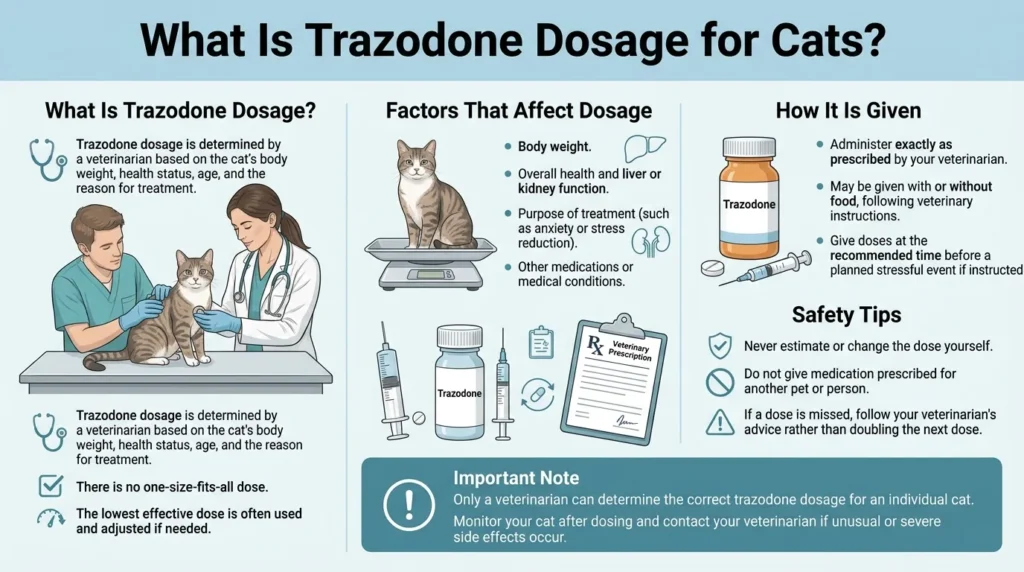
Trazodone is not FDA labeled for use in cats, and there is no specific dose; it is prescribed off label and a good starting dose is approximately 25–50 mg/cat (5–10 mg/kg) administered 60–120 minutes before a stressful situation (such as a veterinary visit), and then adjusting according to an individual cat’s response.
Don’t give any dose without consulting a veterinarian first, since individual cats tolerate this drug very differently and there is not much information about its safety margins.
Trazodone Dosage Chart For Cats By weight
The dosage range shown on the chart below are reported in veterinary publications and in small clinical trials. It is for reference and education purposes only and your vet will select the actual starting dose for your cat based on their weight, health history, temperament and other medical factors.
| Cat’s Weight | Commonly Reported Starting Dose | Typical Range (mg/kg) |
|---|---|---|
| Under 4 kg (under 9 lbs) | 25 mg | ~5–7 mg/kg |
| 4–5 kg (9–11 lbs) | 25–50 mg | ~5–10 mg/kg |
| 5–6 kg (11–13 lbs) | 50 mg | ~8–10 mg/kg |
| Over 6 kg (over 13 lbs) | 50–100 mg (vet-directed only) | up to ~10 mg/kg, occasionally higher under close supervision |
Key details vets weigh when setting a dose:
- Fixed dose as compared to weight-based dose. Some vets use a flat dose per cat (such as “25 mg” or “50 mg” no matter what the weight is) while others use “mg/kg”. Both of these methods appear in the studies, hence the variations in the numbers reported.
- Minimum effective dose (MED). Some veterinarians suggest having a “trial run” at home prior to the actual stressful event, so you and your veterinarian can determine the lowest dose that is effective – this will reduce side effects and is safer in the long run than guessing a higher dose.
- When it comes to giving, timing is just as important as quantity. Trazodone absorbs rapidly (usually within 30-60 minutes) and peak calming effect occurs in 1.5 to 2 hours. Vets generally advise to give 60-120 minutes prior to stressful event.
- The length of time the effect lasts is typically given as being approximately 8-12 hours, depending on the cat.
Do not increase the dose on own as “first dose did not seem to work. A blunted response is something to discuss with your vet, NOT the reason to double the tablet.
What Is Trazodone, and Why Do Vets Give It to Cats?
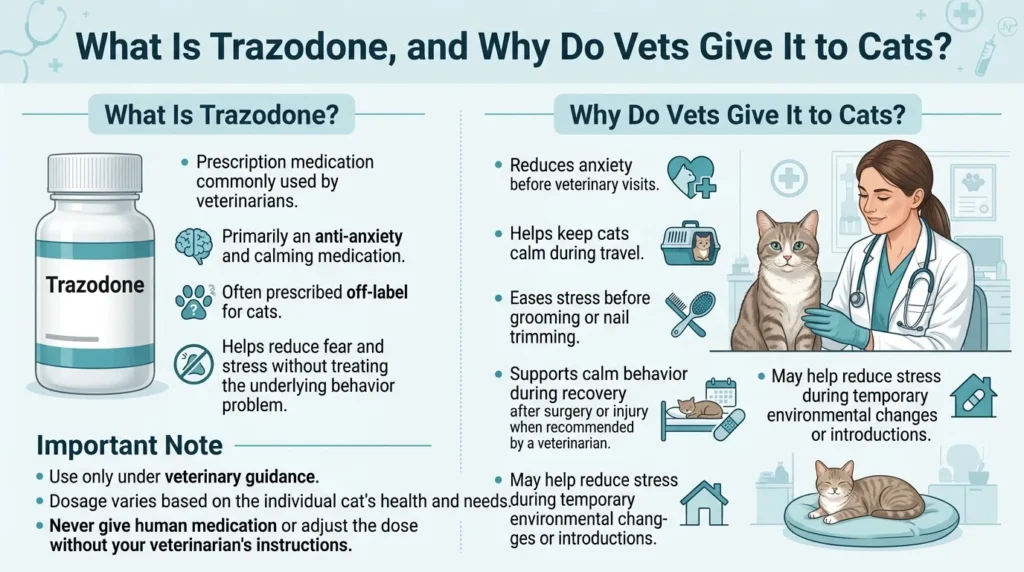
Trazodone dosage for cats is an antagonist of the serotonin receptor and a reuptake inhibitor (SARI) drug originally designed as a human antidepressant. It’s not used by vets to treat feline depression; it is used short-term for situational anxiety and sedation.
Some common conditions for which a vet may prescribe it for your cat:
- Vet visits/exams, particularly for cats that become “fractious”, fearful or aggressive at vet’s office
- Travel or car rides
- Grooming appointments
- Keeping a recovering cat calm and still, post-operatively
- Thunderstorms or fireworks
- Hospitalization stress
There are many more studies of Trazodone in dogs than in cats. The number of controlled clinical studies conducted on cats is limited, partly due to this reason, many sources differ with regard to the recommended dosage for cats.
What Is Trazodone Used for in Cats?
Trazodone is an anxiety medication that can be used to keep cats calm when they are experiencing a short-term anxiety reaction but not for daily use.
Common uses include:
- Veterinary visits — most common use, as anxiety at veterinary visits is a key factor why cats are less likely than dogs to receive regular veterinary attention; one dose before veterinary visits has been shown to help reduce anxiety and improve welfare.
- Groomer visits particularly if the cat gets very stressed by them
- Car rides, flights or moves.
- Thunderstorms or fireworks (noise phobias)
- Recovery after surgery, to ensure crating and hospitalisation are quiet and calm for the cats.
- Disruptions in the home (separations, home changes, visitors, new pets, etc.)
To be effective, trazodone medication should be administered approximately two hours prior to the occurrence of the stressful event, e.g. 2 hours before the cat is placed in a carrier for a veterinary visit. It is usually prescribed in tablet form although a liquid form may be prescribed if necessary.
Gabapentin is more well-studied and effective and safe for use in cats than trazodone, so veterinarians may opt to use it for sedation, or in some cases, it may be combined with gabapentin.
Trazodone’s use as a long-term daily anxiety medication hasn’t been researched in cats (unlike in dogs). For long-term treatment of anxiety, vets first try an SSRI such as fluoxetine (Reconcile), or a tricyclic antidepressant such as amitriptyline, clomipramine, imipramine, or doxepin, which have well-defined dose protocols.
How Does Trazodone Work for Cats?
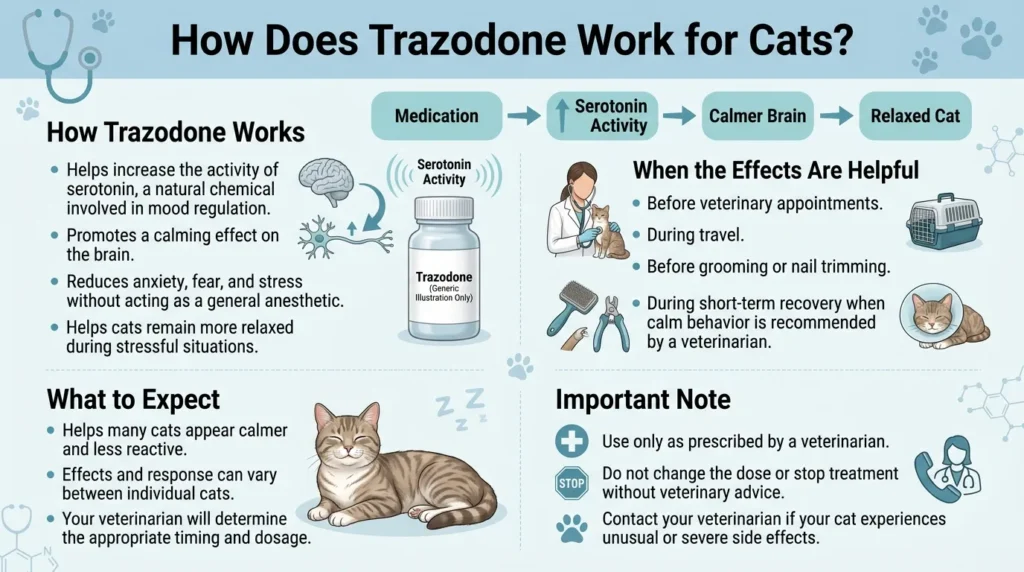
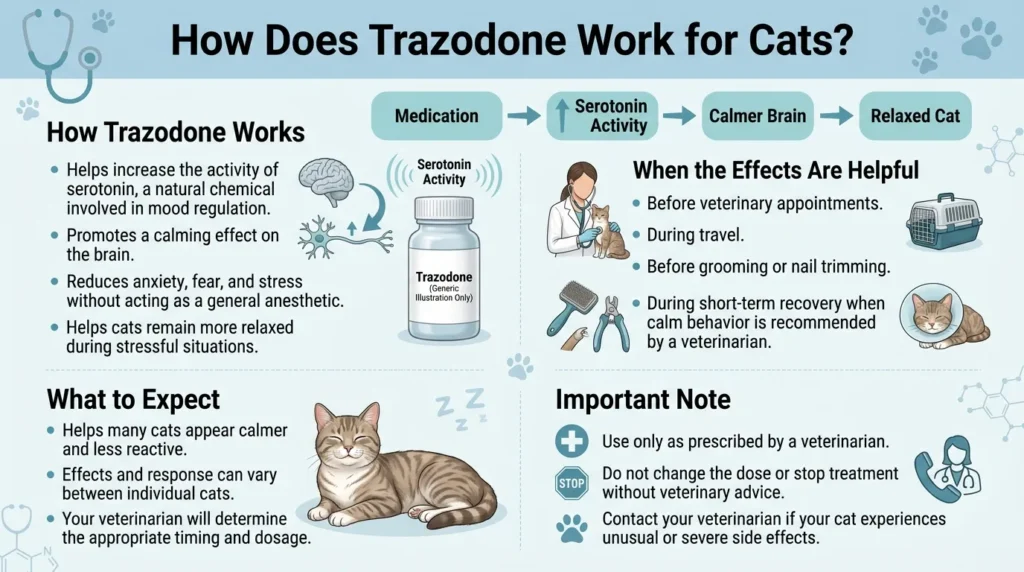
Trazodone dosage for cats is effective in cats because it is a serotonin antagonist and reuptake inhibitor (SARI), which means it increases the bloodstream’s serotonin levels, which in turn helps to decrease anxiety and enhance mood.
Although it’s an antidepressant drug, vets have been using it off label in cats, as it hasn’t been FDA approved for use in cats, it is used and considered safe to treat cat anxiety.
Is Trazodone Safe for Cats?
Yes — if prescribed and monitored by a veterinarian. Single doses administered prior to veterinary visits were effective at improving feline behaviour in small studies without any worrisome side effects. However there are some definite caveats to this “safe” as well:
- It is off label in cats, which means that it has not been formally approved by FDA for this species.
- The margin for error is less in cats as the effective dose may be close to the dose that causes side effects.
- Should NOT be used in combination with some other drugs (see interactions section below) without your veterinarian’s consent.
- It is not intended to be used every day for long periods of time without a treatment plan formulated by your veterinarian.
The bottom line: Although trazodone is a commonly used medication for short-term treatment of feline anxiety, it is a reasonable option, but only as part of a treatment plan formulated by your veterinarian for your cat.
How Vets Actually Calculate a Cat’s Trazodone Dose
If you’re curious, this is how your vet arrives at a number:
- Always begin by using the cat’s actual weight in kg (most veterinary dosing will be in metric).
- Use a low and narrow mg/kg range, which may be on the lower end of range the first time.
- Round to a tablet size available — a vet might prescribe a fraction (such as a quarter or half) of a tablet instead of a weird milligram amount because it’s common for trazodone to come in 50 mg, 100 mg, 150 mg, and 300 mg tablets.
- Consider health history — kidney or liver disease, heart conditions, other medications, and age all can cause a reduction in dose.
- Schedule a test dose — many veterinarians prefer to give your cat the dose at home on a quiet day to see how it affects your cat before using it for a true crisis.
This is why it is never safe to use an online calculator instead: The calculator will not know your cat’s blood tests, medications or how a compounded liquid is concentrated.
How to Give Trazodone to Your Cat
- May give with or without food; absorption may be slightly delayed with food but may help prevent stomach upset.
- Take it exactly when your vet has told you to, typically 60-120 minutes before the stressful event.
- Use only the prescribed formulation. Tablets are not necessarily equivalent in concentration to compounded liquids.
- Do not divide or crush compounded medications or extended-release medications unless directed to do so by your veterinarian or pharmacist.
- Maintain a simple log of dose given, time and how your cat reacted to this to help your vet with fine tuning future doses.
Side Effects: What’s Normal vs. What’s an Emergency
Common, usually mild side effects
- Sleepiness or grogginess
- Wobbliness or subtle loss of co-ordination
- Feeling a little sick or vomiting slightly.
- Decrease in appetite for several hours
- Lethargy that resolves within expected time frame
Signs that need a vet or emergency clinic right away
- Severe or worsening lethargy that doesn’t improve
- Lack of ability to stand, collapse or extreme weakness
- Lack of or very weak breathing
- Agitation, tremors or seizures
- Symptoms of Serotonin Syndrome: increase in body temperature, muscle stiffness, fast heart rate, confusion
- The rare, but reported, side effect of a prolonged, abnormal erection (priapism) in male cats, which requires veterinary attention right away.
- Reactions following exposure to another serotonergic drug in the cat as well.
If you notice any of the emergency signs listed above, please see your veterinarian or local emergency animal hospital as soon as possible. If it is after hours, an animal poison control line (ASPCA Animal Poison Control Center or Pet Poison Helpline) may be able to assist you in triage while you get your cat to care – have the number on your cell phone just in case.
What Are the Most Serious Risks of Trazodone for Cats?
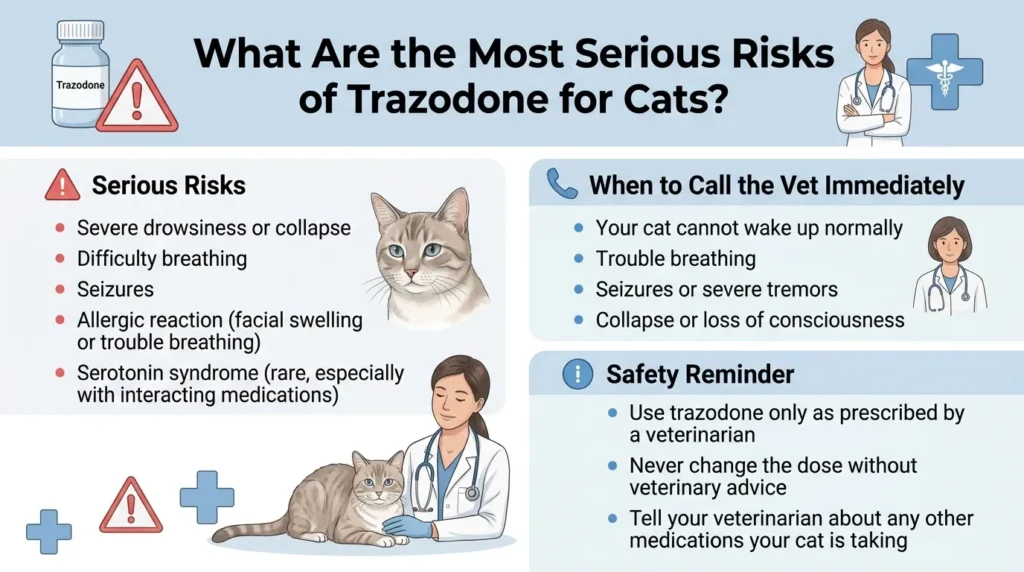
Trazodone cat medication is a relatively well-tolerated medication for most cats, but there are some potential serious side effects, such as:
- Walking incoordinately and wobbly movements
- Vomiting
- Diarrhea
- Changes in appetite
- Dilated pupils
- Paradoxical behavior (aggression, irritability, excitement)
- Racing heart
- Panting
If your cat exhibits any negative effects from taking trazodone, discontinue the medication and contact your vet or a pet poisons hotline for advice. Negative reactions are usually temporary and last for a few hours.
Some risk factors to know about:
Do NOT use Trazodone in cats that:
- Are very sensitive to the medicines
- Are using MAO (monoamine oxidase) inhibitors
- Have angle-closure glaucoma
Caution should be exercised when using trazodone in cats that:
- Have serious heart problems
- Have liver or kidney impairment
- Are pregnant (animal studies have indicated that a very high dose can have harmful effects on the developing fetus, so your vet will weigh the pros and cons before giving it to a pregnant animal)
Drug Interactions to Note with Your Vet
Be sure to inform your veterinarian of any other medications or supplements your cat is receiving before initiating trazodone treatment. Some interesting conversations:
| Medication Type | Why It Matters |
|---|---|
| MAOIs | Can cause a dangerous interaction; trazodone should not be given to cats recently exposed to an MAOI |
| Other serotonergic drugs (certain antidepressants, tramadol) | Raises the risk of serotonin syndrome |
| Cisapride | May increase risk of an abnormal heart rhythm (QT prolongation) |
| Certain fluoroquinolone antibiotics (e.g., pradofloxacin, marbofloxacin) | Similar QT-prolongation concern |
| Other sedatives (e.g., gabapentin) | Not dangerous together, but effects are additive — expect more sedation, sometimes at a lower trazodone dose |
What Are Common Misconceptions About Trazodone for Cats?
Here are some misconceptions about Trazodone, and the facts to dispel them:
Myth: Trazodone isn’t a cure-all for anxiety.
Fact: Trazodone dosage is not the only treatment, and behavior modification and environmental modifications usually are also recommended.
Myth: It does not work every time and takes time to achieve results.
Fact: Trazodone may work fairly quickly, but it may take several doses to have an effect in some cats.
Myth: My cat will become dependent on it.
Fact: Trazodone is not addictive and cats are able to safely discontinue the medication with the help of a vet.
Myth: It is safe for all cats in the long-term.
Fact: Side effects may occur or effectiveness may wane over time and regular check-ups with the vet are important.
Key Takeaways
- The usual dosage of Trazodone for cats is approximately 25–100 mg per cat, but the appropriate dose will be determined by individual factors that can only be assessed by your vet.
- For best results, take it 60-120 minutes before a stressful event.
- A mild sleepiness and wobbliness is normal, but extreme lethargy, breathing difficulties, tremors or priapism are emergencies.
- Be sure to tell people about any other medicines they are taking (particularly other serotonergic drugs) before using trazodone.
- A so-called “dosage calculator” is never more than a beginning, and never a substitute for an actual discussion with your veterinarian.
You May Also Like to Read:
- Ivermectin Dosage For Cats: Calculator, Chart & Safe Guide
- Zofran Dosage For Cats: Calculator, Chart & Safe Guide
FAQs
How much trazodone should be given to a cat?
There is no defined dose, as it is used off label in cats, however a typical starting dose is about 25 – 50mg per feline and your vet will modify this dose according to body weight and response.
What is the maximum mg of trazodone that can be given to a cat per kg?
There are a variety of published dosage ranges, with a general consensus of 5-10 mg/kg, with some sources stating higher doses under close veterinary supervision for situational anxiety. This is NOT a number you should use on yourself without your veterinarian’s approval.
What is the duration of action of trazodone in cats?
Duration of effects is typically 8-12 hours, depending on the individual cat.
When should I start giving my cat trazodone?
Most veterinarians advise administering it 60 to 120 minutes in advance as it takes some time for it to peak.
Can I give my cat trazodone every day?
It’s commonly used for one-off rather than long-term applications. Consult and supervise your vet before using daily or often.
What will happen if I give my cat too much trazodone?
Symptoms of overdose include very lethargic, wobbly, low body temperature, slow breathing, agitation, or very severe cases, seizures. If you think you might have given your pet an overdose, contact your veterinarian or an emergency animal hospital, or an animal poison control hotline, immediately.
Is there such thing as a cat overdosing on trazodone?
Yes. Trazodone is fairly safe for some sedatives, but doses that are significantly higher than prescribed can result in potentially harmful over-sedation and other serious side effects.
Is trazodone the same for cats as it is for dogs?
No, Trazodone is more widely studied in dogs and the doses differ between species – the dose for a dog should not be extrapolated to the dose for a cat.
Is it OK to give my cat trazodone without a prescription?
No. Trazodone is a prescription drug, and should only be administered to a cat under veterinary supervision.
Is trazodone sedative for cats or does it only help calm them down?
Either can happen, and many cats can be seen to be more drowsy and less agile, but others just seem more relaxed and less responsive. Individuality and dosage differences.
Is it possible to use trazodone and gabapentin together in cats?
Yes, some vets will use this combination, usually with a lower dose of trazodone, because the sedative effects are additive, although this should be done under veterinary supervision.
If my cat vomits after taking trazodone, what should I do?
If in any doubt, do not re-dose, consult your veterinarian for advice.
Can I give my kitten trazodone medicine?
There is limited information about dosage rates for kittens; only discuss this with your veterinarian; do not extrapolate from the dosage given to adult cats.