Clonazepam Dosage for Cats: Calculator, Chart & Safe Dosing Guide
If your vet just prescribed your cat some clonazepam Dosage, you most likely have one burning question: how much do I give? This guide explains the exact dosage range vets use, how to determine your cat’s dosage and the safety details that are most important—such as that you should never guess with a leftover human tablet.
Here the quantities are minute, often a fraction of a milligram and so accuracy is more essential than ever. The reference dosage chart is included below, along with a step-by-step walkthrough for calculating the dosage and a free calculator, and there’s clear guidance about what is safe, what isn’t, and when to call your vet.
Clonazepam Dosage Calculator for Cats
Calculate precise dosage and administration volumes for feline patients based on standard veterinary parameters.
Recommended Dosage Results
Quick Answer: Clonazepam Dosage for Cats
As per Papich Handbook of Veterinary Drugs, the standard veterinary reference dose for clonazepam Dosage For cats by weight is 0.05 – 0.2 mg/kg administered orally every 12 to 24 hours. It is not a “one size fits all” number and is dependent on the condition your cat is being treated for and your veterinarian’s specific instructions.
Clonazepam is not FDA-approved for veterinary use, so every prescription is technically “off-label.” That’s normal and common in veterinary medicine, but it also means the exact dose should always come from your vet rather than a general chart.
What Is Clonazepam and Why Do Vets Prescribe It for Cats?
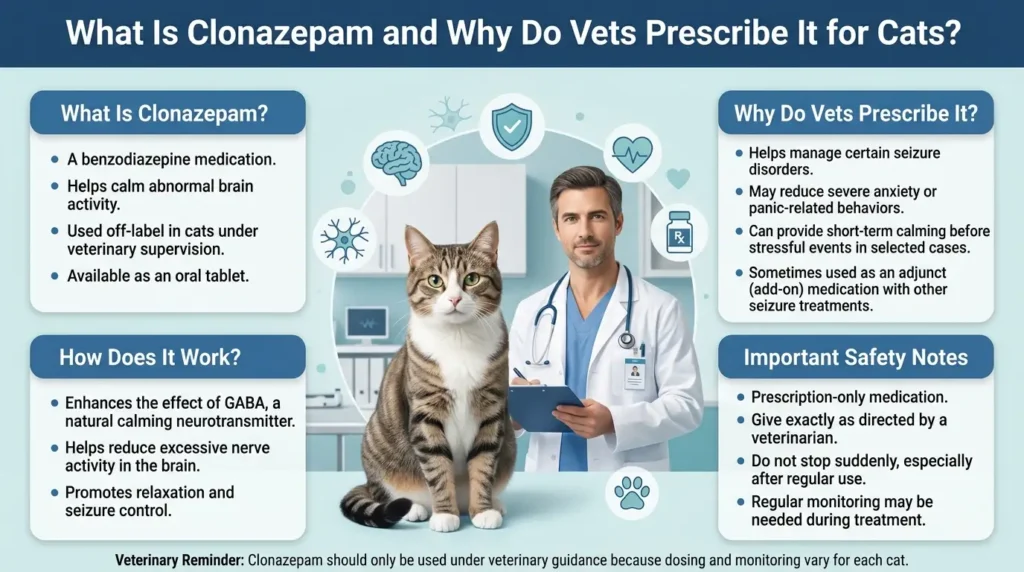
Clonazepam, another member of the benzodiazepine family of drugs (like diazepam (Valium) and alprazolam (Xanax)), is marketed under the brand name Klonopin. It does this by increasing the activity of a calming chemical in the brain called GABA that increases the seizure threshold and decreases anxiety.
Seizures and Epilepsy
Clonazepam medication has been used as an anticonvulsant in cats, but it is not used as frequently as other options as there are more effective anticonvulsant drugs available. Clonazepam is sometimes the drug of choice over diazepam, as diazepam can have a very serious and sudden effect on liver function in cats. It is also occasionally used as a ‘pulse’ for short-term use to help control cluster seizures.
However, it is important to recognize that tolerance to the anticonvulsant effect may occur with chronic use, and its use is predominantly as a bridge or an adjunct drug, rather than a stand-alone drug used for life.
Anxiety and Behavioral Issues
Clonazepam cats dosage can also be used to help control anxiety, fear and stress in cats. It can be prescribed by vets for situational anxiety (vet appointments, car rides, thunderstorms) or for more ongoing stress disorders.
Cats have a different metabolism than humans, and therefore might metabolize – and accumulate – this medication in a different manner, which is one of the reasons cat-specific dosing is critical.
Clonazepam Dosage Chart for Cats By Weight
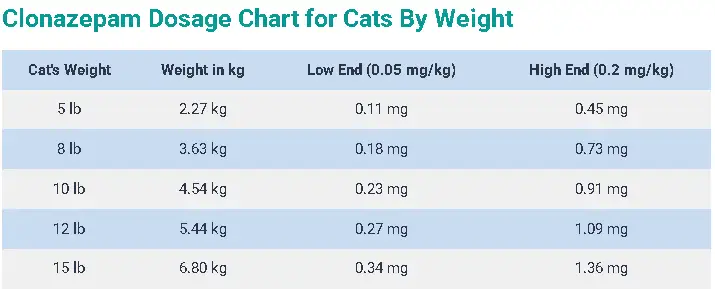
The 0.05 to 0.2 mg/kg reference range has been adjusted to common cat weights on the chart below. These are reference numbers only — please use the mg/kg number specifically prescribed by your veterinarian.
| Cat’s Weight | Weight in kg | Low End (0.05 mg/kg) | High End (0.2 mg/kg) |
|---|---|---|---|
| 5 lb | 2.27 kg | 0.11 mg | 0.45 mg |
| 8 lb | 3.63 kg | 0.18 mg | 0.73 mg |
| 10 lb | 4.54 kg | 0.23 mg | 0.91 mg |
| 12 lb | 5.44 kg | 0.27 mg | 1.09 mg |
| 15 lb | 6.80 kg | 0.34 mg | 1.36 mg |
Key takeaway: Take note of the size of these numbers – they are usually a fraction of a milligram. That is part of the reason why a cat needs a compounded formulation, which is specially formulated for cats, not a part of a tablet for a human.
How to Calculate Your Cat’s Clonazepam Dose
If your vet has given you a specific mg/kg target, here’s the exact math behind it.
Step 1: Convert Weight to Kilograms
If you were measuring your cat in pounds, convert first:
Weight in kg = Weight in lbs ÷ 2.2046Step 2: Multiply by the Target Dose
Required Dose (mg) = Weight in kg × Target Dose (mg/kg)Step 3: Convert to Liquid Volume (If Applicable)
If you’re using a compounded oral liquid, divide the required dose by the concentration on the bottle:
Liquid Dose (mL) = Required Dose (mg) ÷ Liquid Concentration (mg/mL)Worked Example
Assume your cat weighs 9 lb, and the dose is 0.1 mg/kg:
- Convert weight: 9 ÷ 2.2046 = 4.08 kg
- Calculate dose: 4.08 × 0.1 = 0.408 mg per dose
- If using a 0.1 mg/mL liquid: 0.408 ÷ 0.1 = 4.08 mL per dose
A lot for such a small amount of drug; this means that the liquid’s concentration is low enough to be measured with a syringe, which is the whole idea of using a compounded liquid.
How to Give Clonazepam to Cats?
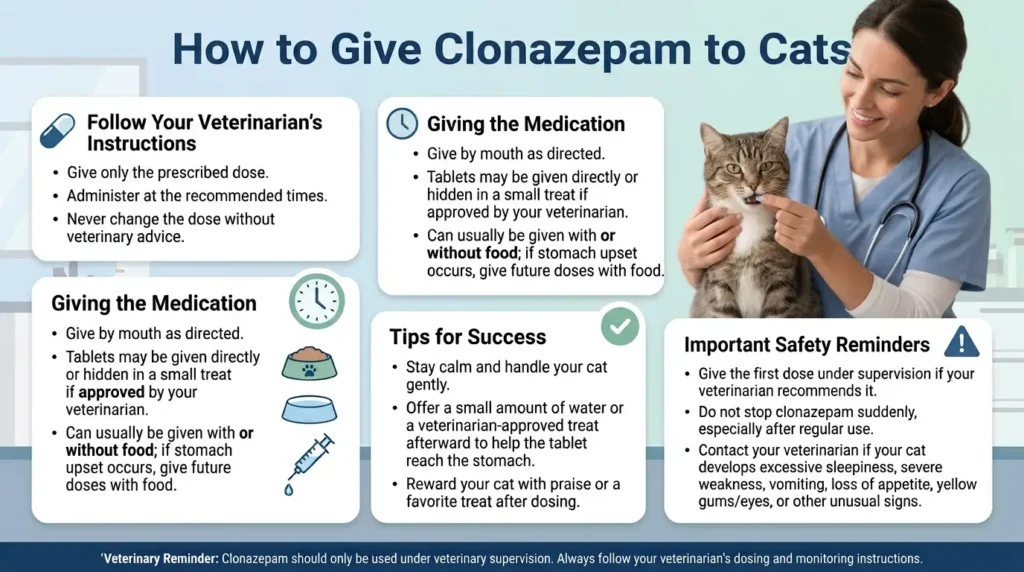
Clonazepam Dosage For Cats is usually taken by mouth in the form of a regular tablet or a dissolving tablet; it can be taken with or without food. If it is vomited on an empty stomach, offer it with a meal or a small treat. Always administer first dose under direct supervision to allow monitoring for any severe reactions.
If anxiety or behaviour related triggers are involved, it is best given approximately an hour before the stressful event. Do not stop this medication suddenly as it can cause convulsions. Clonazepam starts to act quickly and the improvement of symptoms will follow in 1 to 2 hours.
Why You Can’t Just Split a Human Clonazepam Tablet
According to the previous chart, even the smallest of the human clonazepam tablets (0.5 mg) is too strong for most cats to take, and the larger tablets (1 mg, 2 mg) contain too much clonazepam for cats to safely handle.
A tablet that is cut into four or eight parts to get an approximation of a fraction of a milligram can be an unreliable measure, since the drug is not spread evenly throughout the tablet and there is no way to accurately measure a crumb-sized portion.
This is why a custom compounded formula from a veterinary pharmacy – usually a dilute oral liquid – is the safest approach and one that is measured using an oral syringe, and not guessed using a pill cutter.
Tablet vs. Compounded Liquid: Which Is Safer for Cats?
| Compounded Liquid | Split Human Tablet | |
|---|---|---|
| Dose accuracy | High — measured to the mL with a syringe | Low — impossible to split evenly at these tiny doses |
| Flavoring available | Often yes (pharmacy-dependent) | No |
| Standard vet recommendation | Preferred | Not recommended |
| Risk of overdose from a “big” fragment | Low, when measured correctly | Meaningful, especially in small cats |
Factors That Affect Your Cat’s Dosage
Your veterinarian might vary the dosage (between 0.05 and 0.2 mg/kg) and the frequency of administration according to:
- What’s being treated — seizure control and anxiety management often use different points in the range
- Body weight and body condition — dose may need to be reassessed if under- or overweight body condition occurs in the cat
- Liver health — clonazepam must not be used in animals with severe liver disease, and the liver function should be monitored regularly in cats receiving this drug
- Other drugs — your veterinarian should be aware of any other drugs, supplements or herbal remedies your cat is using, as there can be interactions.
- Response and tolerance over time — sometimes doses are changed if effectiveness changes.
Clonazepam Side Effects in Cats
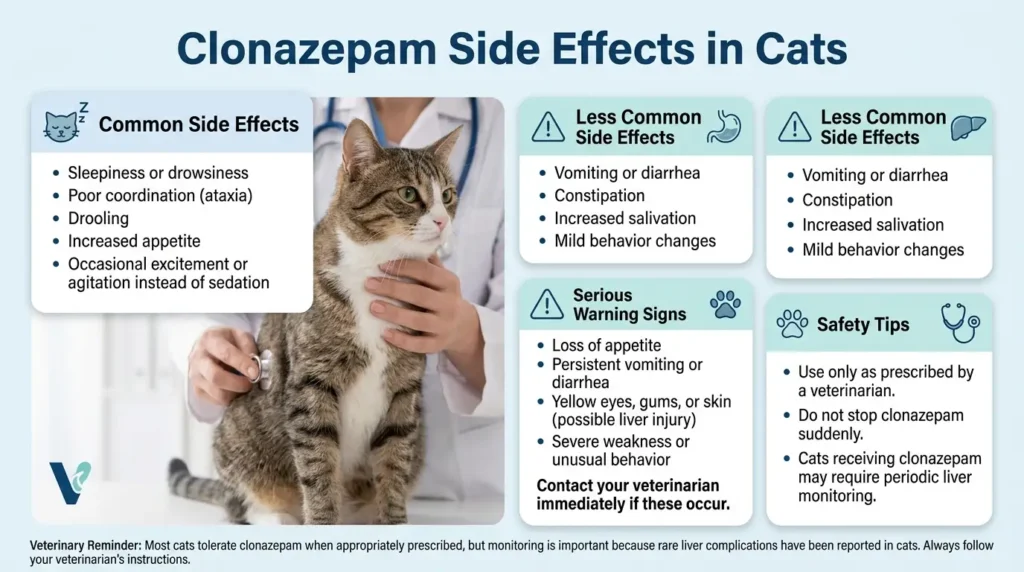
The most frequent side effects are drooling, excitement or increased appetite, loss of coordination, and sleepiness. Some cats experience unusual changes in their behaviour at the start of taking clonazepam, including increased affection, irritability or short-term depression, and clonazepam can also cause increased appetite, particularly in cats.
Some patients may also become diarrhoetic, and a few animals may experience “paradoxical excitation” (they get worse, more excited, anxious or even aggressive rather than calmer).
Not sleeping well or having difficulty with balance and coordination, particularly immediately after beginning the medication, is not uncommon and may improve over time. If it is very bad, or your cat is clearly upset, contact your veterinarian: they may say to skip the treatment for the next dose.
Clonazepam Risk Factors for Cats
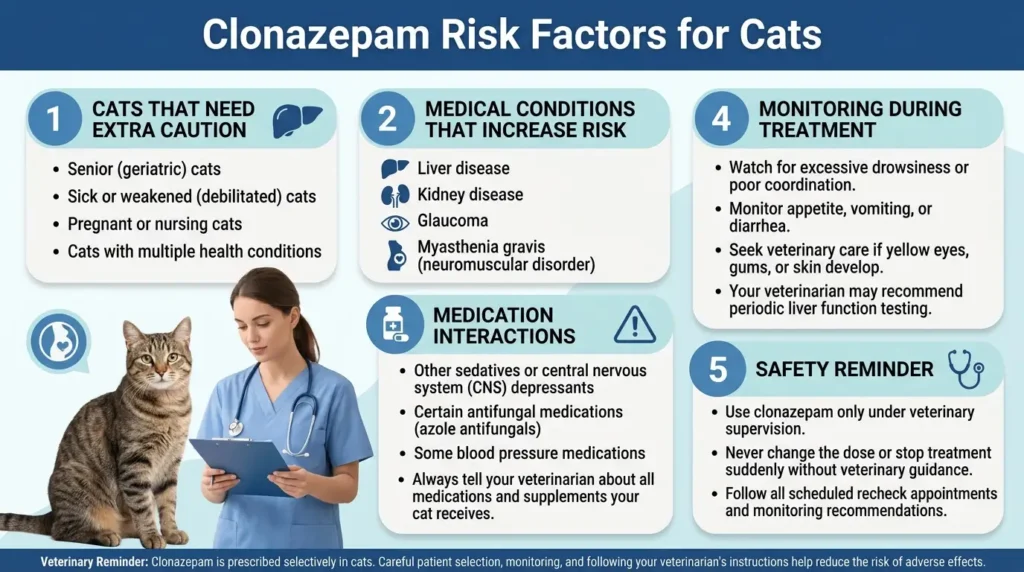
Clonazepam drug should never be administered to cats which are allergic to clonazepam or other benzodiazepines or have severe liver disease. Multi-pet households should also be aware that tablets for dissolving in water should not be given to dogs due to the presence of xylitol, which is harmful to dogs.
Avoid using Clonazepam in animals that:
- Have a history of addiction or dependence to other benzodiazepines or to it
- Take large amounts of acetaminophen, alcohol or drugs in short succession
Dissolving tablets contain xylitol, which is toxic to dogs, and should never be given to dogs.
Be extremely careful when using in pets with:
- Suffer from a liver or kidney disease, or glaucoma
- Have myasthenia gravis
- Are ill or weak
- Are geriatric
- Are pregnant or lactating
- Are aggressive
- Are working animals
Special precautions with oral benzodiazepines:
- Do not place clonazepam and other oral benzodiazepines in places that can be accessed by pets and small children
- In case of overdose, severe respiratory depression may result and emergency medical intervention may be needed.
Clonazepam Drug Interactions in Cats
Clonazepam cat dosage should be used cautiously in combination with the following drugs: anticholinergic agents, antihypertensive agents, azole antifungals, central nervous system (CNS) depressant drugs, cimetidine, diltiazem, erythromycin, and phenobarbital.
Tell your veterinarian if your pet is taking any other medications or supplements, including herbal therapies and/or vitamins, before you begin this treatment, as some products may interact with clonazepam.
Medications which should be used with caution in combination with clonazepam:
- Anticholinergic agents
- Antihypertensive agents
- Azole antifungals
- Alcohol, sedatives, and tranquilizers (tranquilizers do not necessarily have a sedative effect on the CNS)
- Cimetidine
- Diltiazem
- Erythromycin
- Phenobarbital
Before beginning clonazepam, be sure to tell your veterinarian about all medications, including vitamins, supplements and herbal treatments your pet is taking.
When to Call Your Veterinarian Immediately
If you see yellowing in the whites of the eyes, skin or gums (jaundice), consult your veterinarian immediately as this may be a liver issue. A decreased appetite or complete loss of appetite, being depressed, or constant vomiting are also reasons to call ASAP rather than waiting it out in cats.
If you feel your cat has been given much more of a single dose than prescribed, watch for signs of central nervous system (CNS) agitation or depression, gastrointestinal (GI) signs and, in severe cases, respiratory and cardiovascular depression — this is an emergency.
Contact a veterinarian, emergency animal hospital, or pet poison control hotline right away, instead of waiting to see if any symptoms get better.
Missed Dose and Overdose: What to Do
Missed a dose? Give it as soon as you remember and return to the normal schedule that your vet recommended, don’t give two doses at the same time to ‘catch up.
Suspect an overdose? Do not attempt to induce vomiting or to self treat. Contact your veterinarian or a poison control or emergency hotline immediately and have the weight of your cat and amount given on hand to report.
Stopping the medication? Clonazepam should not be discontinued abruptly – it should be stopped gradually as withdrawal seizures have been reported in animals receiving benzodiazepines regularly. Always taper under guidance of your vet.
Cats Who Should Not Take Clonazepam
If your cat: Be sure to discuss the pros and cons with your veterinarian before initiating clonazepam treatment.
- Has a history of liver disease or has significant liver disease
- Has had an allergic reaction to clonazepam or other benzodiazepines in the past
- Is taking other medications that have not been evaluated for drug interactions.
- Is pregnant or nursing — benzodiazepines are usually not used in these situations unless your vet feels the potential benefits outweigh the potential risks (as a class)
Myth vs. Fact
Myth: “I’m not going to give my cat a little bit of my own clonazepam medicine, it can’t hurt him.
Fact: A regular human tablet can be more than a day’s worth of medication for many cats! Never give a cat human medicine unless directed by a veterinarian.
Myth: “The more medicines, the sooner and better it works.
Fact: Benzodiazepines such as clonazepam have a therapeutic index. The more you go over it, the worse the results are—the more at risk of sedation, coordination issues and (in more severe cases) serious CNS or respiratory depression.
Myth: “My cat was not acting ill after I missed a dose, so it’s okay to skip it.
Fact: Extended periods of not giving the medication or a sudden discontinuation can cause withdrawal symptoms in animals that have been taking it for a long time, such as seizures. Never stop using a drug abruptly without your vet’s recommendation.
Key Takeaways
- The recommended dose of clonazepam for cats is 0.05 to 0.2 mg/kg PO every 12 to 24 hours (Papich) but always your veterinarian’s prescription first!
- Be sure to always weigh your cat accurately and then convert lb to kg (÷ 2.2046) before calculating.
- Never cut a human clonazepam tablet, consult your pharmacist for a compounded cat tablet.
- Be aware of the appearance of jaundice, inappetence or of vomiting that does not stop and contact your vet immediately.
- Never discontinue this drug suddenly but always wean off as directed by your vet.
You May Also Like to Read:
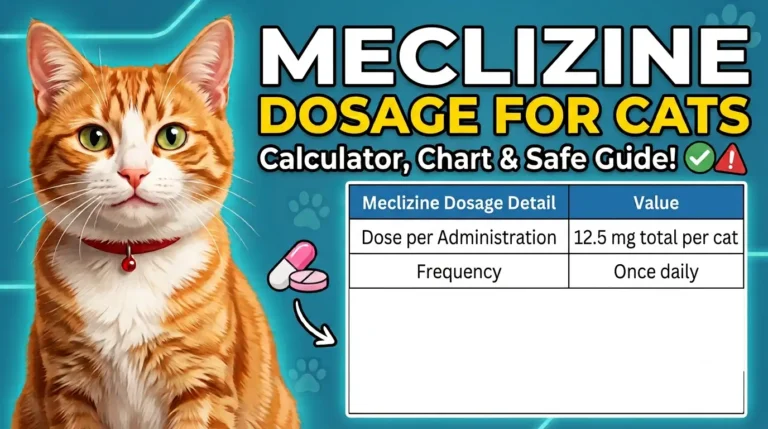
- Meclizine Dosage For Cats: Calculator, Chart & Safe Guide
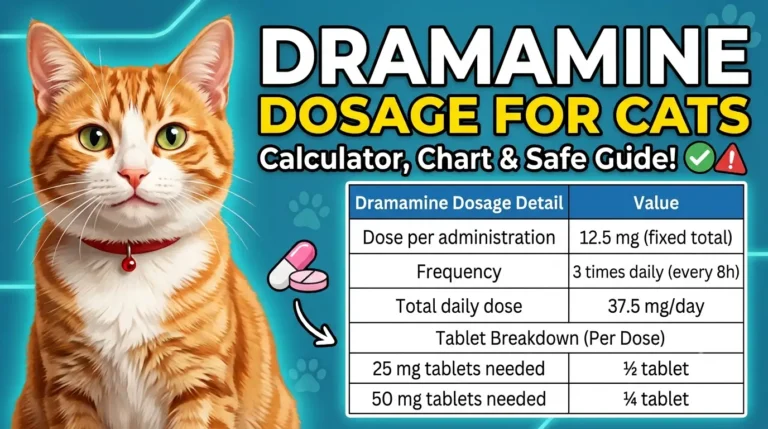
- Dramamine Dosage For Cats: Calculator, Chart & Safe Guide
FAQs
Is clonazepam safe for cats?
Clonazepam Dose is regularly used in cats for seizures and anxiety on a veterinarian’s orders and dose. Should not be used in cats with severe liver disease, or known sensitivity to benzodiazepines; use with caution in all animals receiving the drug.
What is the maximum amount of clonazepam I can administer to my cat?
The typical veterinary dose range is 0.05–0.2 mg/kg PO every 12–24 hours. Use our calculator to calculate the exact dose based on your cat’s actual weight and your vet’s recommended dose of mg/kg.
Would it be OK to give a little of my clonazepam to my cat?
No. Human tablets are too high of a concentration and it would be difficult to divide them to the small doses that cats require. Instead, request a compounded liquid from your veterinarian or one that is created for cats.
How long does a Cat Take clonazepam to effect?
This medication usually starts to work in about 1 to 2 hours when used for anxiety and behavior, and is usually administered about an hour before a known stressful event.
Is Clonazepam liver toxic for cats?
Rare but serious signs include jaundice (yellowing of eyes, skin or gums) and should be reported to your vet immediately. That’s why the liver’s function is monitored during treatment.
If I forget to take a dose, what should I do?
If you forget to give, give as soon as you remember, not double up on the dose to make up for it.
Can I abruptly wean my cat off of clonazepam?
No. It is important to wean this drug slowly and gradually, under the advice of your veterinarian, since withdrawal can result in seizures.
Are there any drug interactions with clonazepam?
May interfere with other drugs, including supplements and herbs; your vet should know any other drugs that your cat is taking.
Can Cats take clonazepam?
No, like most psychiatric and anti-convulsant drugs in cats, it is used off label (extra-label) with veterinary guidance and is perfectly acceptable and legal in veterinary medicine.
Clonazepam for seizures vs. anxiety – what’s the difference?
The medication is the same, but the dose, number of doses, and duration of treatment may vary depending on the condition your veterinarian is treating.
Is it safe for kittens to have clonazepam medication?
This article’s reference dose applies to adult cats. Dosage of very young or growing kittens should be calculated directly by the veterinarian and should NOT be extrapolated from the dosage of adults.
Is Clonazepam medication equal to Klonopin?
Yes — Klonopin is just the human version of clonazepam.
Is it possible to overdose a cat with clonazepam?
In the case of a severe benzodiazepine overdose, a person’s breathing and heart may be depressed, and it is a medical emergency. Call your veterinarian or an emergency/poison control center right away if you think there’s been an overdose.
Since my cat began taking clonazepam, he’s hungrier.
Clonazepam dosage has several side effects, including increased appetite, particularly in cats. Let your veterinarian know at your next appointment so he or she can assure you that it’s normal for your feline’s medication.
Final Thoughts
Clonazepam is a true cat seizure drug and/or anxiety drug, but there is only a narrow therapeutic window and the mathematics do matter. The best guideline is that it is always safest: confirm exactly with your vet on the correct mg/kg dose for your pet; ensure you use an accurate weight; never use a human dose of medicine as a substitute; and complete the calculation carefully (or let the calculator handle it).
If you’re ever uncertain about a dose, a side effect or a missed dose, your veterinarian is the best person to call, and this guide is to help you understand the numbers, not replace your vet.
This article is provided for informational purposes only and should not be used to replace professional veterinary advice, diagnosis or treatment. Before beginning, stopping or changing any medicine for your cat, always consult your veterinarian.