Dramamine Dosage For Cats: Calculator, Chart & Safe Guide
If your cat has ever made car rides a drooling, yowling, vomit-producing ordeal, you’ve likely used the search term Dramamine dosage for cats at some point. It’s a legitimate inquiry: Dramamine is in the majority of medicine cabinets, and vets do recommend it for cats, occasionally.
But it’s also a human drug used off label on a very different animal than us, with a much smaller body and a system that is far more sensitive than our own. Owners get into trouble in that gap.
This guide is a compilation of what veterinary sources actually recommend concerning dosage, safety, side effects and when Dramamine is not the right choice at all – so you are not taking any chances with your cat’s health.
Before you give your cat anything: Dramamine (dimenhydrinate) is not approved by the Food and Drug Administration (FDA) for animal use. It is prescribed by veterinarians “extra-label” (legally, but beyond its original approval). Please check with your vet before you administer it as this article is for reference and not a prescription.
Recommended Dosage
Disclaimer: This calculator is for informational and reference purposes only. It is not a substitute for professional veterinary advice, diagnosis, or treatment. Never administer any medication to your cat without first consulting your veterinarian.
© medscat.com
Key Takeaways
- Dramamine medication contains dimenhydrinate, an antihistamine drug which helps to sedate the vestibular (motion-sensing) system of the inner ears.
- Veterinary sources report the dose for cats in two different ways: a total dose of 12.5 mg three times a day or a dose based on body weight (4–8 mg per kg every 8 hours). The two methods come to about the same ballpark for “cat average,” but of course, they are not the same — but your vet will let you know which one is for your cat.
- Only use single-ingredient dimenhydrinate. Multi-medications or combination medications containing acetaminophen, decongestants, etc. can be toxic to cats.
- Side effects include sleepiness, dry mouth, and urine retention. An overdose is a serious issue and requires emergency treatment.
- It should not be administered to kittens, older cats or those with some health problems, such as glaucoma, heart disease, seizure disorders, or urinary or gastrointestinal obstructions, without direct veterinary guidance.
- Other medications such as meclizine or maropitant (Cerenia) may be more well tolerated or more effective for motion sickness.
What Is Dramamine (Dimenhydrinate) and How Does It Work in Cats?
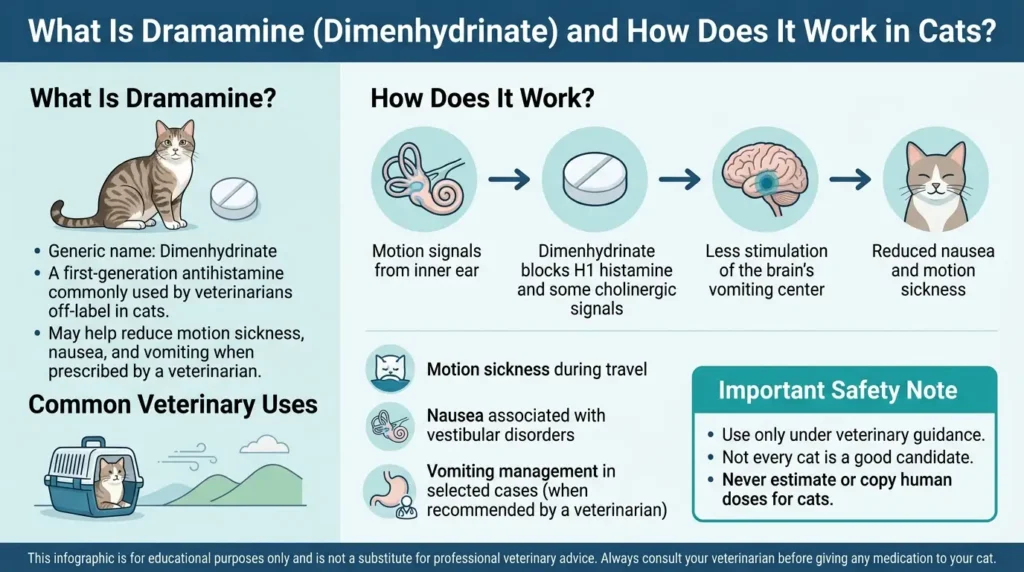
Dramamine is a brand name for dimenhydrinate, which is an OTC antihistamine. It is used off-label to decrease nausea and motion sickness in cats, typically for travel in a car, boat or plane. It is effective because it has a calming effect on the vestibular system (inner ear system that senses movement).
So when this system is over stimulated while traveling, cats can get dizzy and feel sick, hence the drooling, vomiting and generally bad car ride. It blocks that overstimulation which is why some people get drowsy and sleepy after taking antihistamines — and why demenhydrinate can make cats sleepy.
It’s important to know that this medicine is made for humans. Never has been approved for use in dogs or cats by the FDA. The use of human drugs in animals to treat particular diseases is legally allowed by veterinarians and this is known as extra-label (or off-label) drug use, which is one reason why there is some variability in recommended dose rates.
How Is Dimenhydrinate (Dramamine) Used in Pets?
Dimenhydrinate (Dramamine For Cats) is usually administered orally (by mouth) in tablet or chewable tablet form, no more than every 8 hours and 3 times a day. In veterinary clinical use, it is also available in an injectable form and is given under the skin (subcutaneously), into a muscle (intramuscular) and into a vein (intravenous), depending on the treatment required.
This medication can be given with or without food. If your pet does have an upset tummy, consider offering it with a little food or a treat to help it go down. To prevent motion sickness, take tablet 30-60 minutes before travel.
Be sure to take the dose prescribed by your veterinarian and tell your veterinarian if your pet is on any of the following: other medications, vitamins, supplements, or herbal remedies. Check with your veterinarian before discontinuing any prescribed medication.
Is Dramamine Safe for Cats?
Dramamine Medicine is safe for cats, as long as it is given by a veterinarian at a correct dose, is a single ingredient and the cat doesn’t have certain health conditions. Just because it is sold as an OTC it does not necessarily mean that it is safe because it is human safety information, not feline safety information.
Many drugs that are used to treat cats are more potent than they are for people or dogs, in part because cats’ livers metabolize the drug differently than people’s or dogs’. This is why it’s a bad idea to give her anything that was successful for the neighbor’s cat, as body condition, age and underlying health all affect a cat’s response to this medication.
What Are the Benefits of Dimenhydrinate For Cats?
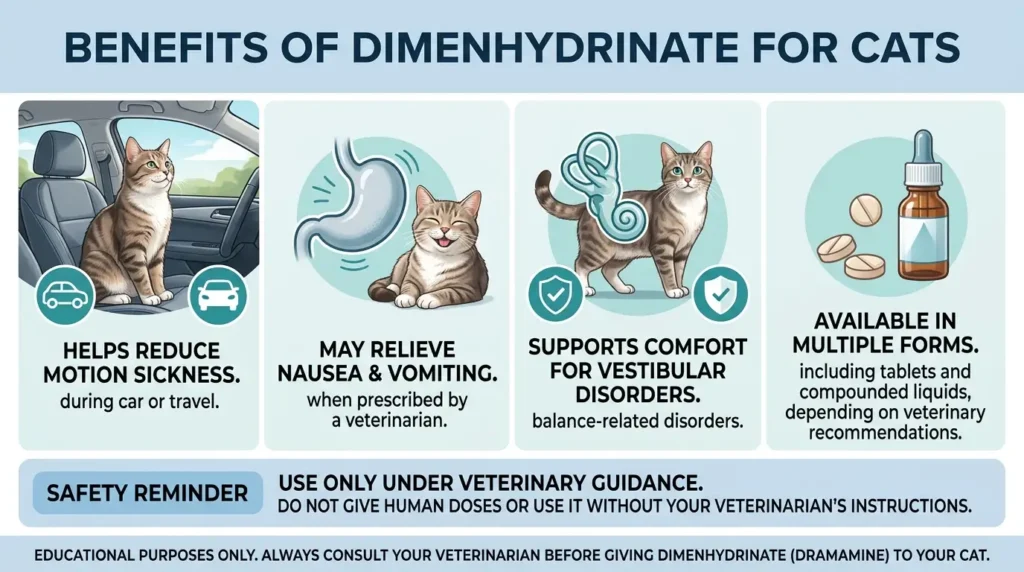
Dimenhydrinate exhibits several important properties for pets:
- Effectively treats and prevents vomiting in dogs and cats unless the dog/cat is suspected of having ingested something toxic.
- Especially useful to prevent nausea and vomiting from motion sickness during traveling.
- Offered in 3 different formats: a tablet, chewable tablet and an injection, which can be administered at the vet’s office and then continued at home with a tablet, if necessary.
- If used properly, generally well tolerated by animals.
Dramamine Dosage Chart for Cats
This is where transparency becomes important: some veterinary references state the cat dose in various ways. Below are the two methods side by side from the different veterinary drug reference books.
Approach 1: Fixed total dose (per-cat, not weight-based)
| Detail | Guidance |
|---|---|
| Dose | 12.5 mg total, per cat |
| Frequency | 3 times daily (about every 8 hours) |
| Tablet math | ¼ of a 50 mg tablet, or ½ of a 25 mg tablet |
| Source pattern | Commonly cited for an “average-sized” adult cat |
Approach 2: Weight-based dose
| Cat’s Weight | Dose Range (4–8 mg/kg, every 8 hours) |
|---|---|
| 5 lb (2.3 kg) | ~9–18 mg |
| 8 lb (3.6 kg) | ~14–29 mg |
| 10 lb (4.5 kg) | ~18–36 mg |
| 12 lb (5.4 kg) | ~22–43 mg |
| 15 lb (6.8 kg) | ~27–54 mg |
Why the discrepancy? The fixed dose of 12.5 mg seems to be a convenient and practical number based on an average-sized adult cat, the mg/kg is based on each cat. Both methods fall within a similar range for an average 8–10 lb cat, but the more off the scale your cat is, the more the two approaches differ.
This is what your vet should work out for you and not just the number that seems easier to use — they will know what reference they are using to work out your cat’s dose and take into account your cat’s health history.
Do not “eyeball” a dose to a human being. A dose of Dramamine for a cat is based on the size of a human body, not a 9 pound cat.
When and How to Give Dramamine to a Cat
- Timing: Dimenhydrinate should be given 30 to 60 minutes before travel commences as it takes about 1-2 hours to fully work.
- Form: Tablet, chewable or compounded liquid. Tablets usually require dividing in half or quarters and if the exact dose is difficult, ask your vet or pharmacist about them being split accurately or compounded to a liquid.
- Ingredient check: Make sure that the product is made with only dimenhydrinate. Ignore those that contain ‘Dramamine Less Drowsy’ (which is actually a different drug, meclizine) and combination formulas.
- Missed dose: If a dose is missed, do it as soon as you remember, and then go back to the regular schedule — don’t double up!
- Access to water: Ensure water is available as dry mouth is a usual side effect.
Cats and Dramamine Side Effects
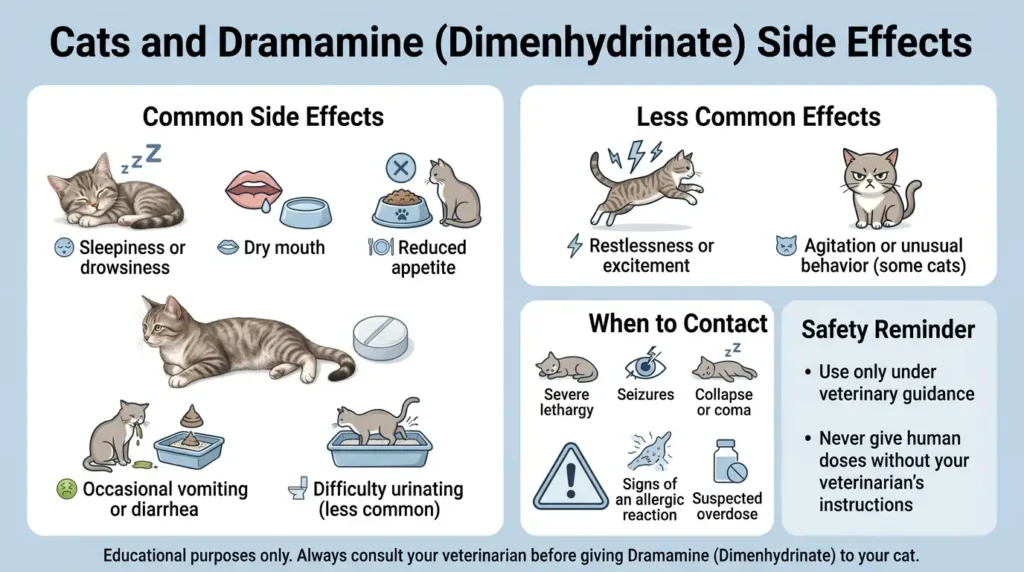
Most side effects are related to its antihistamine, sedating action:
- Drowsiness or sleepiness
- Dry mouth
- Difficulty urinating / urinary retention
- Decreased appetite
- Vomiting or diarrhea
These are typically mild and go away after the drug stops working. If there is any indication of a true allergic reaction (facial swelling, hives, difficulty breathing) it’s an emergency — contact your vet or an emergency clinic at once.
Cats That Should NOT Take Dramamine
Do not give dimenhydrinate to cats with any of the following or special precautions are required; consult your vet before giving:
- History of known hypersensitivity/allergy to dimenhydrinate
- Glaucoma
- Enlarged prostate gland (primarily a problem in male dogs and was noted in veterinary literature for the class of drugs)
- Blockage of the stomach, gut or bladder
- Overactive thyroid (hyperthyroidism)
- Seizure disorders
- Heart disease or high blood pressure
- Chronic respiratory diseases (such as diseases of the chronic obstructive airways)
Kittens and senior cats should be treated with particular care too — younger and older cats might be more susceptible to sedating drugs, and should only be dosed by a vet that has examined the cat.
Drug Interactions to Flag for Your Vet
If your cat is taking any other medications or supplements, consult with your veterinarian prior to beginning Dramamine treatment For Cats. There are two types in particular that it is important to note:
- Anticholinergic drugs (including some tricyclic antidepressants)
- Other CNS depressants, because the effect of sedating drugs can be additive and result in greater than anticipated sedation
Signs of Dramamine Overdose in Cats
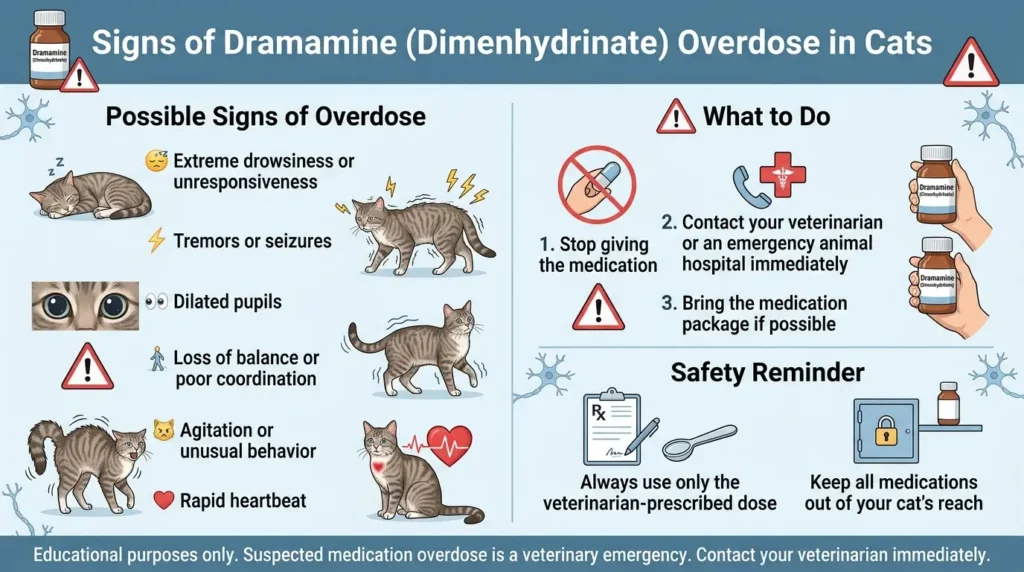
An overdose is a veterinary emergency. Watch for:
- Unusual excitement, agitation or restlessness
- Co-ordination problems, or stumbling
- Disorientation
- Seizures
- Very deep stupor leading to coma
- Slow breathing or trouble breathing.
In case of any suspected overdose (due to an incorrect calculation, or your cat getting into your pill bottle), contact your veterinarian, an emergency animal care facility or an animal poison control center immediately. Do not attempt to make the person vomit at home without expert advice, as this may do more damage if not properly done.
Dramamine Alternatives for Cats
Dimenhydrinate is no longer a first line drug vets turn to. Here’s how it compares to two commonly used alternatives:
| Medication | Type | Typical Use | Notes |
|---|---|---|---|
| Dimenhydrinate (Dramamine) | Antihistamine | Motion sickness, mild nausea | OTC, extra-label in cats, sedating |
| Meclizine (Bonine, Antivert) | Antihistamine | Motion sickness | Often dosed once daily; also used off-label in cats |
| Maropitant (Cerenia) | NK1 receptor blocker | Motion sickness, broader nausea/vomiting (e.g., kidney disease, chemo-related nausea) | FDA-approved for dogs; used extra-label in cats; often considered more effective for motion sickness than antihistamines |
Some vets also prescribe anti-anxiety drugs (such as gabapentin) for cats that are having a stress reaction to the carrier or car, but are feeling only “motion sickness,” and not actual vestibular sickness. You should only be able to determine the category of your cat’s symptoms from your vets.
Myth vs. Fact
Myth: “If it’s safe for humans, it’s safe for cats.
Truth: Cats metabolize a lot of drugs differently than humans. A “small” human dose may be enough and OTC is only for human safety testing.
Myth: “Dramamine Less Drowsy is simply a milder Dramamine.
Fact: It’s not just a smaller dose of the same drug, it’s a different active ingredient (meclizine, not dimenhydrinate).
Myth: “My cat didn’t vomit, it was a good dose.
Truth: There is sedation, urinary retention, and other effects even if not vomited. No vomiting does not equal no side effects.
Non-Medication Tips to Reduce Cat Motion Sickness
Medications only play a part in that, and are not necessarily the first option your veterinarian will take when dealing with a dog needing to shed the pounds.
- Before traveling long distances, get your cat accustomed to the carrier and brief trips in the car in a low stress way.
- Try to travel with an empty stomach — some veterinarians favor a small meal several hours before traveling, instead of a full meal immediately before.
- Make sure the carrier is firmly locked in place and will not slide or rock.
- Do not leave the car too hot and avoid exposing the cat to much visual stimulation (covered carrier can help some cats).
- If someone is having symptoms that are related to anxiety, there are calming pheromone products that can be helpful, but won’t help with true vestibular motion sickness.
You May Also Like to Read:
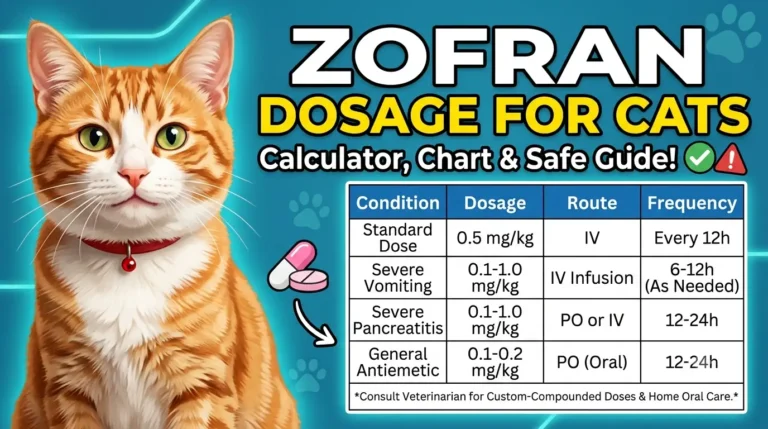
- Zofran Dosage For Cats: Calculator, Chart & Safe Guide
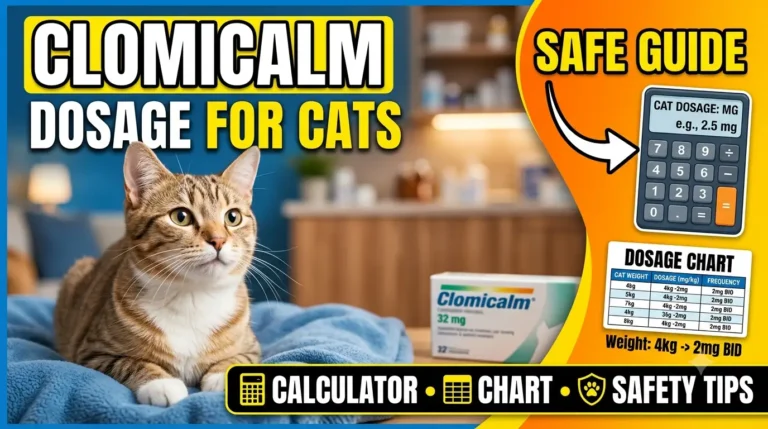
- Ivermectin Dosage For Cats: Calculator, Chart & Safe Guide
FAQs
I have cats and I need to know how much Dramamine dosage can I give my cat?
This is either 12.5 mg three times a day (according to veterinary references) or 4-8 mg/kg every 8 hours. Before administering any dose, ask your veterinarian which of the figures you should use for your cat.
Can I give my cat human Dramamine?
Only plain dimenhydrinate formulation (may only be reduced by a vet) — not a combination product — and not a human dose reduced casually.
When will Dramamine start working for cats?
It usually starts to work in 1–2 hours, so it is generally administered 30–60 minutes before travelling.
Is Dramamine bad for cats?
Yes at higher than recommended doses, with some health conditions, or with other sedating medications. Symptoms of overdose include agitation, loss of coordination, seizures and heavy lethargy.
So what happens if my cat accidentally eats the entire Dramamine tablet?
Call your vet or an emergency animal poison line right away, before symptoms occur, and do not try to make your dog vomit unless directed by your veterinarian.
So which is better Dramamine or Cerenia for cats?
According to a lot of veterinary sources, Maropitant (Cerenia) is more effective for motion sickness, but your vet will choose the best option depending on your cat’s health history and symptoms.
Is Dramamine safe for kittens?
This should only be done as directed by a veterinarian because kittens may be more susceptible to sedative medications, and there is no standard OTC dose that is appropriate for administration without veterinary input.
What’s the difference between Dramamine and Dramamine Less Drowsy?
Regular Dramamine contains dimenhydrinate; “Less Drowsy” Dramamine products contain meclizine, another but similar antihistamine; they are NOT interchangeable at the same dose.
Is it safe to give Dramamine to my cat on a regular basis for an extended period of time?
This is not normal use – often, Dimenhydrinate for cats is mentioned in the context of short term, situational use (such as travelling) and repeated use should be advised by a vet who is keeping monitor of how it affects your cat.
Final Thoughts
Dramamine Dosage For Cats can actually work if your cat is afraid of the car, but can help and can “probably” help are two different things. Things to remember: it’s a human drug being used off label, cats are more susceptible to the effects of drugs than one might think, and the information for off label use is inconsistent between different sources.
That doesn’t mean that should be an excuse to not have the talk with the veterinarian, it’s the reason to have it. Just a few minutes invested in a phone call to verify correct dosage for your individual cat is a small step to avoiding a larger issue.