Meclizine Dosage For Cats: Calculator, Chart & Safe Guide
If your cat gets carsick, is dizzy due to an inner-ear disorder or you just want to double check a dose you’ve been prescribed by your vet, the short answer is that there is no per-pound Meclizine dosage for cats, the standard dose is 12.5 mg total, once a day. We will be explaining just why that is, when you can use it, what you need to be aware of, and how to use it safely below.
The information in this guide is for informational purposes only. Do NOT administer Meclizine Dosage to a cat without the advice of your veterinarian.
Meclizine Dosage Calculator for Cats
Enter your cat’s weight below to check the standard meclizine dosing reference. This tool is based solely on the veterinary dosing guideline provided by medscat.com and does not replace advice from your veterinarian.
Recommended Dosage
What Is Meclizine, and Why Would a Cat Need It?
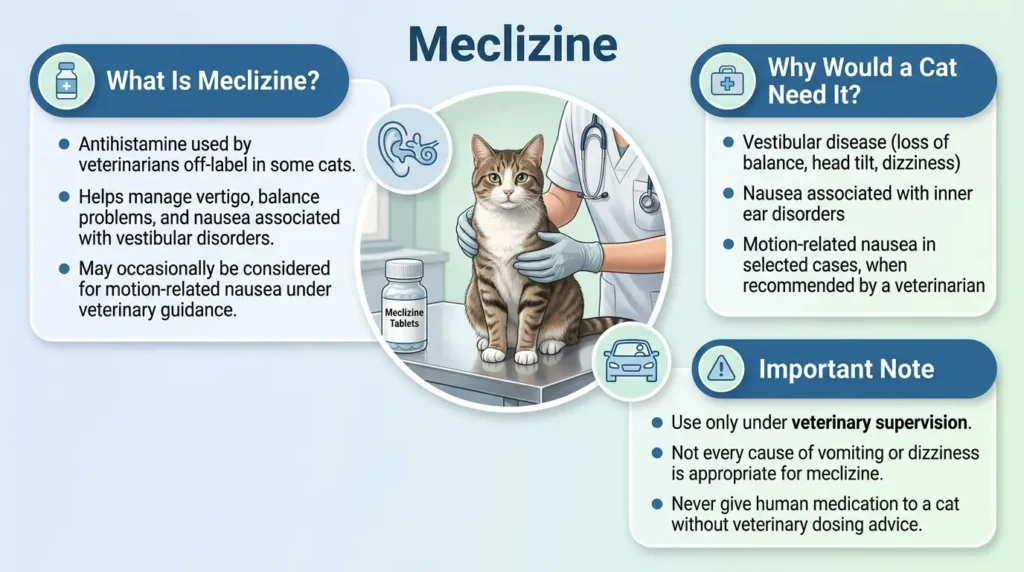
Meclizine for cats is an antihistamine drug most commonly known by the human brand name Bonine® or Antivert®. It is prescribed off label for cats, dogs and other small mammals for the prevention and treatment of motion sickness and associated vomiting. It is also occasionally prescribed for non-travel nausea, e.g., nausea associated with vestibular (inner ear) disease.
How it works: Meclizine blocks histamine and some of the nerve signals that pass between the balance center of the inner ear and the portion of the brain that causes vomiting. Put that route to rest and a cat is much less likely to drool, retch or throw up on a car ride.
One quick note about terminology you will see interchangeably: “meclizine”, “Bonine”, and “Antivert” are all the same drug. Although the drug is labelled for human use only, and not approved by the FDA for use in animals, it can be prescribed “extra-label” (outside of the label) by a veterinarian and is legal.
This is a standard, legal and normal procedure in veterinary medicine, and does not indicate the drug is experimental or dangerous, just that it wasn’t specifically developed and tested for animal use.
Meclizine Dosage for Cats: The Standard Dose
The essential number right from the trusted veterinary dosing resources:
Standard cat dose: 12.5 mg, given by mouth, once daily.
This number has been found in various sources in veterinary pharmacology. One veterinary drug reference has the cat dosage as 12.5 mg/cat per os (by mouth) once daily, which is attributed to Papich (1992).
That is compared with dogs, where it is usually based on weight — general advice is to administer about 2-6 mg/kg orally to dogs, or a fixed dose of 25 mg per dog per day (the dose for cats is not as well defined but is thought to be about half of this).
Why Cat Dosing Isn’t Based on Weight the Way Dog Dosing Is
This makes it confusing for many cat owners—here’s how it works: Many of the cat dosing recommendations for meclizine for cats dosage are expressed as a total dose per cat, rather than a dosage per pound or per kilogram. That’s because the drug has not been studied to the same degree in cats as dogs and the few dosing references available for cats are based on a fixed amount instead of a scaled amount.
However, a different dose is given in certain sources (Day, 1993) as 6.25 mg per 5 kg of body weight, which is approximately equivalent to the flat dose of 12.5 mg for an average sized cat (about 10 lb / 4.5 kg). This is not a contradiction as it is just two ways of stating dosage for cats within a typical weight range. It also indicates why very small kittens or unusually large or underweight cats should be prescribed their dose by a veterinarian.
The takeaway: never increase or decrease the 12.5 mg dosage according to your cat’s weight without consulting a veterinarian. Your veterinary practitioner should make the determination if your cat is noticeably smaller or larger than an average sized adult feline.
Meclizine Dosage Chart for Cats
| Cat Profile | Typical Total Daily Dose | Frequency | Notes |
|---|---|---|---|
| Average adult cat (~8–12 lb) | 12.5 mg | Once daily | Standard reference dose |
| Small, underweight, or senior cat | Individualized | As directed | Do not assume a lower dose is automatically safe — ask your vet |
| Kitten | Not established | N/A | Consult your veterinarian; meclizine is not routinely recommended for kittens without veterinary guidance |
| Cat with liver or kidney disease | Individualized, often lower | As directed | Drug clearance may be slower, raising the risk of accumulation |
This is a chart of typical veterinary dosage information and should not be used in lieu of a prescription from a veterinarian for your individual cat.
How to Use the Meclizine Dosage Calculator
The calculator used on this page is based upon the same criteria: a total dose of 12.5 mg once daily for a cat in a realistic adult weight range. Use it as follows:
- Type in your cat’s weight in pounds or kilograms.
- Click Calculate Dosage.
- Check the results card for dose, frequency and total daily dose.
- Read the notes and disclaimer–they are not filler, they are important.
There is a realistic range for weight, so the calculator will not call out a dose if the weight entered is out of range to prevent a data entry error. It is a reference book, not a prescription; check with your vet before administering any dose or dosage.
How and When to Give Meclizine to a Cat
- Meclizine dosage for cats comes in tablet form. May be administered with or without feed; should be administered with a piece of feed or small meal to avoid vomiting.
- When used for motion sickness, administer at least 30–60 minutes prior to travel.
- If the nausea is not travel related, your vet will let you know the schedule to follow – the duration of the treatment will be dependent on the underlying condition, your cat’s response and whether any side effects occur.
- Finish the entire course of treatment recommended by your vet, even if your cat appears to be better after one or two days, as otherwise you may end up with a relapse.
- Don’t double up on the next dose; consult your veterinarian if you forget to give a dose and if you want to give it as soon as you remember it, or if you want to skip the dose and pick up with your regular schedule.
Quick fact: Meclizine tablets typically are sold in the following strengths: 12.5 mg, 25 mg, and 50 mg, and one 12.5 mg tablet may be the standard cat dose without any splitting. Always verify the strength on the label before administering a dose; a 25 mg or 50 mg tablet could be mistakenly picked up instead of the intended dose and would be a double or quadruple dose.
Is Meclizine Safe for Cats?
Meclizine is relatively safe and effective for cats, when prescribed and directed by a veterinarian. However, as with all medications, it is not suitable for all cats and may have side effects for some.
Cats Who Should Not Take Meclizine (or Need Extra Caution)
- Meclizine should not be given to cats known to be hypersensitive or allergic to meclizine.
- To be used with caution in cats with prostatic diseases (intact males), bladder outlet obstruction, severe heart failure, angle-closure glaucoma, and obstruction between the stomach and small intestine.
- Pregnant or lactating cats should also be used with caution.
- The kidneys and liver eliminate the drug, so cats with a kidney or liver disease may be more susceptible to drug accumulation and, in turn, adverse effects.
- If your cat’s allergy skin testing is scheduled to occur, meclizine may affect the results — it’s best to stop the medication 3–7 days prior to skin testing.
Possible Side Effects of Meclizine for Cats
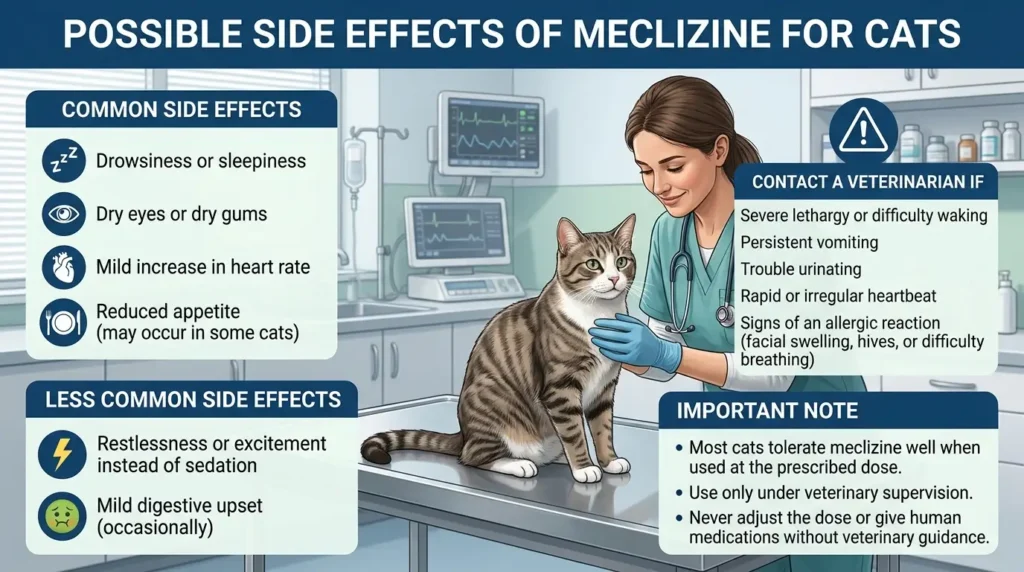
- Sedation or sleepiness is the most common side effect.
- Dry gums and eyes or a faster heart rate (less common).
- In rare instances, sedation will not occur, but rather central nervous system (CNS) stimulation, causing excitement or restlessness instead of drowsiness.
- In cats, in particular, meclizine can lead to decreased appetite.
- The effects are usually temporary and will pass in 24 hours or less, but may persist for more than 24 hours in liver and/or kidney disease.
Don’t panic, but if your cat exhibits any of these effects, do call your veterinarian, particularly if the symptoms are serious or worsening after 24 hours.
Meclizine Risk Factors for Pets:
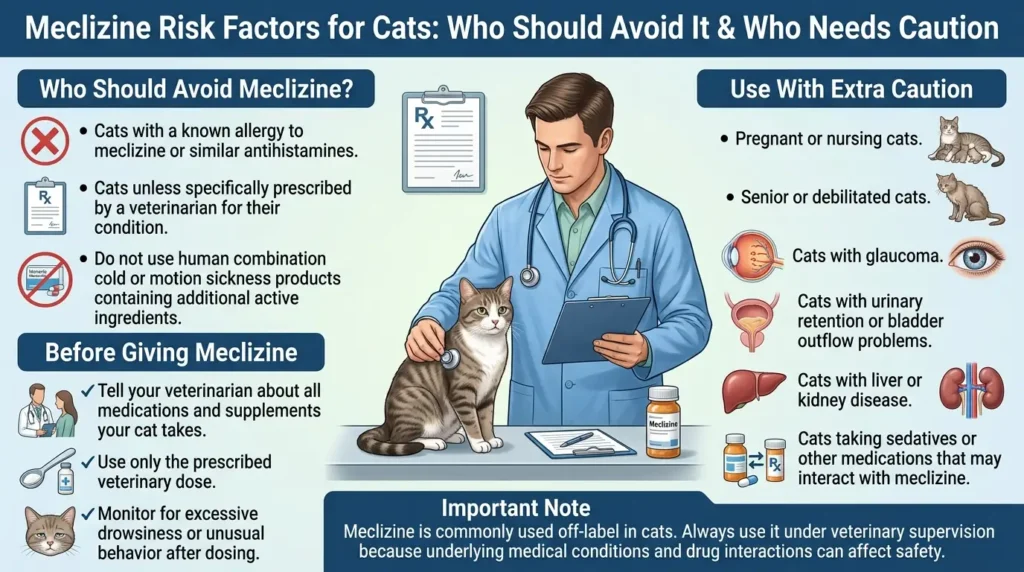
Meclizine cats dosage should never be given to pets that are allergic to it. Use with caution in pets with prostatic hypertrophy (enlarged prostate), bladder neck obstruction, severe heart failure, angle-closure glaucoma, pyeloduodenal obstruction (obstruction between the stomach and small intestine); or in pregnant or nursing pets. This medication can also interfere with allergy skin testing; it should be stopped 3-7 days prior to testing.
Common drug interactions to be aware of:
Let your veterinarian know of all the medications and supplements your cat is taking. Some interesting encounters to note:
- Other anticholinergic drugs (such as atropine or glycopyrrolate) can add to meclizine’s anticholinergic effects.
- Meclizine may enhance the effect of CNS depressants, such as benzodiazepines, gabapentin, opioids or trazodone.
- For cats taking heart medication, the absorption of digoxin may be enhanced by meclizine slowing the movement of the gut.
What to Do If You Miss a Dose: Meclizine Missed Dose Guide for Pets
If you forget to administer the meclizine to your pet, administer it as soon as you remember. Always ask your vet first, though, as if it’s close to the time of the next dose, your vet might say it is best to skip the dose and then continue on the normal dosing schedule.
Wait for recommended interval between doses; do not give two doses at the same time or additional doses to make up for a missed dose.
What If My Cat Gets Too Much Meclizine? (Overdose Signs)
Moderate medication overdose symptoms are drowsiness or sometimes over-excitement followed by vomiting or rapid pulse. A serious overdose can lead to being very sleepy, acting as if hallucinating, seizures, a fast heart rate or difficulty urinating.
Little data specific to cats is available, but general data on toxic effects of this class of antihistamines provide a good guideline: when less than approximately 33 mg/kg BW were administered, animals had only mild hyperactivity or depression and not severe toxicity. That’s a good guideline but not a green light, as the signs of an accidental overdose can take as long as several hours to appear or as short as 10–15 minutes after ingesting it.
If you suspect your cat got into meclizine — yours or theirs:
- Never induce vomiting except on the advice of a veterinarian.
- Record the amount and time of the dose(s) taken (no. of tablets × tablet strength).
- Contact veterinary office immediately, if unavailable follow veterinary office advice on how to reach the emergency facility.
- Do have the original container of the medication available should the veterinarian or poison control require it and the strength.
Meclizine vs. Other Cat Anti-Nausea Medications
Meclizine isn’t the only option for nausea and motion sickness in cats, and it isn’t always the first choice. Here’s how it compares to the most common alternative, maropitant (brand name Cerenia®):
| Medication | FDA Status in Cats | Typical Use | Typical Dosing Basis |
|---|---|---|---|
| Meclizine (Bonine®, Antivert®) | Off-label / extra-label | Motion sickness, general nausea | Flat 12.5 mg per cat, once daily |
| Maropitant (Cerenia®) | Labeled for use in both cats and dogs 16 weeks and older | Motion sickness, vomiting | Dosed by body weight, around 1 mg/kg by mouth |
Some veterinarians favor maropitant as it is labeled specifically for cats and is dosed by weight, which is better for cats with health issues which are not a good fit for antihistamines. Maropitant has some precautions, such as its avoidance when a patient is suffering from liver dysfunction or is taking some heart medications, like calcium channel blockers, beta-blockers or sotalol.
This is not to say that one drug is necessarily better or the other — it’s a choice left to your vet, depending on your cat’s health history.
Myth vs. Fact: Meclizine for Cats
Myth: “It’s just Bonine, which I get at the drugstore, so any dose is okay.
Fact: Human Bonine tablets are frequently 25 mg (double the typical dose for cats). One of the most frequent causes for cat overdose is using human packaging without changing the dose for your cat.
Myth: “The more medication, the more effective it is (or the quicker it works!)
Fact: adding an extra “just in case” does not increase effectiveness, but rather increases the risk for sedation, a fast heart rate, or worse. Follow the recommended dosage and frequency.
Myth: “The per-pound dose my vet gave my dog is the same for my cat.
Fact: As mentioned above, dosing of meclizine is usually in a straight total dose, rather than on a per-pound basis as is sometimes done with dogs.
Myth: “It’s available over the counter, I don’t need to ask my vet first.
Fact: Meclizine is sold over the counter, but should only be administered by a veterinarian under her supervision and guidance. Accessibility is only indicative of human use and should not be interpreted as an OK for pet use without supervision.
Common Mistakes Cat Owners Make With Meclizine
- Taking a human or dog dose of a 25 mg or 50 mg tablet rather than 12.5 mg for cats.
- Administration of a second dose due to a first dose “not working” within an hour.
- Thinking that it is safe for kittens because it is safe for adult cats.
- Failing to disclose to the veterinarian that the patient was taking another drug – such as a sedative or heart drug – prior to the meclizine therapy.
- Discontinuing a drug as soon as symptoms resolve (rather than completing the vet prescribed course of treatment).
- Not waiting 30–60 minutes before traveling before administering the dose.
You May Also Like to Read:
- Dramamine Dosage For Cats: Calculator, Chart & Safe Guide
- Zofran Dosage For Cats: Calculator, Chart & Safe Guide
FAQs
What is the max dose of meclizine for a cat?
The usual dose is 12.5 mg a day (total) for an average adult cat, but always consult a veterinarian for the actual amount and frequency of use.
Can you give meclizine to cats?
Yes, in general, it is safe to take, when prescribed and supervised by a veterinarian, but it is not suitable for every feline, as some cats with heart, eye, prostate, and urinary issues should not take it.
How long does it take the drug meclizine to work in cats?
Should be taken at least 30–60 minutes prior to travel to be most effective in preventing motion sickness.
How many times a day can I give my cat meclizine?
The normal frequency is once a day. Never increase it on your own, even if your cat is still not feeling comfortable.
If you miss a dose, what should you do?
If you remember it, ask your veterinarian if it is OK to give it as soon as you remember or to skip it and wait until the next scheduled dose — and in no case to double up to make up for a missed dose.
Is meclizine only used for motion sickness in cats or vestibular disease?
Yes — meclizine is also used to treat nausea not due to motion sickness, such as inner ear (vestibular) disease.
Can cats take meclizine pills?
No. It is used off-label (extra-label) in cats; that is, the FDA has not approved this use, but it is permissible for veterinarians to prescribe it in this context according to their professional judgment.
If my cat got into a bottle of meclizine, what should I do?
Call your veterinarian or emergency/poison control center immediately and report the amount that may have been swallowed (if known) and do not attempt to induce vomiting unless directed to do so by a veterinarian or an emergency/poison control center.
Will my cat be drowsy for the duration of the drive in the car?
Sedation is the most frequent side effect and it usually goes away within 24 hours, so slight drowsiness during travel can be seen as a side effect and does not necessarily mean anything on its own.
Is it safe for kittens to use meclizine?
There is no consensus about dosing in kittens in the literature available for this guide, so that should be left to the discretion of the veterinarian and not based on the adult cat dose.
Is there any other medication that meclizine doesn’t mix with that my cat is taking?
It can — particularly other anticholinergic drugs, CNS depressants like benzodiazepines or opioids, and heart medications like digoxin. Be sure to list all the medications you give your cat with your veterinarian.
Final Thoughts
When used properly, meclizine is a tried and true medication that can help make your cat’s car rides a little easier and help with inner ear issues and nausea, but “properly” means that the dosage, frequency, and cat are all a perfect match, and that involves a veterinarian’s call.
It’s easy to remember the standard reference point (12.5 mg, one a day), but simple isn’t the same as automatic: your cat’s health history, current medications, and sensitivity to any medication should be taken into consideration.
Loop in your veterinarian before administering the first dose, read the safety information and use the calculator above as a quick reference. That’s the mix that makes a good medicine, good.
This article is intended for educational purposes only and is not a substitute for veterinary care. Be sure to check with your veterinarian before you administer any drugs, such as meclizine, to your cat.