Spinosad Dosage For Cats: Calculator, Chart & Safe Guide
So the short answer to “how much spinosad Dosage can I give my cat if I have a Comfortis package?” is that it depends entirely on your cat’s weight, the dosage is at least 22.5 mg per pound (50 mg per kg) of body weight, and it’s administered as a single tablet once a month. Your cat’s strength of tablets will vary depending on which weight band they fall into – if it’s not right, then your cat is either under-protected or getting too much medication.
You’ll find a calculator to do the math for you, the official weight-based dosage chart, and simple answers in plain English to the questions that cat owners ask: What to do if you miss a dose, what side effects are normal and when to call your vet.
Spinosad Dosage Calculator for Cats
Accurate monthly COMFORTIS® (spinosad) dosage determinations based on feline body weight.
Recommended Dosage
Administration & Dosage Guidance
Key Takeaways
- Spinosad (brand name Comfortis) is dosed by weight, at a minimum of 22.5 mg/lb (50 mg/kg), given once a month.
- Please note that cats have their own dosing schedule and never dose a cat using a dog’s Comfortis dosing schedule and vice versa.
- The chart is FDA approved, and is for cats between 4.1 and 24 lbs; cats over 24 lbs receive two types of tablets to achieve the proper total dose.
- The most frequent side effect is vomiting. Guidance is to “redose with full dose” if it occurs within an hour of dosing.
- Spinosad Dosage For Cats should be used with caution when applied to cats that are treated with extra-label (off-label) high dose ivermectin and has not been tested for use in pregnant or lactating cats.
- This article is informational only — it is not a replacement of your veterinarian’s advice on your cat.
What Is Spinosad For Cats?
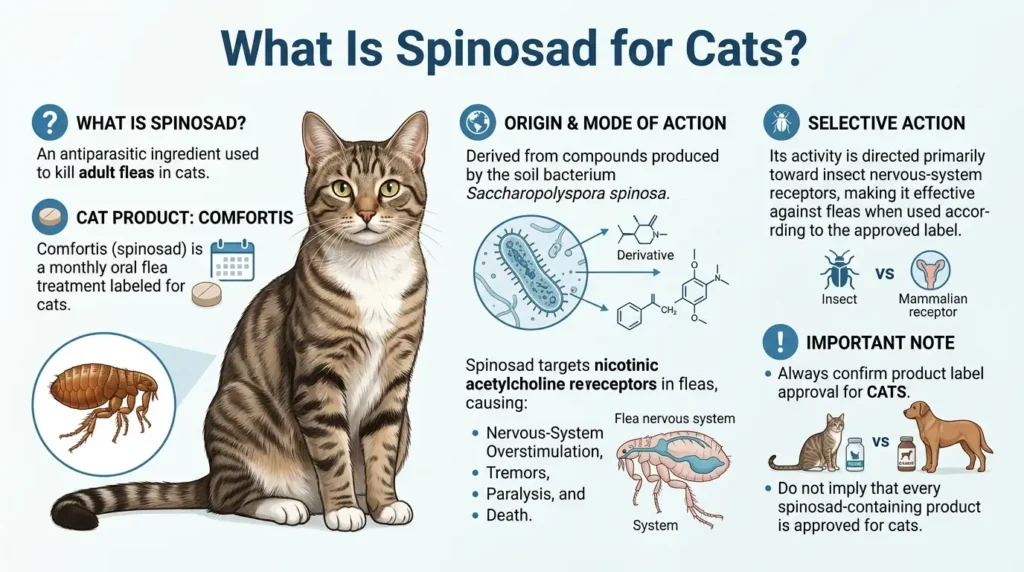
Spinosad for cats is an antiparasitic ingredient which kills adult fleas on dogs and cats. In cats, it’s sold under the brand name Comfortis, a chewable, meat-flavored tablet given once a month. Comfortis was first approved for dogs in 2007, and was later approved by the FDA for cats in 2012.
Brand Names and Where It Comes From
Comfortis is made by Elanco (formerly animal health division of Eli Lilly’s). Spinosad cats dosage is actually a naturally occurring soil bacterium, Saccharopolyspora spinosa, and is not even a fully synthetic chemical — which may be the reason that it’s also labeled for use as an insecticide on organic produce.
Spinosad is also the flea-killing ingredient in Trifexis, another Elanco product to protect against fleas and deworms (combines spinosad and milbemycin oxime). Presently, there is no label for Trifexis in cats, with Comfortis (spinosad) being labeled for cats only.
How Spinosad Kills Fleas
Spinosad for cats dosage interferes with the flea’s nervous system, which causes an overstimulation of a receptor type (nicotinic acetylcholine receptors) necessary for normal nerve function in fleas. This disrupts the flea’s nervous system, resulting in tremors and paralysis that will kill the flea.
The receptors in cat’s and dogs’ are different enough from those in an insect that the drug is selective for the parasite.
Spinosad Dosage Chart for Cats By Weight
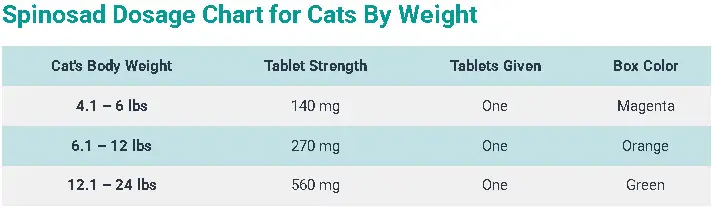
This is the exact FDA recommended dose schedule for Spinosad (Comfortis) Dosage for Cats By Weight. Color coding on each box is a quick check to ensure that you are taking the correct tablet size.
| Cat’s Body Weight | Tablet Strength | Tablets Given | Box Color |
| 4.1 – 6 lbs | 140 mg | One | Magenta |
| 6.1 – 12 lbs | 270 mg | One | Orange |
| 12.1 – 24 lbs | 560 mg | One | Green |
Quick facts about this chart:
- Always one tablet as per size of weight band – there is no need to cut or measure within the normal chart.
- Comfortis should be taken with food to get the maximum effect.
- Dosing once a month — make a calendar or use a phone reminder, as consistency of dosing is the key to flea protection.
What If My Cat Weighs More Than 24 Lbs?
The official label instructs owners to use “the appropriate combination of tablets” for cats over 24 lbs, the total dose of spinosad still would be at or above the minimum recommended dose of 22.5 mg/lb. In reality, this simply involves taking two of the typical pill sizes (e.g., 560 mg and one smaller tablet) and not altering to some different product.
This is the same calculation that the calculator above does automatically and something that you can’t easily “eyeball” because it could under- or over-dose a large cat if you don’t know the amount.
What If My Cat Weighs Less Than 4.1 Lbs?
The chart just doesn’t begin until 4.1 lbs and Comfortis for cats is approved for cats and kittens 14 weeks and older and 4.1 lbs or more. If your kitten or little cat falls below that amount, it is not a “round down” problem – ask your veterinarian which type of flea medication would be best for your pet’s specific size and age.
How to Give Spinosad to Your Cat
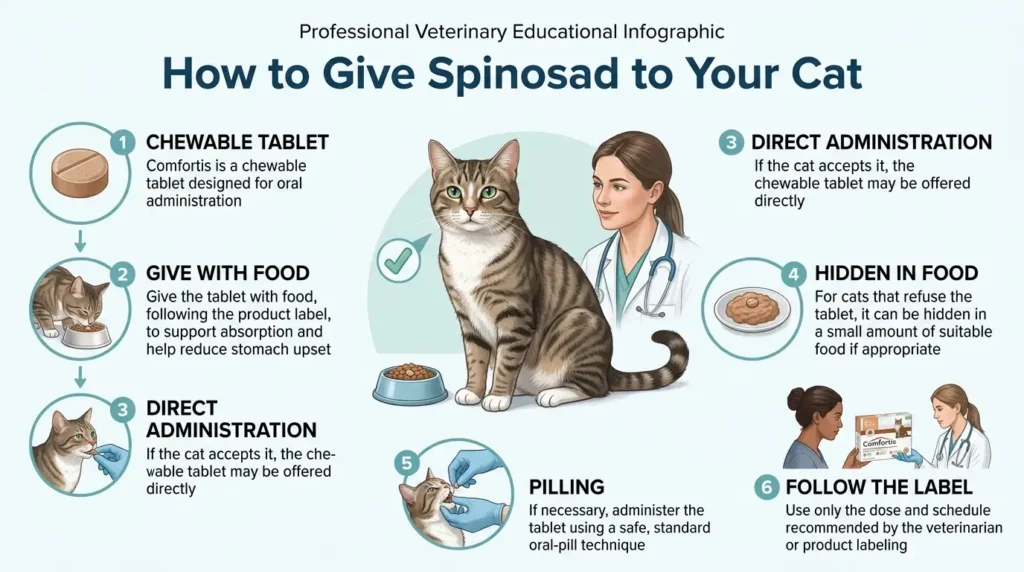
Comfortis is chewable tablet and most cats will greedily take it from your hand as a treat before or after eating. If your cat is more finicky, the tablet can also be disguised in food, or administered as any other pill. In either case, taking it with food aids in effectiveness and may also help prevent the incidence of upset stomachs.
What If I Miss a Dose or My Cat Vomits?
Vomiting Within an Hour
The label instructions for the medicine are that if your cat vomits within an hour of receiving their dose, you should administer another full dose, as the cat may not have absorbed enough of the drug. If your cat vomits after that initial hour, there’s usually no need for redosing as there will be sufficient spinosad Dose in their body, but it’s always best to call the vet if in any doubt.
Missed or Late Monthly dose
In the event of a missed or late dose, the dose can be administered as soon as it is remembered and the monthly dosing routine resumed. Don’t try to “catch up” with an extra dose, but remember that each day without treatment is one day in which the fleas can bite, feed and even lay eggs, so it is important to be as close to schedule as possible, particularly during the flea season.
What Is Spinosad Used For? (Uses & Benefits)
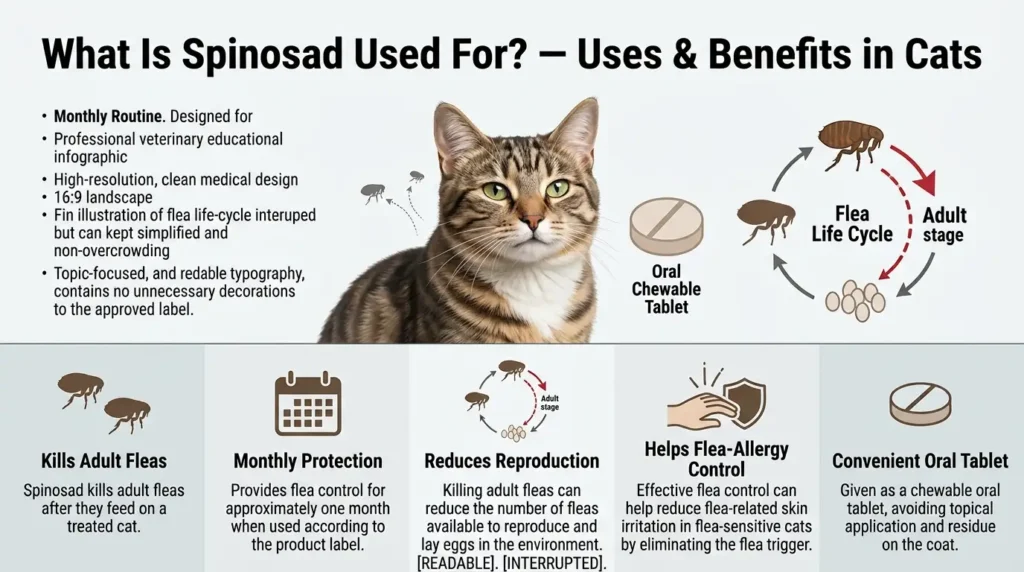
- Eliminates adult fleas on contact after they bite a treated cat.
- Helps to prevent flea infestations for 1 month after each application.
- Destroys and kills fleas before they can lay eggs, thus reducing the flea life cycle in your home over time – not just on your cat.
- Simply removes fleas to eliminate symptoms of flea allergy dermatitis (FAD) in flea-sensitive cats.
- No topical application, no waiting period before your cat can be touched or groomed, no mess, convenient once a month oral dosing.
How Fast Does Spinosad Work?
Controlled laboratory studies showed Comfortis for cats was working within 30 minutes, and was 98% effective on cats within 4 hours. Field studies conducted in homes already infested with fleas showed that flea numbers were reduced by approximately 97-99% after one to three months of regular monthly treatment.
Side Effects of Spinosad in Cats
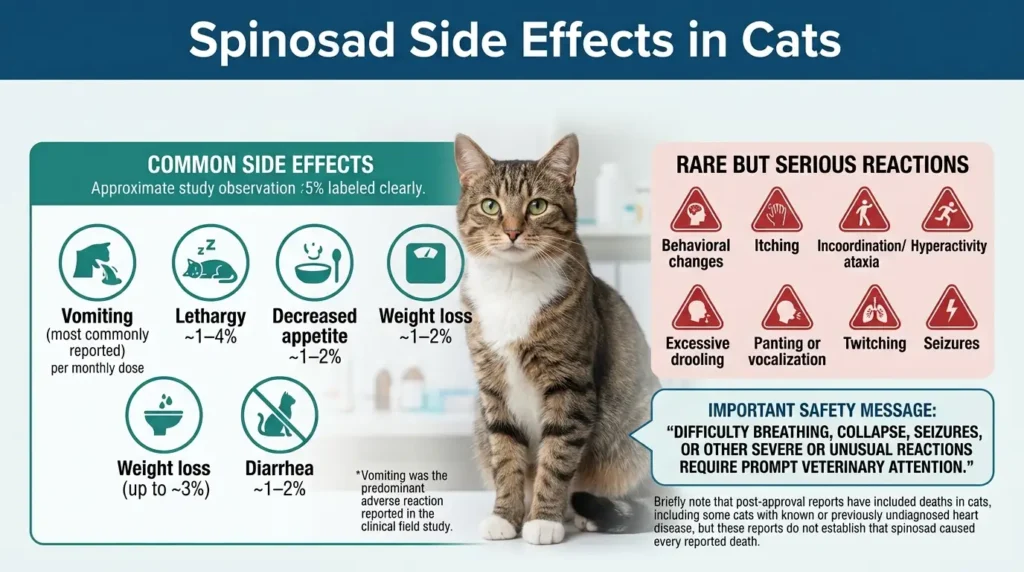
Common Side Effects
These are the most commonly reported reactions resulting from the field study data reviewed by the FDA in cats treated with Comfortis:
| Side Effect | Approx. % of Treated Cats (across 3 monthly doses) |
| Vomiting | ~14% per month (most common) |
| Lethargy | ~1–4% |
| Decreased appetite (anorexia) | ~1–2% |
| Weight loss | up to ~3% |
| Diarrhea | ~1–2% |
The predominant response was vomiting, with more than 25% of all cats vomiting on the day of or the day following at least one dose during the entire 3-month study.
Rare but Serious Reactions
Rarely reported, but important to know:
- Behavioral changes, itching (pruritus), incoordination (ataxia), hyperactivity
- Excessive drooling, panting, vocalization, difficulty breathing, twitching
- Seizures
There have also been reports of death in post approval safety monitoring, some of which occurred in cats already with (or undiagnosed) heart disease. That does not imply that spinosad caused these deaths in all instances, but it does mean that if any unusual response occurs, particularly a difficulty breathing, collapse or seizures, you should contact your vet immediately.
Risks, Warnings & Who Should Use Caution
There are no formal contraindications listed on the FDA label for Comfortis in cats, but there are several precautions that are important:
Drug Interactions (Ivermectin)
Note that if your cat is already taking extra-label (off-label) doses of ivermectin, such as for treating mites, this can cause some cats to experience symptoms such as unsteadiness, tremors, seizures, dilated pupils, disorientation and temporary blindness, so use extra caution with this combination.
However, routine, label-directed heartworm preventives given with ivermectin are another story: post-approval monitoring is ongoing to confirm the safety of Comfortis in conjunction with correctly dosed heartworm preventives.
Kittens, Pregnant, and Nursing Cats
Comfortis dosage can be used on cats and kittens 14 weeks and older. It has not been tested for breeding, pregnant or nursing cats, so it’s not something you’d want to take a chance on alone, you’d want to discuss with your veterinarian.
Cats With Heart Disease
Some deaths have occurred after administration and the cats had pre-existing or previously unknown heart disease, so it is important to let your veterinarian know if your cat has a heart disease before you begin spinosad treatment, and to be vigilant for breathing changes, lethargy, or collapse after an application.
Storage instructions: Comfortis should be stored at room temperature (68-77°F/20-25°C) out of the reach of children and pets, and away from light.
Spinosad vs. Other Flea Treatments for Cats
| Spinosad (Comfortis) | Topical spot-ons (e.g., selamectin, fipronil-based) | Isoxazoline chews (e.g., afoxolaner, lotilaner) | |
| Form | Oral chewable tablet | Liquid applied to skin | Oral chewable tablet |
| Dosing frequency | Monthly | Monthly (varies by product) | Monthly (varies by product) |
| Also covers ticks? | No — fleas only | Some products do | Most do |
| Water/bathing concerns | None — it’s oral | Can be affected by bathing/swimming depending on product | None — it’s oral |
| Best for | Cats who tolerate pills well and need flea-only coverage | Cats who resist oral medication | Cats needing flea + tick coverage |
This table is a good starting point to a discussion with your vet about which one is right for you and your cat, depending on the parasites that are a problem in your area and the lifestyle of your cat, as well as how she takes her medicine.
Myth vs. Fact
Myth: A dog’s dose of Comfortis is not suitable for use in cats.
Fact: You need to use a different minimum mg/lb target and tablet chart for dog and cat Comfortis dosing. Never substitute one species’ chart for the other.
Myth: “My cat sometimes vomits after taking his/her first dose, so I should always give another dose.
Fact: Redosing is only recommended if vomiting occurs within approximately 1 hour of the initial dose, as sufficient amounts of the drug should be absorbed after this time.
Myth: I’ve seen fleas on my cat in the past month so the cat medicine didn’t work.
Fact: Comfortis dosage for cats works to destroy biting fleas on your cat, but it doesn’t prevent new fleas from jumping on. The presence of an occasional flea a few weeks in should not be considered a failure of a treatment – it is most likely a new flea from the outside world that is being killed before it can lay eggs. This can be minimised by treating all pets in the home.
Common Dosing Mistakes to Avoid
- Using an approximation of your cat’s weight rather than an up-to-date and correct figure.
- Putting a dog Comfortis tablet in a cat (or a cat Comfortis tablet in a dog).
- Splitting or cutting a tablet without veterinary advice, particularly if the cat is at the high end of a weight band.
- Providing a “catch up” double dose if a month is missed.
- Not seeking veterinary advice early enough and ignoring vomiting, breathing changes or seizures.
You May Also Like to Read:
- Cerenia Dosage For Cats: Calculator, Chart & Safe Guide
- Sentry Fiproguard Plus Dosage For Cats: Calculator, Chart & Safe Guide
FAQs
How many times do you apply spinosad to a cat?
Frequently use once per month at the same time of month for continual flea protection.
Is spinosad safe for cats?
The FDA has approved it for use in cats and kittens 14 weeks of age or older, and weighing 4.1 lbs or more, and vomiting is the most reported side effect. Like any drugs, individual cats may respond differently — keep an eye out for unusual side effects and consult with your veterinarian if you have any questions.
If I give my cat too much spinosad, what will happen?
Poor muscle coordination, increased vomiting, and diarrhea are the most typical symptoms of an overdose. If you think your cat has been overdosed, contact your veterinarian immediately.
Is it OK to give half a tablet spinosad (Comfortis) to my cat?
Tablet splitting is not covered in the standard label dosing, the chart is based on weight bands and whole tablets. If your cat’s weight is somewhere between bands then consult your vet, don’t try to half dose a tablet.
If my cat vomits after taking Comfortis, what should I do?
Repeat full dose if occurs within approximately an hour of administration. After that window, redosing usually isn’t necessary. Call your veterinarian if the vomiting is severe, frequent or accompanied by other symptoms.
Can kittens take spinosad medication?
Yes, Comfortis for cats can be used from 14 weeks old and 4.1 lbs body weight. If your kitten is younger or smaller than that, your vet will need to create a plan that is different for them.
Can spinosad be used in conjunction with heartworm prevention?
Continuing post-approval monitoring is used in combination with the appropriate label directed heartworm preventive that is dosed properly with Comfortis. It’s a specific caution about extra-label (off-label) high dose ivermectin – that’s what should be given under veterinary supervision.
Will spinosad work for ticks?
No – spinosad is a flea control insecticide. If a tick control product is needed, consult your veterinarian regarding a product that will control both parasites.
How fast does spinosad start working?
Studies in the laboratory indicate it becomes effective in killing fleas in about 30 minutes and in cats, it reaches about 98% effectiveness in 4 hours.
In case I miss a dose, what will happen?
Do it as soon as possible – never double dose it to “catch up”.
Is spinosad safe for pregnant or lactating cats?
Safety has not been demonstrated in breeding, pregnant or nursing cats, and should be used under the advice of your veterinarian.
Why can’t I stop my cat getting fleas after I give them Comfortis?
Fleas can still jump on and bite before killing them, but from the environment. If all the pets in the house are treated with an approved flea product then it reduces the continued reinfestation.
What are the differences between Comfortis and Trifexis for Cats?
Comfortis is a flea control product that only uses spinosad. Trifexis also contains a dewormer for heartworm and intestinal parasite treatment, but is not yet approved for use in cats; Comfortis is available for cats.
How and where is spinosad stored and how long is it effective?
Follow product label directions for use of room temperature storage (68-77°F / 20-25°C), away from light and out of reach of children and other pets.
Final Thoughts
The one number that is key in getting a dose of spinosad correct for your cat is current and accurate body weight. The chart (and the calculator above) takes care of the rest. The larger safety gains are related to habits of dosing: sticking to a monthly schedule, watching for vomiting in that first hour, never stepping over a dog’s dosing chart to a cat, and looping in your vet anytime something doesn’t seem right, particularly with dosing ivermectin, pregnancy, or an existing heart condition.
As directed, spinosad is a well-studied and fast-acting way to keep fleas off of your cat — but “as directed” packs a lot of meaning into that sentence — be sure to keep this chart bookmarked for next month’s dose.
The information and opinions contained in this article are for informational and reference purposes only and are not a substitute for professional veterinary advice. Before giving any medicines, always check with your vet to ensure the correct dose for your cat.