Penicillin Dosage For Cats: Calculator, Chart & Safe Guide
You are looking at a bottle with the word “penicillin” and don’t know how many milligrams that equates to for a 9-pound cat. This is one of the most often asked cat questions that cat owners seek after visiting the vet and you are not alone.
A quick answer: Oral penicillin is typically administered at a rate of 5-10mg per kilogram of cat, as per Merck Veterinary Manual guidance. That’s the reference range; your vet might prescribe something outside of that range depending on the infection, type of penicillin dosage for cats and your cat’s condition. The calculator below is a good one to use for an estimate, but your vet’s prescription should be used as the final word!
Penicillin Dosage Calculator for Cats
Estimate a reference penicillin dosage range for cats based on body weight.
What Is Penicillin, and Why Would a Cat Need It?
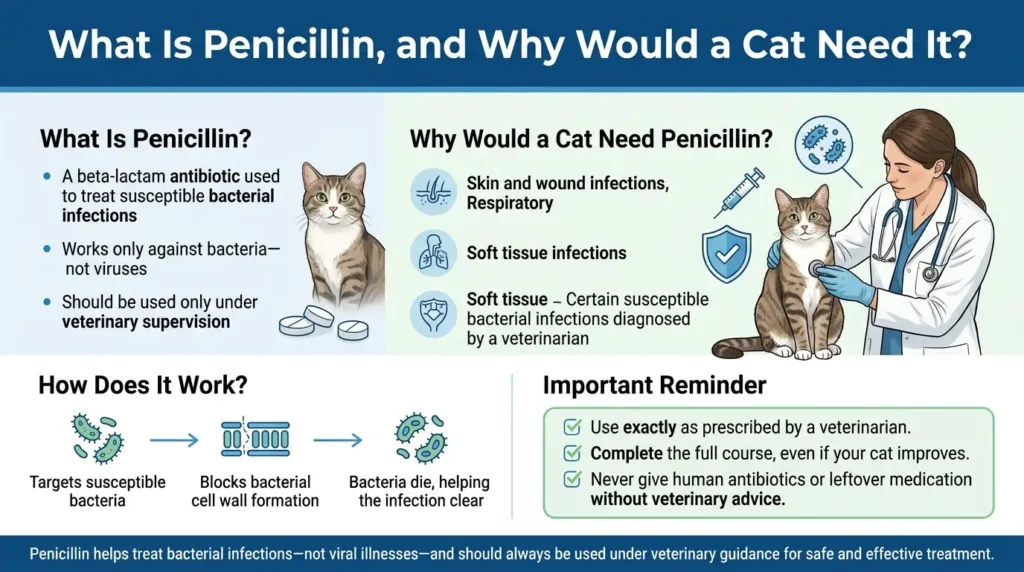
Penicillin is one of the oldest classes of antibiotics in medicine, and is still prescribed for cats today. It is active against the bacteria by disrupting the synthesis of bacterial cell walls, thus destroying bacteria, not merely slowing their growth. Penicillin is a drug that vets will commonly use to treat infections by Gram-positive bacteria, such as the species Staphylococcus, Streptococcus, Clostridium — such as skin infections, wounds, respiratory infections, and some urinary tract infections.
It should be understood that “penicillin” is not a single drug. Penicillin G is the most commonly used form in veterinary medicine (as an injectable or oral product), and Penicillin V, the form used by people, has never been approved by FDA for use in animals. If your veterinarian prescribed a penicillin type antibiotic (such as amoxicillin) instead, the dosage is different; see further below.
Penicillin Dosage Chart for Cats by Weight
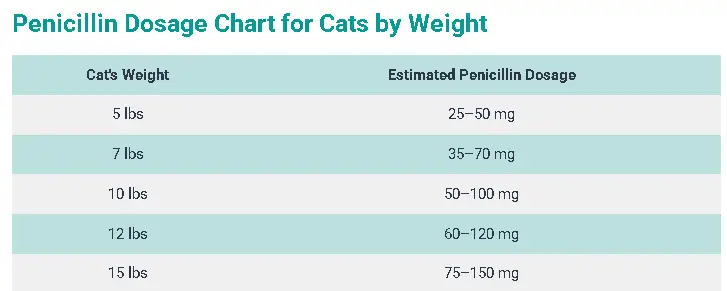
Alternatively, if you would prefer to see it in a table, here it is in the same 5–10 mg/lb range, spread over common cat weights:
| Cat’s Weight | Estimated Penicillin Dosage |
|---|---|
| 5 lbs | 25–50 mg |
| 7 lbs | 35–70 mg |
| 10 lbs | 50–100 mg |
| 12 lbs | 60–120 mg |
| 15 lbs | 75–150 mg |
Important to note: The dose is directly proportional to the weight, so all cats on this chart are receiving 5-10 mg/pound. This is why the calculator above can give you an idea of the range of any weight in between these two numbers, and not just the ones listed.
How the Dosage Is Calculated
The calculation is as easy as multiplying your cat’s weight, in pounds, by 5 to get the low end of the range, and by 10 to get the high end. A 9 lb cat, for example, lands at 45–90 mg. How high or low your cat’s vet falls in that range — or how often he or she is to be repeated — will vary with factors a chart cannot predict: type of infection, severity of infection, specific type of penicillin, and your cat’s kidney and liver function.
How Often and How Long Do Cats Take Penicillin?
Many online charts are lacking in this regard — dosage is not the only component. Oral penicillin is usually administered once a day in general veterinary practice, but may be more or less frequently depending on the product and infection. The courses of treatment are typically 7 to 14 days and longer if the infection is refractory.
This is always an over-riding rule: the frequency your veterinarian recommends to you should always be most important, including this article (our data doesn’t say that there is a universal frequency, and neither should this article assume so).
One cardinal rule about using any antibiotic: give it until the end of the course; don’t stop after a few days just because your cat seems perfectly normal. One of the reasons for the emergence of antibiotic resistant bacteria is that people stopped taking them too early and the bacteria were not killed, making them more difficult to treat the next time they were infected.
How Penicillin Works in Cats
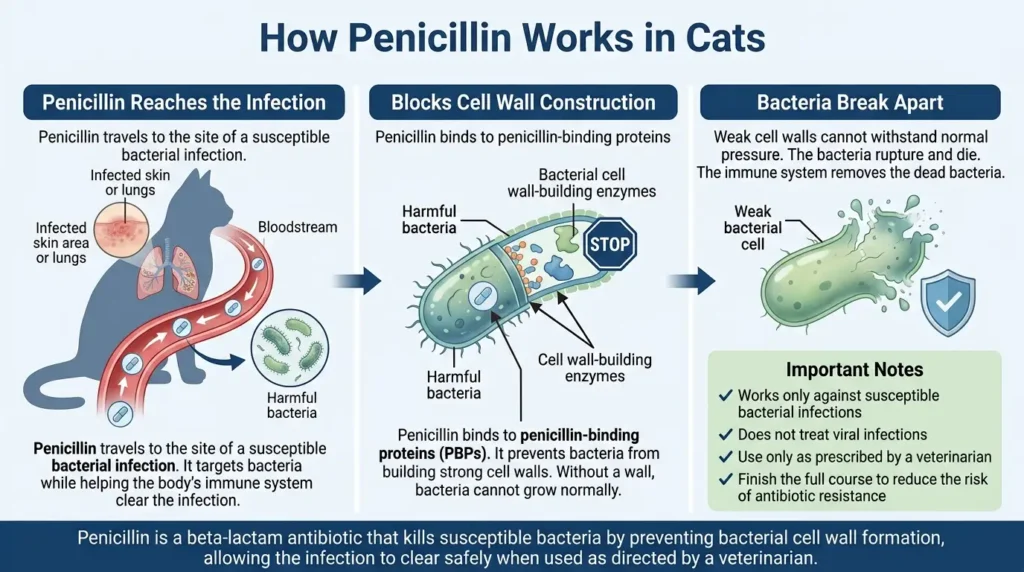
It prevents susceptible bacteria from forming an important component of the cell wall. It interferes with the ability of a bacterium to build the cell wall, thereby weakening and destroying it. The bacteria can therefore not survive, which results in its destruction and thus in the elimination of susceptible bacterial infections in cats.
How to Give Your Cat Penicillin
- Administer the medicine at the same time(s) every day to maintain a consistent blood level.
- Some antibiotics may be more easily tolerated when given with a little food; this may also help to prevent stomach upset (this is not the case for all antibiotics; consult your product’s label or veterinarian).
- Keep oral tablets in a cool dry place, out of direct sunlight (usually 68 to 77° F), or if a liquid suspension was given to you, it may need to be refrigerated and may need to be used within a specified time after preparing. Read and follow label directions.
- Store the medication so that it is out of reach of your cat (and other pets and children). If you forget to take one dose
Contact your veterinarian’s office for advice on your cat’s product and time. The basic rule for most oral medications, and antibiotics in particular: If you remember soon after the scheduled time, administer the dose as soon as possible after the missed dose; if it is almost the time for the next dose, skip the dose and resume the next dose on time.
Don’t “catch up” on doses as this puts you at risk of side effects and doesn’t help.
Signs of a Penicillin Overdose or Allergy in Cats
Although cats may have been given penicillin for cats before without problems, they can become allergic to it at any time. Though rare, severe reactions can be life-threatening and should be treated immediately by a veterinarian. Keep an eye out for the following after giving your cat penicillin:
- Itching or scratching too much
- Rash, redness or hives on skin
- A swelling particularly of the face or muzzle
- Trouble breathing or other breathing issues
- Stomach pain or stomach upset
- Lethargy or other unusual weakness
- Excessive salivation (drooling)
- Rare but life threatening anaphylactic shock
If your cat exhibits any of these signs after being administered penicillin, discontinue the drug and contact your vet or emergency veterinary center right away.
Alternatives to Penicillin for Cats
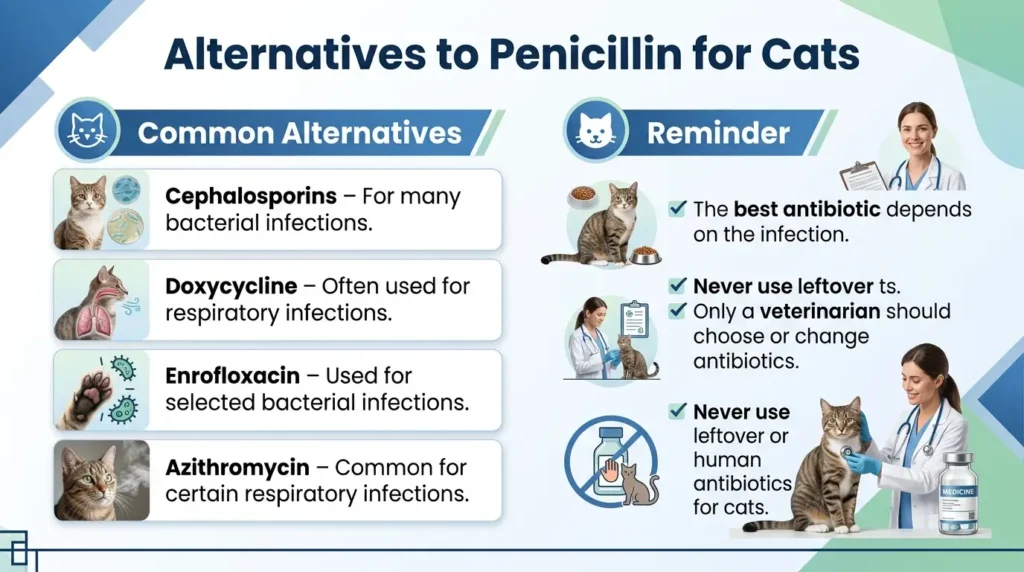
Although penicillin is one of the many antibiotics that can be used to treat bacterial infections in cats, it is not necessarily the most effective. The best antibiotic will vary depending on the infection, the bacteria and your cat’s health.
Your veterinarian may prescribe a different antibiotic if the cat is allergic to penicillin and/or the medicine doesn’t work. Sometimes, treatment may need to be changed or perhaps a mix of antibiotics could be necessary if the initial antibiotic is not working as expected.
Cats that are allergic to penicillin may be treated with:
- Often prescribed for many bacterial infections, particularly if the bacteria is resistant to penicillin medication or if a cat is allergic to penicillin.
- Cephalosporins – A large class of antibiotics that can be used to treat many bacterial infections.
- Doxycycline – A medication often used for respiratory and urinary tract infections, as well as tick-borne diseases. It comes in both pill and injectable.
- Enrofloxacin – An antibiotic used to treat a variety of bacterial infections, but generally not the first choice for treatment.
- Azithromycin – Most frequently ordered for upper respiratory infections, but can be ordered for other bacterial infections where appropriate.
- Amikacin or Gentamicin – Strong antibiotics, only used for more severe infections, since these are more likely to cause kidney damage.
- Chloramphenicol – a broad-spectrum antibiotic which can be used if other antibiotics fail or are inappropriate.
Always, the best antibiotic should be used based on the type of infection, sensitivity of the bacteria, medical history of your cat, and previous drug reactions.
What to Do If You Miss a Dose
While penicillin is one of the safer antibiotic classes for cats, ‘generally safe’ doesn’t mean ‘risk free. These are the things to look for.
Side Effects and Warning Signs
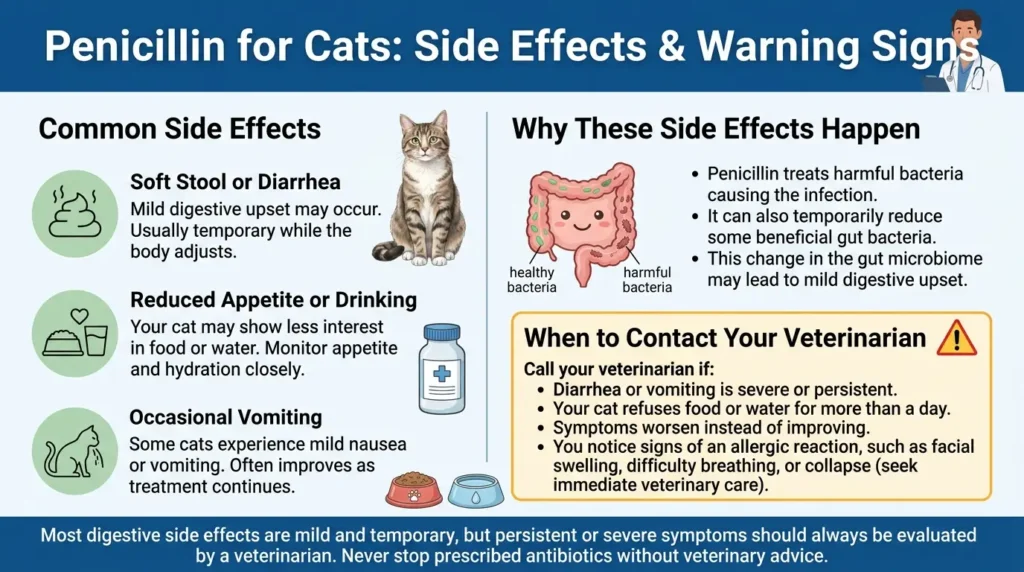
- Soft stool or diarrhea
- Little interest in eating or drinking
- Occasional vomiting
These typically occur when the antibiotic upsets the balance of healthy bacteria in the gut as well as the harmful bacteria being treated. If they don’t improve after a day or two, or if they appear severe, contact your veterinarian.
Signs of a Serious Allergic Reaction (Emergency)
Although rare, cats can be truly allergic to penicillins and the allergy can be severe: If you notice: Discontinue the drug and seek immediate veterinary attention.
- Swelling of face or throat
- Itching, hives or skin rash over the whole body
- Shortness of breath or rapid and shallow breathing
- Sudden vomiting and diarrhoea together.
- Collapsed, weak, or fast and weak pulse
They may be symptoms of anaphylaxis, a rare but severe reaction that may occur within minutes to a couple of hours after a dose. Remember, this isn’t a “wait and see” situation, it is a real emergency.
Liver or kidney disease could also affect the way that cats process penicillin, so be sure to tell your veterinarian about any other health conditions before starting a cat on a course of antibiotics.
Penicillin vs. Amoxicillin for Cats
Amoxicillin belongs to the penicillin group of antibiotics, and actually is used more frequently than plain penicillin today in cats, due to the fact it is equally effective against a wider variety of bacteria. On a very basic level, here’s how they compare:
| Penicillin (Penicillin G) | Amoxicillin | |
|---|---|---|
| Typical use | Gram-positive infections (skin, some respiratory/GI) | Broader range of bacteria; very commonly prescribed |
| Typical oral dosing basis | ~5–10 mg per pound (per the chart above) | Different dosing scale (mg/kg, product-specific) — not covered by this chart |
| Cats allergic to one | Should generally avoid the other too | Same — cross-reactivity is common |
| FDA-approved for cats | Formulation-dependent; check the specific product label | Yes, in approved veterinary formulations |
Important: Note that the above amoxicillin dosage calculation is for comparison purposes — above is just for penicillin; the calculator and chart in this article are strictly based on the dosage data given for penicillin. Never dose penicillin or any other antibiotic using the penicillin chart, consult your vet for correct dose for the antibiotic used.
Myth vs. Fact: Penicillin for Cats
Myth: “Leftover human penicillin/amoxicillin is okay to give my cat.
Fact: Human formulations, strengths and inactive ingredients are not always safe or are not always dosed properly for cats. A product and dose that your veterinarian has expressly recommended for your cat.
Myth: “A little is good, so more must be better and faster.
Fact: Taking more than the recommended dosage will not make the person turn over any sooner, and will increase the risk of side effects, including adverse reactions. Follow the dosage instructions.
Myth: “My cat looks better, so I won’t give him the antibiotic any more.
Fact: When treatment is stopped, surviving bacteria may rebound – sometimes as a more resistant infection that is more difficult to treat. Complete the entire course of treatment prescribed by your veterinarian.
As a pet owner, you know that there are times when you should consult your vet.
When to Call Your Veterinarian
- You do not know the proper dosage, product or time schedule
- Cat has diarrhea, vomiting, or anorexia for more than 1 or 2 days
- Your cat is allergic to any antibiotic(s).
- Your cat suffers from kidney or liver disease
- The symptoms have not improved after a few days of taking the drug
If any of the following occurs following a dose, seek emergency care immediately: facial swelling, hives, difficulty breathing or collapse.
You May Also Like to Read:
- Clonazepam Dosage for Cats: Calculator, Chart & Safe Dosing Guide
- Meclizine Dosage For Cats: Calculator, Chart & Safe Guide
FAQs
How much penicillin dose can I give my cat?
Oral Penicillin (based on standard reference range) is approximately 5-10 mg/lb body weight. This is a starting range; the actual dose will vary based on the type of infection that you have and the product that your vet prescribes.
Is it OK to give my cat human penicillin?
No, human penicillin formulations and doses cannot be used in cats. Always use a product prescribed by and approved by a veterinarian.
What is the dosage of penicillin for cats?
This varies with the product and the type of infection; most often oral penicillin is prescribed once a day, but your veterinarian’s recommendations always prevail.
How long will the cat have to take the penicillin medicine?
Courses of treatment last 7–14 days, although your veterinarian may opt for a longer period for more intractable infections. Always take the entire course as directed.
If I treat my cat with too much penicillin, what will happen?
If you think you may have administered too much, call your veterinarian or an animal poison control center. Do not wait until symptoms are present to call.
How does a cat react if he’s allergic to penicillin?
Be alert for signs of swelling of the face, hives, trouble breathing, sudden vomiting or diarrhea, or collapse. These need immediate veterinary attention.
Can I give penicillin dosage with food?
Certain formulations may be more well tolerated when taken with food; check with the product. Check your medication’s label or ask your vet or pharmacist.
Is there any difference between Penicillin and Amoxicillin for Cats?
Amoxicillin belongs to the penicillin group, but has a wider spectrum of bacteria and is prescribed at a different dose. If one is allergic to one, they should usually avoid both.
Is penicillin OK for kittens?
Under veterinary supervision only — dosing and precautions for kittens may vary from adult cats and the chart in this article does not consider the specific needs of kittens.
If my cat vomits immediately after giving him/her the dose, what should I do?
You should contact your vet for advice whether you need to redose or wait (this varies depending on the medication and when it was administered).
Can I use this calculator as an alternative to asking my veterinarian?
No — this tool gives an indication estimate only. Always consult your veterinarian who will rely on the actual examination and diagnosis of your cat to offer a prescription.
Final Thoughts
A dosage chart can provide you with the math (weight in, milligram range out), but it can’t look at your cat, culture the infection or know the complete medical history of your cat. The calculator and chart on this page are to help you understand why your veterinarian made the prescription, and to sanity check the numbers—do not use to replace the prescription.
When doing a Google search, if anything about your cat’s dose, symptoms or reaction to the medication seems amiss, the best next step is to call your vet’s office.