Hartz Ultraguard Dosage For Cats: Calculator, Chart & Safe Guide
Hartz UltraGuard Dosage Calculator for Cats
Verify safety requirements for Hartz UltraGuard Topical Flea & Tick Treatment.
When you have just purchased a box of Hartz UltraGuard and you stand over your cat and wonder how much of this I really use, you are in the right place. This is a guide to the right dose of each product in the Hartz UltraGuard cat line, the frequency of application, and what the label, and other sources, really tell the truth about safety.
Quick Answer: Majority of the Hartz UltraGuard topical products on cats are not weight-dosed. One full applicator tube is the dose, applied once a month, for cats and kittens 12 weeks of age or older weighing at least 5 pounds. The size of the tube varies depending on what formula you purchased: Hartz UltraGuard Topical and Hartz UltraGuard Plus have 1.65 ml of formula per 1 monthly dose, whereas Hartz UltraGuard Pro has 1.8 ml of formula per 1 monthly dose. Always use no more than one tube per cat, and never divide a dog product to use on a cat.
What Is Hartz UltraGuard for Cats?
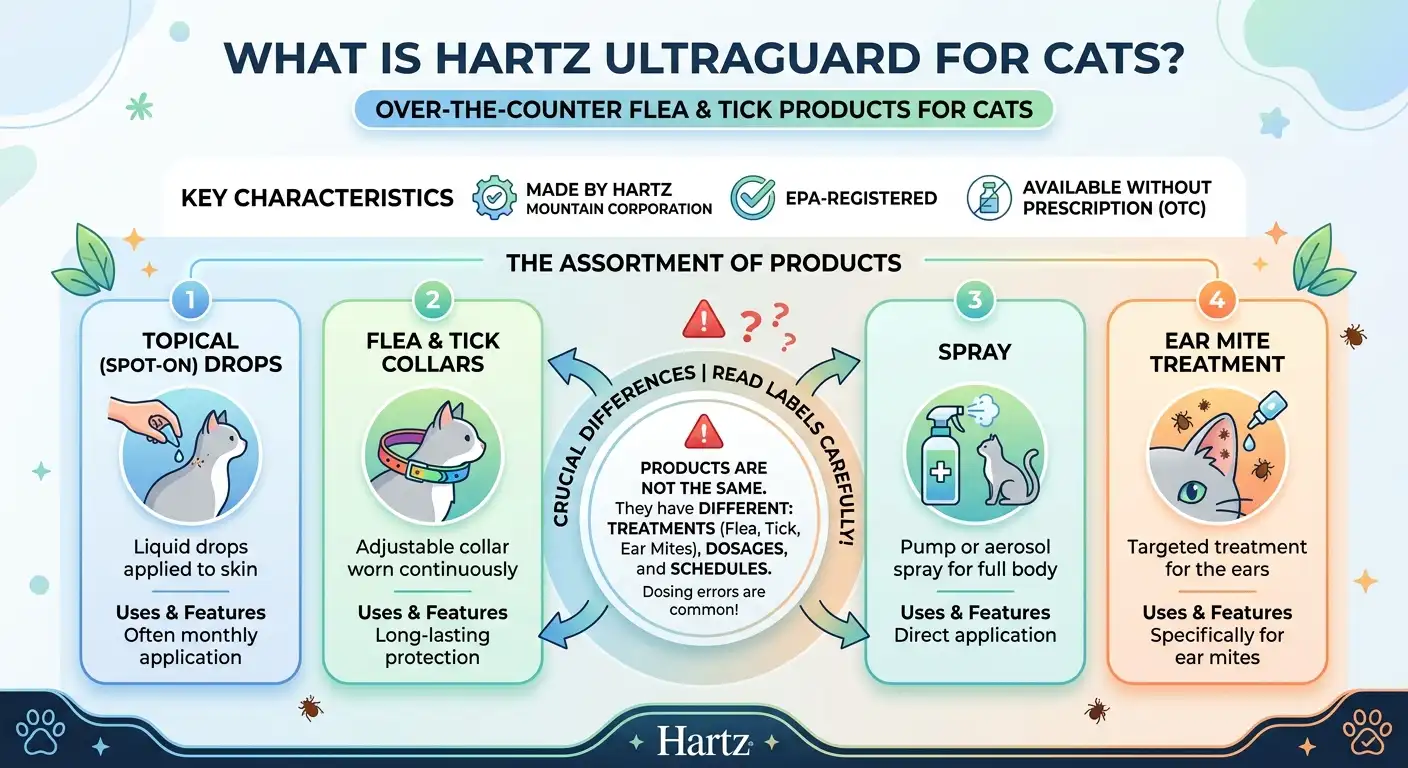
Hartz UltraGuard for cats is a line of over-the-counter, EPA-registered flea and tick products made by the Hartz Mountain Corporation. In the case of cats, the assortment consists of topical (spot-on) liquid drops, a spray, a flea and tick collar, and an ear mite treatment. These are not all the same product – they do not treat the same things, at the same doses, on the same schedules, and this is where most of the confusion (and dosing errors) lies.
The Three Cat Formulas: Topical, Plus, and Pro
All Hartz UltraGuard topical cat formulations are based on the active ingredient, etofenprox, a synthetic non-ester pyrethroid, which is a flea and tick target. Others are enhanced with methoprene, an insect growth regulator that prevents the growth of flea eggs and larvae. That makes you three different products:
| Product | Active Ingredients | What It Kills | Dose per Monthly Tube |
|---|---|---|---|
| Hartz UltraGuard Topical | Etofenprox only | Fleas, deer ticks; repels mosquitoes | 1.65 ml |
| Hartz UltraGuard Plus Topical | Etofenprox + methoprene | Fleas, deer ticks, flea eggs; repels mosquitoes | 1.65 ml |
| Hartz UltraGuard Pro Topical | Etofenprox (40%) + (S)-methoprene (3.6%) | Fleas, deer ticks, flea eggs and larvae; repels mosquitoes | 1.8 ml |
The 1.8 ml that the majority of individuals search is a part of the Pro formula. In case your box only has Hartz UltraGuard on it, but does not have Pro on it, then you should take 1.65 ml per tube instead – same schedule, same age, same weight restrictions, just a little smaller tube since the underlying formula does not have the additional larvicidal claim.
Hartz UltraGuard Dosage for Cats Chart
Topical & Plus Dosage
| Cat Requirement | Dose |
|---|---|
| Minimum age | 12 weeks |
| Minimum weight | 5 lbs (2.2 kg) |
| Dose per application | 1 full tube (1.65 ml) |
| Frequency | Once every month (30 days) |
| Maximum | 1 tube per cat, regardless of weight above 5 lbs |
Pro Dosage (1.8 ml)
Directions For Use
- It is against Federal Law to use this product in a way that is not in line with its labeling.
- READ LABEL COMPLETely before use.
- APPLICATION ON CATS or Kittens 12 weeks old and above.
- This product includes 3 doses (1.8 ml each) monthly. Use not more than once a month.
- Do not get this product in your cat’s eyes or mouth.
The entire dosing instructions are the label language – there is no column specifically for a 6-lb cat or a 14-lb cat. A box contains three tubes, enough to feed one cat in three months.
Why There’s No “By Weight” Tiering Like Dog Products
This confuses many, since the dog topicals made by Hartz do have four distinct weight bands (5-14 lbs, 15-30 lbs, 31-60 lbs and 61-150 lbs) and each band is provided with a different tube size. The cat versions do not do so. Rather, Hartz establishes a single lower weight cutoff of 5 lbs, and a fixed tube size above the cutoff. Each cat (5-lb and 14-lb) receives one tube. That is deliberate: cats are much more limited in the range of healthy weights than dogs, so one tube size is effectively the entire adult cat population, as long as the cat weighs more than 5-lb.
Key takeaway: Never use any Hartz UltraGuard topical product on a cat that is less than 5 lbs (typically, that is a kitten younger than 12 weeks old). There is no “half dose” or “kitten dose.” Instead, discuss with your veterinarian age-appropriate options.
How to Apply Hartz UltraGuard to a Cat (Step by Step)
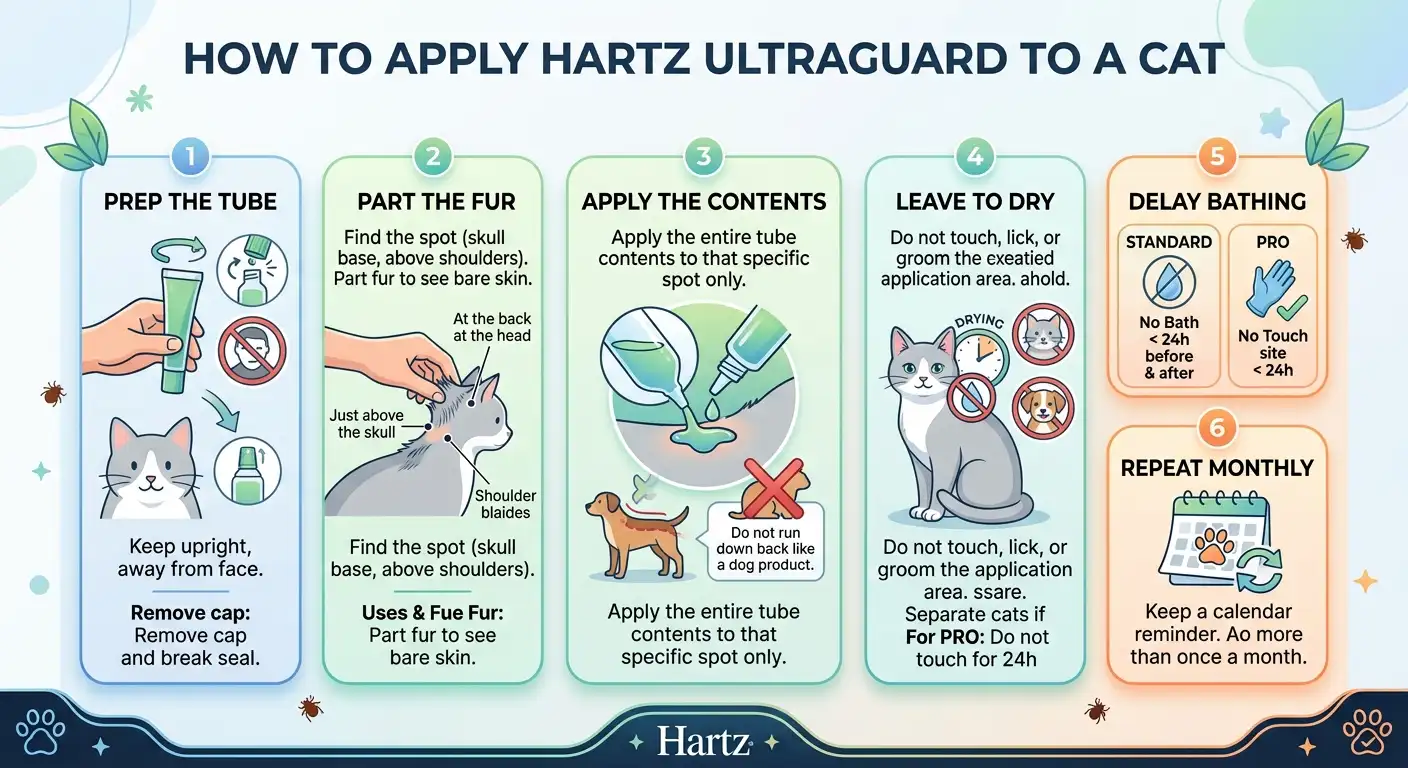
- Prep the tube. Keep the applicator straight, not towards your face. Take off the cap, and then apply it (or a twist-and-press action, depending on the model) to crack the seal of the tube.
- Part the fur. Lift the coat, very carefully, at the bottom of the skull, just above the shoulder-blades, and at the back of the head, until you can see bare flesh.
- Slap on the entire tube. Push all contents on the uncovered skin in that area – do not run it down the back like you would with a dog product.
- Leave it to dry, undisturbed. Be careful not to have the cat (or other pets in the house) touch, lick, or groom the area of application until it is completely dry.
- delay bathing. In the case of standard UltraGuard, it is important not to take a bath in 24 hours before and after application. In the case of Pro, it is recommended not to touch the site within 24 hours of application; the cat can be bathed at that time.
- Repeat monthly. Keep a reminder on your calendar – do not do it more than once a month.
This is the most important step in multi-cat homes: cats groom and one cat licking a wet substance off the neck of another cat is one of the most frequent ways pets get to ingest something they should not.
How Often Can You Apply Hartz UltraGuard?
Once a month–no more. The label is clear that you must not apply it more than once in the course of 30 days, and you must never use more than a single tube of applicator, regardless of the size of the cat and the extent of the infestation. The doubling will not make it work faster, it will only add more pesticide on the skin of your cat with no added advantage.
Missing a dose: just apply it immediately you remember and then just continue the 30 days countdown on that new date. Do not use an additional tube to make up.
Hartz UltraGuard Spray Dosage for Cats
The Plus Spray is another animal altogether– it is not a weight-based spray, but a stroke-based one:
| Cat Size | Spray Strokes |
|---|---|
| Small cat | 15–25 strokes |
| Large cat | 25–35 strokes |
| Longhaired cat (either size) | May need additional strokes to reach the skin |
Lightly spray until the ends of the coat are wet, not the eyes, rub into the fur all the way to the skin, allow to dry about 10 minutes and towel dry and comb. It is applied weekly, not monthly, and is approved on cats and kittens 12 weeks old and older with no minimum weight listed.
Hartz UltraGuard Ear Mite Treatment Dosage
It is a different animal, too, this product, as it does not treat fleas or ticks, it treats ear mites, and the dosage is by weight, and is given as drops per ear, not a complete tube:
| Body Weight | Dosage |
|---|---|
| 5–15 lbs | 4–5 drops/day/ear |
| 16–30 lbs | 5–10 drops/day/ear |
| 30 lbs and over | 10–15 drops/day/ear |
Use every day, 7-10 days, rubbing the bottom of the ear so that the drops penetrate the wax then repeat the entire process in two weeks, in case of mites. It’s also restricted to cats 12 weeks and older. When you have this product, be sure that you are not also confusing it with the flea/tick topical – they are in similar-looking tubes but they have very different functions.
Hartz UltraGuard Collar for Cats: How It’s Different
There is no dosed-in the-traditional-sense of collars, no liquid measure, just proper fit. Hartz UltraGuard cat collars contain tetrachlorvinphos (TCVP), an organophosphate insecticide, occasionally with methoprene, and are designed to be worn by cats and kittens over 12 weeks old.
The standard collar is effective at killing ticks in five months and two months later, or a total of about seven months of wear, and extreme cases may necessitate a more frequent change of collar. Since collars act not in monthly bursts, but continuously, they are not a truly distinct tool as compared to the topical drops, but not a more powerful or less powerful form of the same dosage.
Uses & Benefits
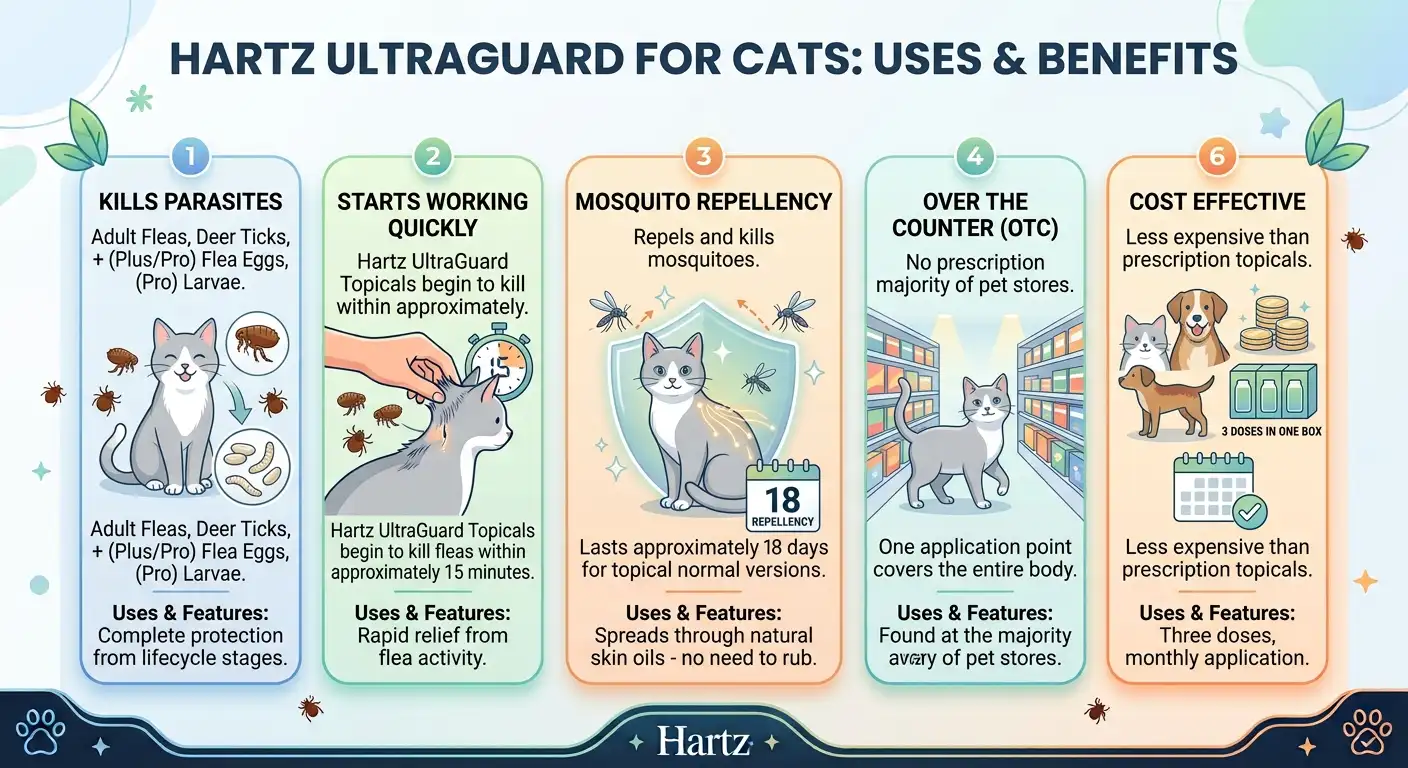
- Kills adult fleas and deer ticks ( Plus/Pro versions also kill flea eggs ( Pro also kills larvae).
- Starts working quickly – Hartz UltraGuard Topicals begin to kill fleas within approximately 15 minutes of application.
- Lasts about 18 days on topical normal on repelling and killing mosquitoes.
- No prescription required – can be found over the counter at the majority of pet stores.
- One application point covers the entire body – the product spreads through the natural oils of the skin instead of having to be rubbed across the entire body.
- Less expensive than prescription topicals, three doses in one box monthly.
Side Effects & Warning Signs
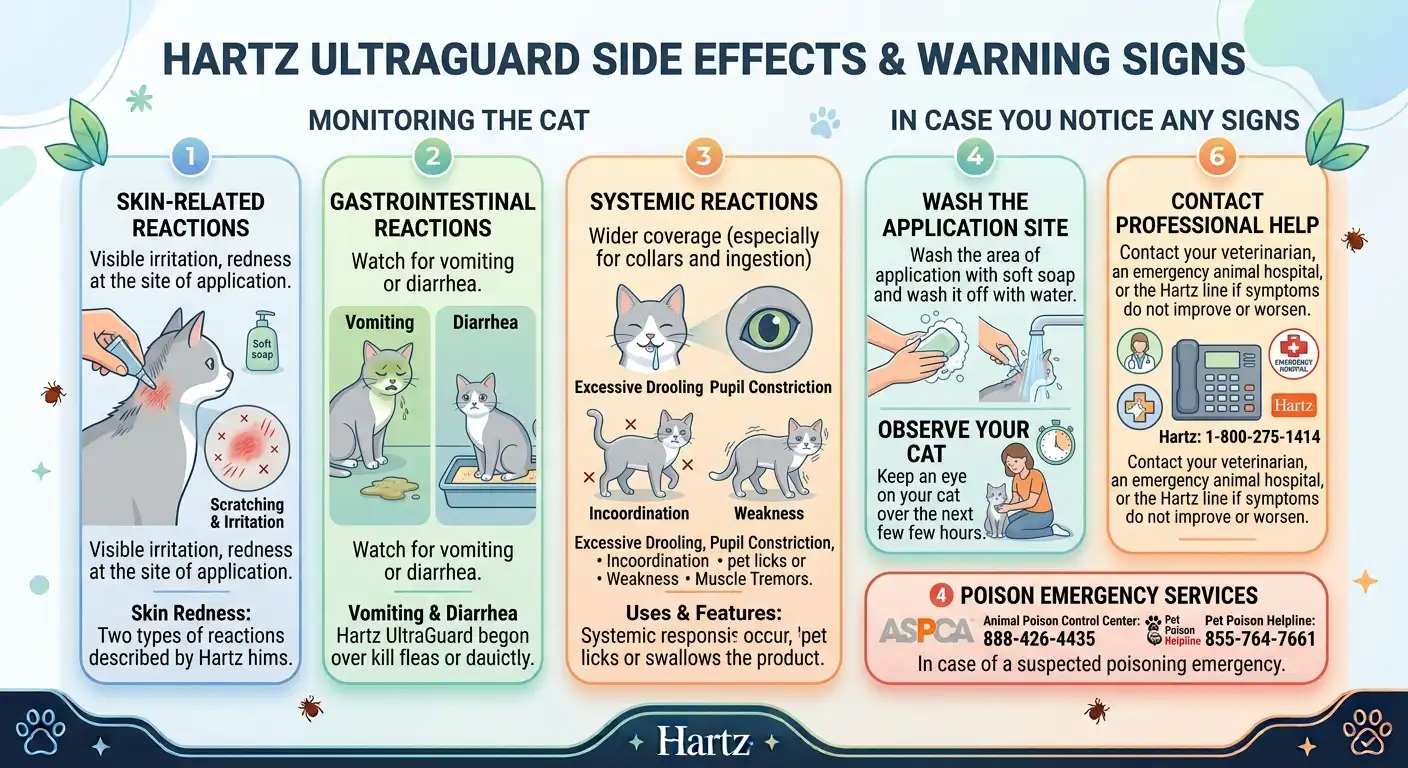
According to the classification of the two types of reactions, as described by Hartz himself, the two types of reactions to be monitored following application are skin-related and gastrointestinal:
- Scratching or other visible irritation of the skin at the site of application, redness.
- Vomiting or diarrhea
Wider coverage of the entire UltraGuard line, including the TCVP-based collars, also includes excessive drooling, pupil constriction, incoordination, weakness, and muscle tremors as potential responses, especially when a pet licks or swallows the product. In case you notice any of the following signs:
- Wash the area of application with soft soap and wash it off with water.
- Keep an eye on your cat over the next few hours.
- Contact your veterinarian, an emergency animal hospital or the product line at Hartz (1-800-275-1414) in case symptoms do not improve or appear to be worsening.
- In case of a suspected poisoning emergency, the ASPCA Animal Poison Control Center (888-426-4435) or the Pet Poison Helpline (855-764-7661) are also available.
Is Hartz UltraGuard Safe? What the Data Actually Shows
This is where most product pages fail to go, and it is what many searchers are really concerned about, so we should be straightforward with it.
The actual history: In 2005, the EPA urged Hartz to rebrand and recall some of its older cat flea products, the “Advanced Care” brand, rather than the present formula, UltraGuard Pro, after complaints of hair loss, drooling, tremors and deaths in cats.
Independently, around 2008-2010, the EPA recorded an industry-wide surge in adverse-event reports across all spot-on flea and tick products – not just Hartz – and attributed much of it to misapplication, such as pet owners applying dog-strength products (which contain permethrin, a pyrethroid that is harmful to cats even in small doses) to cats.
What has changed since: The etofenprox is used in the current Hartz UltraGuard cat topicals, replacing permethrin. According to Hartz, etofenprox has the lowest oral toxicity rating, Class IV, and that products must exhibit a safety margin even at five times the recommended dose before the EPA will approve them.
Hartz has also referred to EPA adverse-event data that indicates that the share of reported reactions of UltraGuard has been disproportionately low with respect to the extent of the product is being sold in retail.
What actual users continue to report: There are still some individual complaints that do emerge, such as those mentioned on the Q&A sites by veterinarians regarding drooling, twitching or skin reactions after application, particularly when the cat has licked the product before it has dried. This agrees with what is on the label: the product is bitter-flavored on purpose (to deter licking), and oral exposure may lead to salivation even in the absence of a medical hazard.
The clinically significant implication: As indicated on the label – right weight/age cutoff, single tube, monthly, applied in an area where the cat cannot reach it, not used with other pets until dry – the safety profile of Hartz UltraGuard is comparable to other retail spot-on products. The majority of flea-drop complaints, regardless of the brand, are related to one of three factors: application of dog product to a cat, application of more than the recommended dose, or cat licking an un-dried area of application.
What to Do If You Overdosed or Misapplied It
- Used more than a tube: Cleanse the location with a light dish soap and water, observe drooling, shakiness, vomiting, or lethargy, and contact your veterinarian or the numbers above in case of any of the above.
- Cat licked the place: Do as you can reach, keep a close watch, call when you need instructions instead of waiting to see whether it will clear.
- Applied a dog product to a cat: Consider this an emergency and call a veterinarian or a poison control line immediately: most dog flea products contain permethrin, which is lethal to cats.
- On a kitten younger than 12 weeks or a cat younger than 5 lbs: Wipe off any remaining product on the skin and call your veterinarian to consult, even though the kitten may appear okay.
Common Mistakes to Avoid
- Applying any Hartz product to a cat (or the other way around) with the dog version.
- It is not possible to reapply less than 30 days since you still see fleas.
- Putting the wet or freshly bathed fur as compared to the dry skin.
- Allowing cats to groom immediately after application.
- Suppose a larger cat requires two tubes – it does not.
- Missing home and yard treatment – a topical will only treat the cat, not the already existing eggs and larvae in your carpet or furniture.
Hartz UltraGuard vs. Vet-Prescribed Options
| Hartz UltraGuard | Vet-Prescribed (e.g., Frontline, Revolution) | |
|---|---|---|
| Prescription needed | No | Sometimes |
| Typical active ingredient | Etofenprox (+ methoprene) | Fipronil, selamectin, or similar |
| Price point | Lower | Higher |
| Available over the counter | Yes | Varies by product |
| Heartworm coverage | No | Some products, yes |
| Best for | Budget-conscious owners with straightforward flea/tick needs | Cats with heartworm risk, sensitivities, or multi-parasite needs |
There is no universal better choice between them, it all depends on the health history of your cat, other medicines and the type of parasites you are dealing with. In case your cat is already taking any other drug, old age, pregnant, nursing or has a history of skin sensitivity, consult your vet before either of them.
You May Also Like to Read:
- NexGard COMBO Dosage For Cats: Calculator, Chart & Safe Guide
- Anxitane Dosage For Cats: Calculator, Chart & Safe Guide
FAQs
How much Hartz UltraGuard do I give my cat?
One full applicator tube, applied once a month. Standard UltraGuard and UltraGuard Plus have a tube size of 1.65 ml, or UltraGuard Pro has a tube size of 1.8 ml – dose is not weight-adjusted above 5-lb minimum.
Is Hartz UltraGuard dosage based on cat weight?
Just because your cat has to weigh 5 lbs before you can administer the topical drops at all. There are no more than one tube of the same per eligible cat above that line.
Is it possible to apply Hartz UltraGuard to a kitten?
The kitten must be at least 12 weeks old and weigh 5 lbs. This product should not be given to younger or smaller kittens; consult your vet on an age-specific product.
What is the time lag of Hartz UltraGuard?
Hartz UltraGuard topicals start to kill fleas in approximately 15 minutes of application and last the entire 30 days.
Is it possible to bathe my cat using Hartz UltraGuard?
Wait at least 24 hours after applying standard UltraGuard or UltraGuard Plus before bathing. In the case of UltraGuard Pro, it is not recommended to touch the site within 24 hours; bathing is usually acceptable after 24 hours.
Is the same thing as Hartz UltraGuard Pro?
No. They both contain etofenprox, but Pro contains a greater concentration of (S)-methoprene, kills both eggs and larvae, and is available in a small 1.8 ml tube compared to the standard version, which has a 1.65 ml tube.
Do I need to treat my cat if I don’t see fleas anymore?
Yes – monthly treatment throughout the flea season (or all year round, as advised by your veterinarian) will keep any eggs and larvae already in your house unable to cause another infestation.
Is it possible to apply Hartz UltraGuard cat drops to my dog?
No. Cat and dog formulas are not dosed and formulated the same way. Do not cross apply flea and tick products across species.
What is the number of doses per box of Hartz UltraGuard?
Three applicator tubes a month – a three month supply of one cat.
Will Hartz UltraGuard also treat ear mites?
No, ear mites are not treated by flea/tick topical. Hartz also has a different Ear Mite Treatment product, which is administered in drops per ear, depending on the weight of the cat.
Can pregnant or nursing cats take Hartz UltraGuard?
Do not apply any Hartz UltraGuard product to a pregnant, nursing, aged or debilitated cat without consulting a veterinarian.
What about other medication of my cat?
Consult your vet prior to taking any medication, some may react with the pesticide-based flea and tick treatment.
Final Thoughts
The Hartz UltraGuard for cats dosing question is actually two numbers: does your cat weigh at least 5 pounds and is 12 weeks old? Yes, a single tube – 1.65 ml standard/Plus, 1.8 ml Pro – rubbed on the dry skin at the back of the neck, once a month, is the right and full dose. It will not require any weight-based calculations after that initial checkpoint, and this makes it easier than most people expect once the product lineup is unraveled.
It is not the dose that is at risk: either underdosing or overdosing by dose, but rather misuse: applying the product of the wrong species, applying it too frequently, or allowing a cat to lick a wet area of application. As the label says, observe your cat during the first few hours of each application, and have the number of your vet on hand, and Hartz UltraGuard works as it should.