Capguard Dosage For Cats: Calculator, Chart & Safe Guide
The quick answer is that Capguard for cats is available in a single strength (11.4 mg tablet). All cats in the 2-25 lb range receive one full tablet, no matter which weight falls within that range. It can be repeated once every 24 hours if fleas come back, but should never be given more than once a day.
That’s the number most people searching for this are looking for. The complete weight chart, math, safety info for kittens and pregnant cats, side effects to look for, and answers to the most common questions cat owners have, are all below.
What Is Capguard?
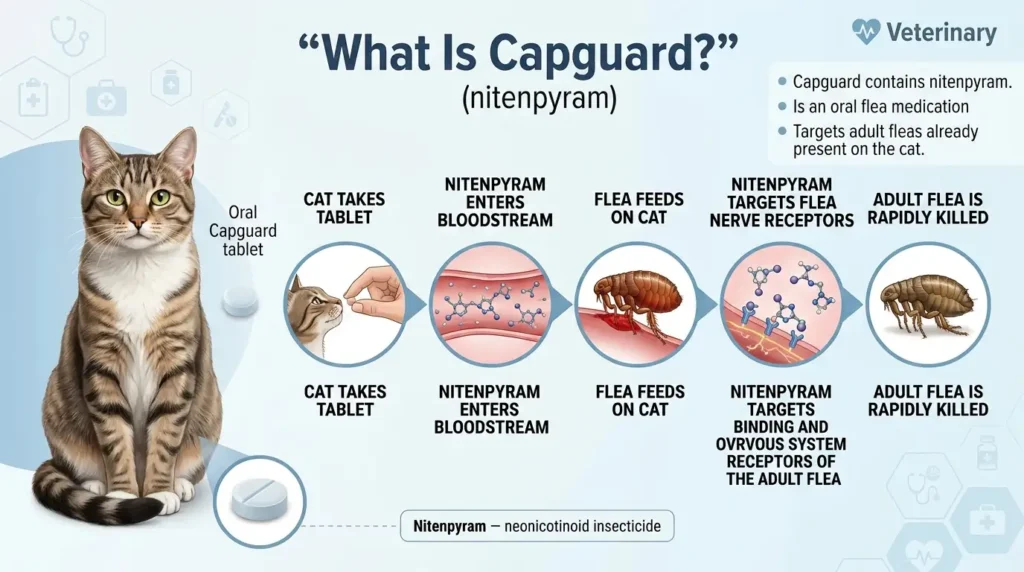
Capguard is the brand name for nitenpyram medication, an oral flea medicine that eliminates the adult fleas that are present on your cat. Same active ingredient as Capstar (Elanco’s version) and PetArmor FastCaps — just different names, same drug, same purpose.
Nitenpyram is in a chemical group known as neonicotinoids. After swallowed, the medication goes through the bloodstream. A flea ingests the nitenpyram when it feeds on your cat’s blood. The drug attacks a particular type of nerve receptor in the flea’s nervous system, paralyzing and killing the flea.
It’s sold over the counter, no prescription needed, as a small, easy-to-swallow tablet.
Capguard vs. Capstar — Are They the Same?
Functionally, yes. Capguard and Capstar both contain nitenpyram at 11.4 mg, follow the same dosing instructions for cats and small dogs and are at least 1 mg per kg of body weight. Capguard is a brand made by Sentry (a Perrigo Pet brand) which is typically less expensive and purchased over-the-counter at farm and feed stores and pet retailers.
The more popular Capstar is Elanco’s brand and is generally available in vet offices. If your vet says “use Capstar” but only have Capguard on hand (or vice versa) you’re using the same product at the same dose, so there’s no need to purchase a different product.
Capguard Dosage for Cats by Weight
Capguard tablets for cats are available in one strength – 11.4 mg nitenpyram. Capguard For cats is a fixed dose product – you administer one whole tablet – not part of one – as long as your cat is within the weight range stated on the label.
Capguard Dosage Chart
| Cat’s Weight | Capguard Dose |
| 2 lb – 25 lb (0.9 kg – 11.3 kg) | 1 tablet (11.4 mg) |
| Under 2 lb | Not labeled for this weight — talk to your vet |
| Over 25 lb | This tablet strength isn’t sufficient — a larger-dog formulation is needed |
| Under 4 weeks old (any weight) | Do not use |
How the Dose Is Calculated
The label’s minimum effective dose rate is 1 mg of nitenpyram per kilogram of body weight. That’s how it works at the extremes of the weight spectrum:
- A cat at the upper end of the range (25 lb ≈ 11.3 kg) requires a dose of approximately 11.3 mg, which is almost exactly provided by the 11.4 mg tablet.
- The house cat at the bottom of the range (2 lb or 0.9kg) technically requires only 0.9mg, but is still getting the full 11.4mg tablet. That would be about 12 times the minimum dose, but that is on purpose, because nitenpyram is a very safe material – manufacturer safety trials have been conducted at a rate of 10 times the label rate for weeks and no adverse effects have been seen. A small cat does not receive the same dose of the drug as a 25-pound cat and is not being “overdosed”.
For cats in the label’s “within the range” section, no cutting, splitting or dissolving and measuring out a portion is necessary — it’s just “one tablet” and that’s it.
How to Give Your Cat Capguard
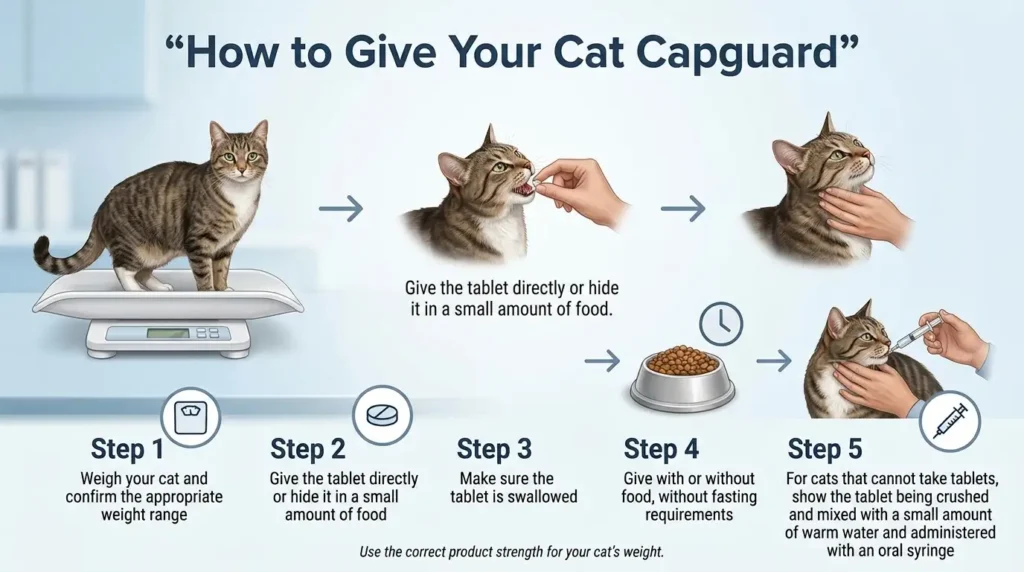
- First weigh your cat. Check that they are in the 2 to 25lb range before dosing.
- To give directly, or hide in a small quantity of food.
- Watch to make sure it’s swallowed. In case you aren’t certain your cat truly took the entire tablet, it is safe to give it once again.
- No fasting/timing rules – it can be given with or without food and at any time of day.
- Cats that refuse tablets can have the tablet crushed and dissolved in a small amount of warm water and then administered with an oral syringe. Usually 1 mL of water in a small syringe will dissolve the tablet without being too diluted to give effectively.
How long does it take Capguard to work?
Capguard dosage for cats is effective in killing fleas in approximately 20 to 30 minutes. Most sources attribute it to having more than a 90% success rate in killing adult fleas on a cat within 6 hours, and virtually all within 24 hours of a single application.
Its effect doesn’t last, though. Nitenpyram is excreted from a cat’s body in approximately 48 hours and its effect on killing fleas is minimal after about 24 hours. That is the compromise for the speed of action – fast knock down, short duration.
What Capguard Does and Doesn’t Treat?
This is the one thing that is most misunderstood about this medicine, so let us just be plain:
- Capguard is effective against adult fleas. That’s it.
- It is ineffective against flea eggs, larvae and pupae which comprise the majority of the flea population at any one time.
- Does not deter or keep fleas from jumping on.
- It has no residual protection. After it falls off (usually after 24 hours), your cat will be unable to protect itself from fleas.
For this reason, Capguard cat dosage is not a flea control program, but rather a fast “reset button. If your cat is currently infested, then killing all the visible adult fleas today is of no help since the eggs already on your carpet or bed will hatch over the next two to three weeks. That’s why the product label itself advises it to be used with a longer acting monthly preventative.
Benefits of Capguard for Cats
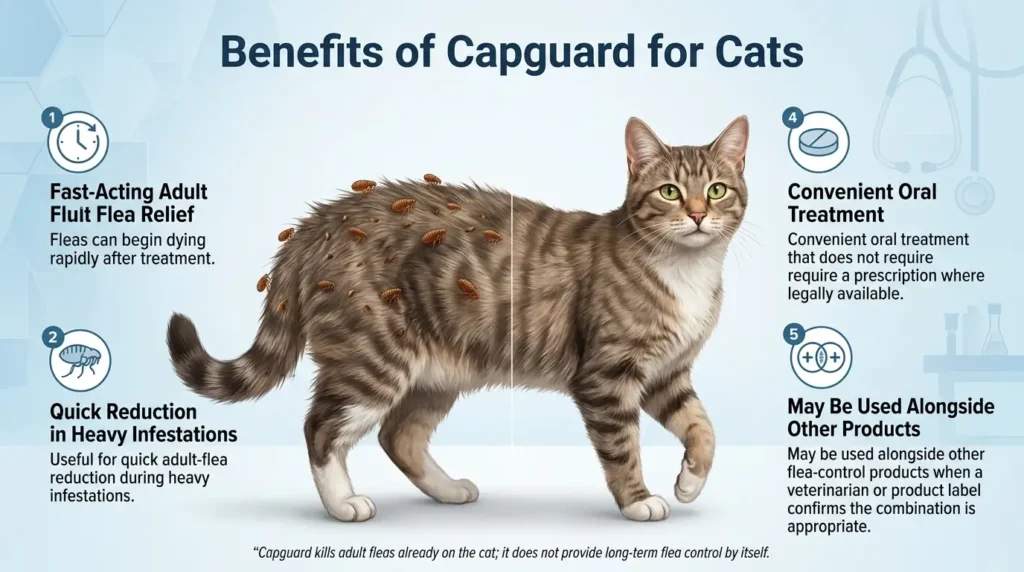
- Fast relief. A flea ridden, itching, biting cat finds relief — and quick relief at that — sometimes within an hour.
- Can be helpful for an initial “quick kill” prior to another treatment. Vets often use it immediately prior to bathing a cat that is very infested – this removes live adult fleas first to increase the effectiveness of the bath and make the cat less stressed.
- Very wide safety margin. It is reportedly thousands of times more selective for insect nerve receptors than mammalian receptors, so it is safe for young kittens and pregnant and nursing cats.
- It doesn’t need a prescription and is cheap in comparison to many flea treatments.
- Can be used in conjunction with other flea products. It can often be used in conjunction with other treatments, such as those applied topically, such as a fipronil-based product or given monthly orally.
Side Effects of Capguard in Cats
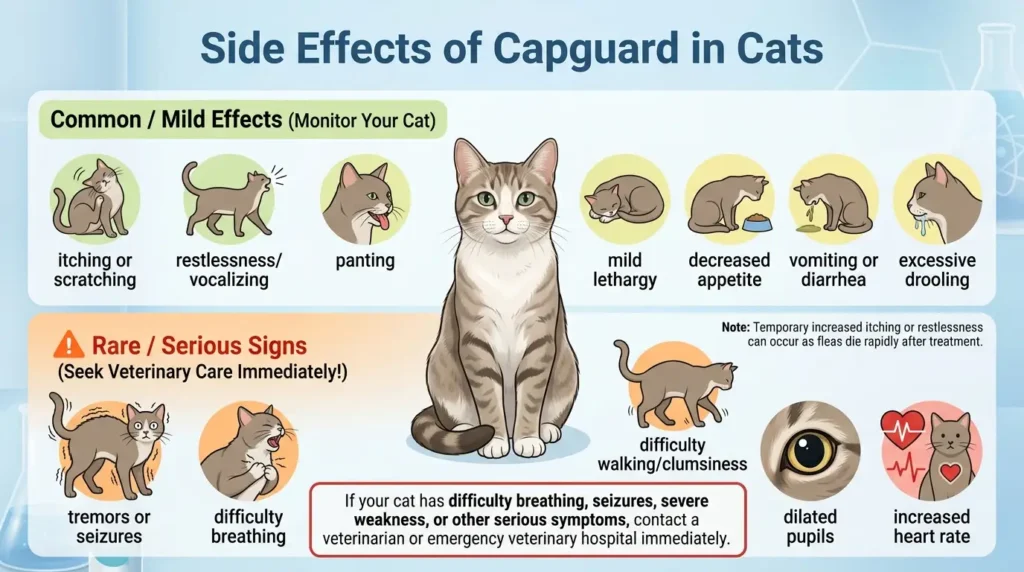
While Nitenpyram is likely one of the safer flea products available, no product is completely without risk and cat owners deserve to be told the whole story, and not just the good news.
Common, mild side effects
These are not caused by the drug itself, but are usually associated with a die-off reaction, that is, the fleas will quickly die on the cat’s skin and usually get better within 24 hours without treatment:
- Itching or scratching (which may be confused with the drug “not working”)
- Restlessness, hyperactivity or vocalizing
- Panting
- Mild lethargy
- Decreased appetite
- Vomit or diarrhea
- Excessive drooling
Rare but serious side effects
More severe reactions have been reported, but less frequently; more often reported with doses much higher than label, or in very small, thin cats or very young or very old cats:
- Tremors or seizures
- Difficulty breathing
- Clumsiness or difficulty with walking.
- Pupils are dilated, heart rate is elevated
If your cat exhibits any of these critical symptoms, call your vet or a veterinary emergency hospital immediately.
Notably, manufacturer safety tests administered 10 times the recommended dose of this medication to cats for 30 days and did not report any negative effects. While serious reaction is rare, “rare” is not “zero” and it is prudent to watch a cat for the first few hours after giving the dose, particularly the first time.
Is Capguard Safe for Kittens?
Capguard is indicated for use in kittens 4 weeks of age and older that weigh 2 lbs. or more. On no account give to kittens less than 4 weeks of age.
Even in the approved age range, there should be extra care for kittens between 4 and 8 weeks old because they are at increased risk for having a more severe reaction—due to being underweight or being in a fragile state. Although it is labeled as safe for a very young or small kitten, it is best to make a quick phone call to your veterinarian first if you are treating a tiny kitten.
Is Capguard Safe for Pregnant or Nursing Cats?
Nitenpyram for cats is usually one of the safer treatments to use during pregnancy and lactation, and is frequently used by shelters and rescues for this very reason — because it is not long lasting in the body and shows up in about 2 days.
However, there are a few reports of problems in breeding animals in the general safety literature and it would be prudent to consult a veterinarian before taking the final decision on your own when using this product on a pregnant or nursing queen, especially on a feral or community cat where you are not able to carefully observe the animal after use.
Capguard Drug Interactions
Capguard for cats medication is not likely to interact with other drugs. It can be used concurrently with dewormer, antibiotic, corticosteroid, vaccine and flea/tick shampoos without any known issues, and is often used with a monthly topical or oral flea preventative as part of a comprehensive flea-control program.
As with all medicines, be sure to let your vet know if your cat is taking any other medication (including over the counter and supplements) before starting any new medication.
What Happens If You Miss a Dose or Give Too Much?
Missed dose: Missed dose is not really applicable to Capguard since it is used as needed. If you’re applying it on a regular basis because the flea problem is ongoing, simply apply the next dose once fleas are seen again, rather than doubling up to make up for it.
Overdose: The risk of overdose is considered low thanks to nitenpyram’s wide safety margin. If your cat is able to ingest more than one dose in a 24 hour period or if you are concerned about ingestion of multiple tablets, please consult your veterinarian or an emergency veterinary facility. Be aware of the potentially serious side effects mentioned above (tremors, seizures, difficulty breathing) and not to assume that taking an additional pill is always a bad thing — but always have a professional listen.
Capguard vs. Other Flea Treatments — Where It Fits
| Capguard (nitenpyram) | Monthly topical (e.g., fipronil-based) | Monthly oral preventative | |
| Speed | Kills adult fleas in ~30 min–6 hrs | Takes 24–48 hrs for full effect | Varies, generally slower onset |
| Duration | ~24 hours | ~30 days | ~30 days |
| Kills eggs/larvae? | No | Some products, check label | Some products, check label |
| Prescription needed? | No | Varies by product | Usually yes |
| Best used for | Fast knockdown of visible adult fleas | Ongoing monthly prevention | Ongoing monthly prevention |
The bottom line: Capguard is not a monthly preventative — it’s an add-on to monthly preventatives. Many vets recommend using Capguard for the immediate problem and starting (or continuing) a monthly product for lasting protection.
Common Mistakes to Avoid
- Only treating one cat in a multi-cat household. Fleas will merely transfer to animals that have not been treated and the infestation will continue.
- One shot for a cure of an infestation. Fleas will continue to reappear if the eggs and larvae are not treated in the home (vacuuming, washing bedding, treating carpets).
- Applying the large dog tablet dosage to a cat. Always check the cough syrup contains the 11.4 mg tablet, and not the 57 mg tablet designed for use on dogs that weigh more than 25 lbs.
- If itching occurs after taking the dose, the drug is ineffective. When the drug is working, the flea die-off reaction is an increase in scratching in the first hour.
- Not calling the vet because the product is available over the counter (for very young, very small, or pregnant cats).
You May Also Like to Read:
- Fipronil Dosage For Cats: Calculator, Chart & Safe Guide
- Griseofulvin Dosage For Cats: Calculator, Chart & Safe Guide
FAQs
What does Capguard do for cat?
Capguard treats are applied to kill adult fleas which are already on the cat. Does not inhibit re-infestation and does not control flea eggs and larvae.
What amount of Capguard will I give my cat if he weighs 10 pounds?
One 11.4 mg tablet. The dose is the same across a range of 2-25 lb: one whole tablet.
May I administer Capguard to my cat daily?
Yes, if needed. The label states that it can be redosed up to every 24 hours, but no more often.
Is Capguard similar to Capstar?
Yes, they are both nitenpyram (the strength is 11.4 mg for cats) from two different companies: Sentry from Capguard and Elanco from Capstar. These can be taken at the same dosage.
What’s Capguard’s speed of action?
Most of the adult fleas die within 6 hours and all die within 20 to 30 minutes.
May I crush Capguard and add it to food?
Yes, as long as your cat consumes the entire dose. For those cats that refuse to take pills, crushing and dissolving in a small quantity of water for syringe feeding is an accepted technique.
Can I use Capguard on kittens?
Yes, for kittens 4 weeks of age or older that weigh at least 2 pounds. It’s not labeled for kittens younger than 4 weeks.
Does Capguard kill fleas on contact or does my cat have to bite the flea for the treatment to work?
The flea must bite and ingest the blood to obtain the drug – Capguard is not a contact killing/ repellant so it must be ingested with a blood meal.
Now what about if my cat weighs less than 2 pounds?
Capguard is not labeled for cats less than 2 lbs. Discuss with your vet an alternative that’s suitable for you.
If my cat is over 25lbs what?
The 11.4 mg cat/small-dog tablet isn’t sufficient. A different, higher strength tablet for larger animals would be required – consult your veterinarian or the label.
May Capguard be used on pregnant cats or lactating cats?
It is generally regarded as one of the safer choices for pregnant and nursing cats but consult with a vet, particularly if you will not be able to monitor the cat closely afterwards.
Is Capguard a monthly flea preventative?
No. Only effective for approximately 24 hours, and does not affect flea eggs or larvae. Best used in combination with a longer acting monthly product.
What are the most common side effects?
Mild itching, restlessness, panting and sometimes vomiting or loss of appetite (most of this related to the fleas dying off and not the drug itself and will usually resolve within a day).
When to call the vet after administering Capguard?
If your cat is trembling, experiencing seizures, trouble walking or breathing, get them to your veterinarian or emergency animal hospital right away.
May Capguard be used in conjunction with other flea products?
Yes, it’s commonly used together with topical or oral monthly preventatives, and has been used safely alongside dewormers, antibiotics, and vaccines.
Final Thoughts
But if you translate the “jargon”, Capguard’s dosing is refreshingly simple: it’s one 11.4 mg tablet when your cat weighs from 2 to 25 pounds, whether he’s a 3-pound kitten or a 24-pound tabby. It’s not about the numbers, it’s about what the medicine can and can’t do. It is not a long-term solution for flea control, but is a quick and tolerated method to treat fleas the adult cat possesses today.
If it is used properly (according to weight and age of the cat, combined with a longer-lasting product, and administered to all cats in the home) it does exactly what it does, and does it well. A quick telephone call to your veterinarian will always be the safer route of action if in doubt about any particular cat’s situation, such as a very young kitten, a pregnant queen, or a cat taking other medicines.
The information provided in this article should be used for informational purposes only and should not be a replacement for professional veterinary advice. Check with your veterinarian before beginning, stopping or changing your cat’s medications.