Fipronil Dosage For Cats: Calculator, Chart & Safe Guide
Getting a fipronil dose wrong is easier than most cat owners expect. The spray label alone makes it difficult to make the conversion from milliliters/ lb to the number of pump applications, and then you have to consider your cat’s weight, length of coat and that the spot-on pipettes are only one size for cats. This guide clearly explains the dosing process, provides a calculator to quickly calculate the dosage, and offers safety information that all cat owners need to know before using ANY flea or tick product.
These information is for reference purposes only and should not be substituted for the instructions provided by your veterinarian and the product label. Before treating your cat always check the dose with your vet.
Fipronil Dosage Calculator for Cats
For cats only. Enter your cat’s weight and product details below.
Recommended Dosage
- Dose per administration
- —
- Frequency
- —
- Total dose per administration
- —
- Strength / formulation
- —
© medscat.com
Quick Answer: How Much Fipronil Does My Cat Need?
- Topical (spot-on) solution: One 0.5 ml pipette, applied once a month, regardless of your cat’s exact weight.
- Topical spray: 1.5 to 3 ml of spray/lb of Body Weight once per month. The bottom end of this range is for short hair and normal hair coats and the top end is for long hair coats.
Every fipronil Dosage For Cats is based on those two facts. That’s what this guide will help you understand and how you can convert the spray dose into an actual number of pumps.
What Is Fipronil For Cats?
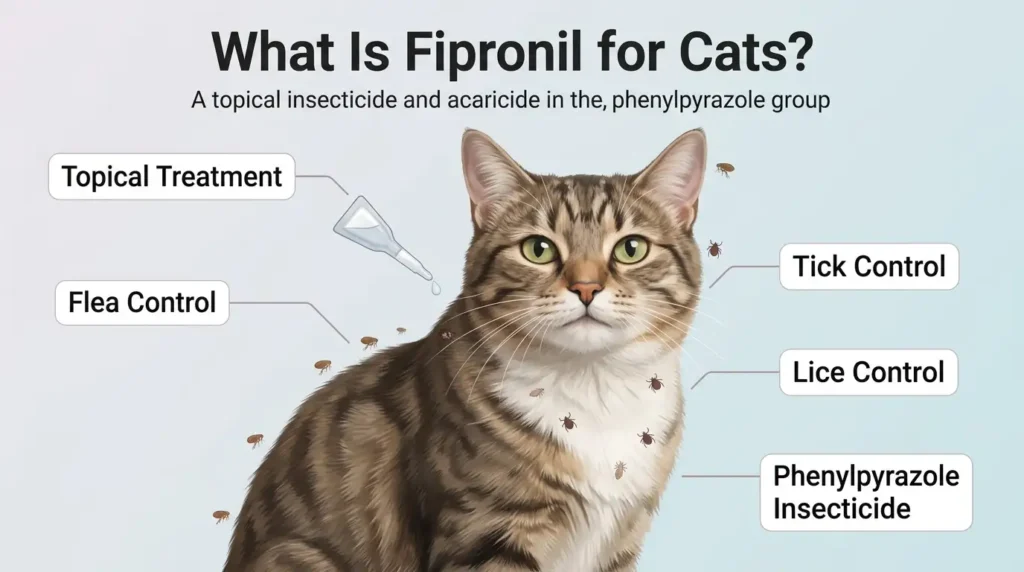
Fipronil medication is an insecticide and an acaricide of the phenylpyrazole group for use as a topical flea, tick and lice treatment for dogs and cats. The fipronil products come under numerous names, such as Frontline for cats and a host of generics.
How Fipronil Works
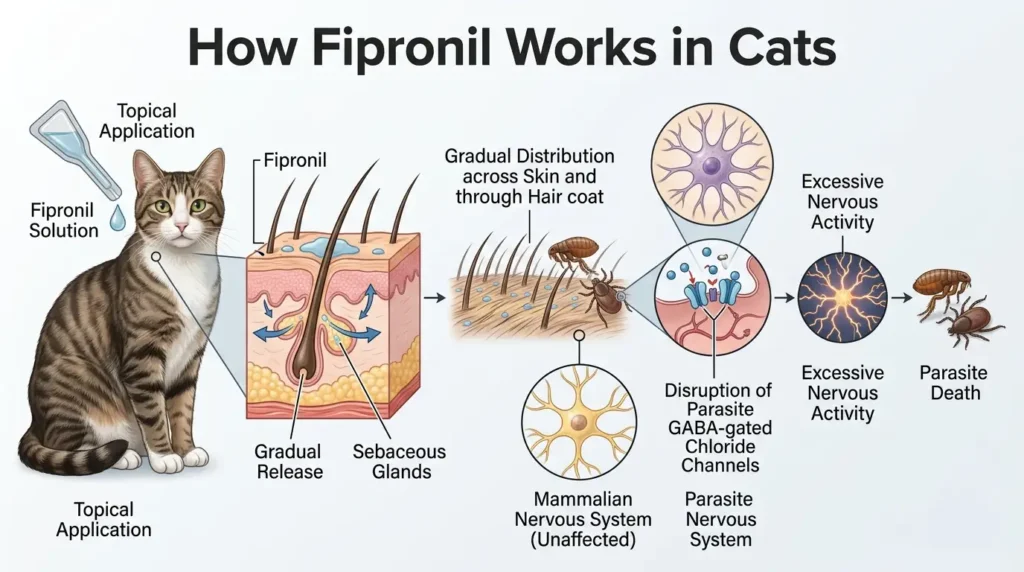
Fipronil interferes with the normal functioning of the GABA-gated chloride receptor in the insect nervous system and causes excessive nerve activity, which ultimately results in the death of insects and parasites that come into contact with it. This is because it is selective for the nervous system of insects and other invertebrates and not mammals, leading to a wide safety margin for cats and dogs when applied as directed.
Once applied, fipronil dose for cats will not be absorbed into your cat’s bloodstream in significant quantities. Instead, it sits on the surface of the skin and seeps into the sebaceous (oil) glands from where it is slowly released over the course of several weeks to continually coat the hair and skin. The “once-monthly” thing is that it’s not that the drug would “wear off” at day 30, but that the reservoir in the oil glands in the skin is designed to last for about 30 days.
Fipronil vs. Fipronil + S-Methoprene
Many cat products containing fipronil medication will contain another active ingredient, S-methoprene, an insect growth regulator that inhibits the development of adult fleas from eggs and larvae. Fipronil is a contact insecticide that kills adult fleas and ticks, and S-methoprene disrupts the flea life cycle, helping to stop new infestations from forming around your house as the result of eggs shed by your cat.
When the label of your product gives you two active ingredients, then it is likely the combination you are considering – the fipronil part of the dose is the part this article covers.
Fipronil Dosage Chart for Cats By Weight
Fipronil Dosage for cats is sold in two formulations, and each one is dosed differently.
Topical Solution (Spot-On) Dosage for Cats
| Product form | Pipette size | Frequency | Notes |
| 9.7% topical solution | 0.5 ml (one size for all cats) | Once every 30 days | Unlike dog pipettes, which come in four weight-based sizes, the cat pipette is a single fixed size |
Cat spot-on pipettes are not weight-tiered like cat pipettes. The number of pipettes to use depends on which of four sizes corresponds to the dog’s weight; for a cat, it is a 0.5 ml pipette, used once a month, regardless of cat weight (6 lbs. or 14 lbs.). That’s an eye-opener to many owners who think that cat dosing is akin to dog dosing — it isn’t.
Topical Spray Dosage for Cats
| Variable | Value |
| Dose range | 1.5–3 ml of spray per pound of body weight |
| Lower end of range | Short- or normal-coated cats |
| Higher end of range | Long-haired cats (need more product to coat the skin under a thick coat) |
| Frequency | Once every 30 days |
Spray-to-Pump Conversion Table
Spray bottles are marked in “pumps” and most dosing errors occur in milliliters. The two most popular bottle sizes are converted as follows:
| Bottle size | Volume per pump | Pumps per pound (short/normal coat) | Pumps per pound (long-haired) |
| 100 ml bottle | 0.5 ml per pump | 3 pumps/lb | 6 pumps/lb |
| 250 ml bottle | 1.5 ml per pump | 1 pump/lb | 2 pumps/lb |
Worked example: A 10 lb, short-haired cat using the 250 ml bottle needs roughly 1.5–3 ml/lb × 10 lb = 15–30 ml total, or about 10–20 pumps depending on where in the range you land. Using the lower end (short coat) puts that cat closer to 10 pumps; a long-haired 10 lb cat would need closer to 20 pumps.
How to Apply Fipronil to a Cat, Step by Step
- Part the fur at the back of the neck, between the shoulder blades, where your cat can’t lick it.
- For spot-on: Press the applicator tip against the skin (not just the fur) and squeeze out the entire pipette in one spot, or in a couple spots on the back if the label indicates this.
- For Spray: Ruffle coat with one hand and spray with other to get to the skin, not just coat surface. Do not spray directly on the face — spray on a gloved hand first and then apply to fur around head, away from eyes and mouth.
- Do not let your cat lick, groom, or come in contact with other pets until it has dried and separate cats until it is completely dry.
- Avoid bathing your cat for the first 48 hours before or after applying and avoid direct sun and moist environments for the first 24 hours.
- Wash your hands with soap and water after using, and do not allow it to come into contact with your skin, eyes or clothing.
How Often Should You Apply Fipronil to a Cat?
Once a month, for both the spot-on and the spray. Doing more than the recommended application will not increase the efficacy because the reservoir in the sebaceous glands is already full after correct application, but will lead to skin irritation and other side effects.
What if You Miss a Dose?
If a dose is missed, it is administered as soon as it is recalled and the monthly clock is restarted from that day. For instance, if the cat should be applied on the 1st of the month, then not on the 18th, the cat’s next time is on the 18th of the next month.
Never to “catch up” with two doses at once. If you don’t know when the last dose was, ask your vet before giving another dose.
Fipronil Side Effects in Cats
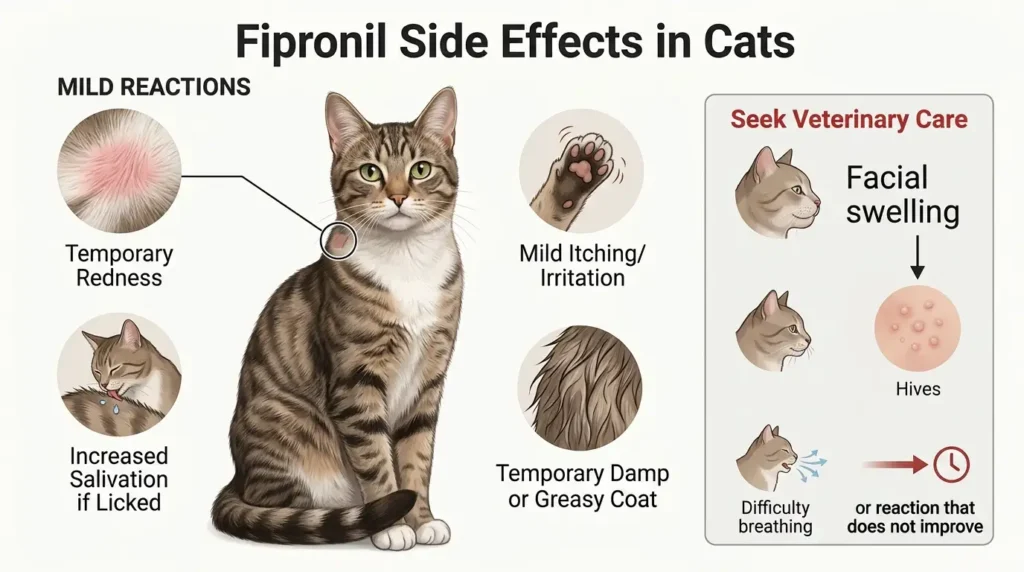
Reported side effects are uncommon and generally mild:
- Transient redness, itching or irritation of the application site.
- A very uncommon true allergic skin reaction.
- If your cat licks the area before it dries, you’ll notice an increase in salivation or a foaming at the mouth.
- It is normal to see a damp, greasy or slightly clumped look to the coat at the application site for up to 24 hours.
If you notice any swelling on the face, trouble breathing, hives or that the reaction doesn’t appear to be subsiding, reach out to your veterinarian right away.
Is Fipronil Safe for Cats? Risk Factors & Precautions
When used properly (strictly according to the instructions) and with the right cat product (the correct label), fipronil products are generally deemed safe for cats. But, the label precautions can differ with each product and brand, so always check your label for your specific product, the following are general precautions that apply to all fipronil products:
- As a general rule, not for kittens younger than 8 weeks (some products have a cut-off at 12 weeks, check the label for specific products).
- Use with caution in elderly, frail, sick, pregnant or nursing cats — consult your veterinarian for your cat’s complete medical history before beginning use.
- Never use a dog-only fipronil product on a cat. The concentrations and pipette sizes vary, and the “dog spot-on” products may also contain other ingredients that are toxic to cats (see the permethrin section below).
- Avoid applying to broken, irritated or recently shaved skin.
- Rabbits may be highly sensitive to fipronil, which is not labeled for use on them.
Fipronil Overdose in Cats: Signs & What to Do
If the topical dose is properly measured, a toxic overdose is unlikely to occur. Most toxicity issues occur when the cat licks or eats a big quantity of the product immediately after application, or if an owner accidentally applies a dog-size dose to a cat. Watch for:
- Too much salivation, vomiting, or loss of appetite.
- Shaking, twitching, or weakness of the muscles
- Ataxia, wobbliness or lack of co-ordination
- With more severe presentations: agitation, seizures or collapse.
If any of these symptoms are present, or if you think that your cat may have been given too much product, contact your veterinarian or an animal poison control centre right away. The ASPCA Animal Poison Control Center and Pet Poison Helpline have staff on hand in the U.S. to handle this. Don’t wait to see if symptoms resolve on their own.
Fipronil vs. Permethrin: Why This Matters for Cat Owners
This is one of the most significant safety differences about flea/tick and it’s often misunderstood. Fipronil dosage is not in the same risk class as permethrin, and the cat labeled product is used at recommended doses. Permethrin is a totally different type of insecticide and is used in many dog-specific spot-on products and cats don’t have the liver enzymes necessary to metabolize it properly—even incidental exposure to a Permethrin product (such as snuggling a dog that has been treated) can cause severe and potentially fatal toxicity in cats.
Fipronil isn’t species specific that way, so it’s safe to be used directly on cats. The actual problem with fipronil products is using the wrong product, species label or dose.
Drug Interactions & Vet Monitoring
No significant, well documented drug interactions have been reported for fipronil. However, consult your vet about all existing medications, supplements, and herbal products your cat is taking before beginning another flea/tick product (for instance, a flea spot-on and a flea collar) and refrain from using more than one flea/tick product unless advised by your veterinarian.
No routine blood tests or monitoring is needed with cats on fipronil; your veterinarian may just ask if it’s working to control ticks and fleas at your next check-up.
How to Store Fipronil
Keep fipronil products for cats in their original containers, out of direct sunlight and out of reach of heat and open flame, usually out of direct heat and below approximately 86°F (30°C). Don’t place within reach of children or pets and do not refrigerate.
Fipronil for Cats vs. Dogs: Key Differences
| Cats | Dogs | |
| Spot-on pipette sizing | One fixed 0.5 ml size for all cats | Four weight-tiered sizes (0.67 ml, 1.34 ml, 2.68 ml, 4 ml) |
| Spray dose | 1.5–3 ml per lb | 1.5–3 ml per lb (same formula) |
| Frequency | Monthly | Monthly (some products allow every-2-weeks for paralysis-tick regions, per label) |
| Cross-use | Never use dog spot-on products on cats | Never use cat spot-on products expecting dog-level protection |
Myth vs. Fact
Myth: “The larger the cat, the larger the spot-on pipette needed.
Fact: Cats receive the same pipette size for the topical solution, whether they weigh 4 pounds or 12 pounds. Weight only affects the dose of the spray formulation.
Myth: “The more the better if a little is good.
Fact: There is no point in applying too much – the skin’s oil glands can only contain so much of the product – and it increases the likelihood of irritation or toxicity.
Myth: “All flea and tick spot-ons are all the same – if a dog product is good for them, it is okay to use on a cat in an emergency.
Fact: Certain products are only for dogs and contain Permethrin, which is deadly to cats. Always make sure it is marked for cats.
You May Also Like to Read:
- Griseofulvin Dosage For Cats: Calculator, Chart & Safe Guide
- Clomicalm Dosage For Cats: Calculator, Chart & Safe Guide
FAQs
What do you use fipronil for on cats?
Fipronil is a topical drug that treats and controls fleas, ticks and chewing lice in cats. Some veterinarians use it off-label for other parasites, such as mites.
What is the proper amount of fipronil spray to use on my cat?
1.5 to 3 ml per lb of body weight, once monthly — short coated cats will require the lesser amount while long haired will require the higher amount.
How much Fipronil spot-on should I use on my cat?
One 0.5 ml pipette, once a month, regardless of your cat’s weight.
How long does it take for fipronil drug to start working on a cat?
The flea will usually die within a few hours of the proper application and the tick will die for the next 12-24 hours or more.
Is it safe to use fipronil on kittens?
The label will indicate the minimum age as specified by the manufacturer for the specific product (usually 8 to 12 weeks). Check your product’s packaging and confirm with your veterinarian before treating a kitten.
Can I use fipronil on a pregnant or lactating cat?
Fipronil medication is not typically administered to a cat that is pregnant or nursing. Before using a flea or tick control product on a pregnant or lactating cat, consult your veterinarian.
If my cat licks fipronil after application, what will happen?
Licking of a little will result in some drooling or slight upset stomach. If you observe more severe symptoms such as vomiting, tremors or wobbliness, after a large ingestion, contact your veterinarian.
Can I bathe my cat after applying fipronil?
Avoid applying within 48 hours before and after. Fipronil dosage for pets stays on the skin for a longer period if it is completely dried and does not get washed off frequently, however, frequent bathing can reduce the duration of action of a dose.
Is there any difference between fipronil and Frontline?
Fipronil is the active ingredient of a Frontline brand product (which may include S-methoprene). Many generic products have the same active ingredient at the same concentration, however, please check the exact concentration and dosing on the particular product used.
What do the terms ‘fipronil’ and ‘fipronil plus S-methoprene’ mean?
Fipronil will kill adult fleas, ticks and lice on contact. S-methoprene also prevents flea eggs and larvae from maturing, helping to interrupt the flea life cycle in your home.
I want to use a dog product that contains fipronil on my cat but simply apply half the amount.
No! DO NOT use a dog product to make a cat dose. Use a product that is intended for cats.
If you think your cat is reacting poorly, what should you do?
Call your veterinarian right away. If outside of hours, call an emergency vet or Animal Poison line and take their advice.
Does fipronil expire?
Yes — always look for the ‘Best before’ date on the packaging; after that date, use of the product may not be effective.
Final Thoughts
When it comes to dosing cats, the meat and potatoes of fipronil is really straightforward once you distinguish between the two types of products: spot-on is one fixed pipette per month and spray is a range based on weight and adjusted for coat length. Owners tend to have issues with the conversion, such as “1.5 to 3 ml per pound” becoming “1.5 to 3 pumps from a particular bottle” or with using the wrong species’ product.
Make sure to use the above calculator to determine an accurate number for your cat, use it properly and regularly, and involve your vet in any doubts about weight, age, health or possible reaction. Nothing here is a substitute for a real consultation with the veterinarian who knows your cat best — use this guide as a resource to go over with your veterinarian.