Anxitane Dosage For Cats: Calculator, Chart & Complete Guide
Anxitane Dosage Calculator for Cats
Anxitane S (50 mg L-Theanine) Administration Guide
When your cat is stressed at the vet, or during travel, fireworks or when you introduce a new pet to the house you have likely encountered Anxitane Medication. The dosing instructions are brief on the box, and it is precisely because of that that so many cat owners find themselves here, trying to get a better understanding of that.
This tutorial provides you with the specific dose, an online calculator, a printable graph, and the safety data that your veterinarian would prefer you to know, is found at Virbac official product information, the Drugs.com veterinary label and VCA Animal Hospitals.
Key Takeaways
- Standard dose: 1/2 tablet of an Anxitane S (50 mg), twice a day, as continued (long-term) therapy.
- Pre-stress: 12 hours prior to the stressful event: 1/2 tablet, another 1/2 tablet 2 hours before the event, 1/2 tablet every 6 hours during the event.
- Cats do not respond to dosing based on weight. All cats, irrespective of size, take the same size (50 mg) tablet with equal dose.
- Not in cases of severe phobia, separation anxiety, or a history of aggression in cats – discuss with your vet.
- Allow it a few days before you can notice any difference when using in the long term; when it comes to events, time is more important than accumulation.
- Always verify dosing with your vet, particularly when your cat is on other medication, or has liver or kidney disease.
What Is Anxitane?
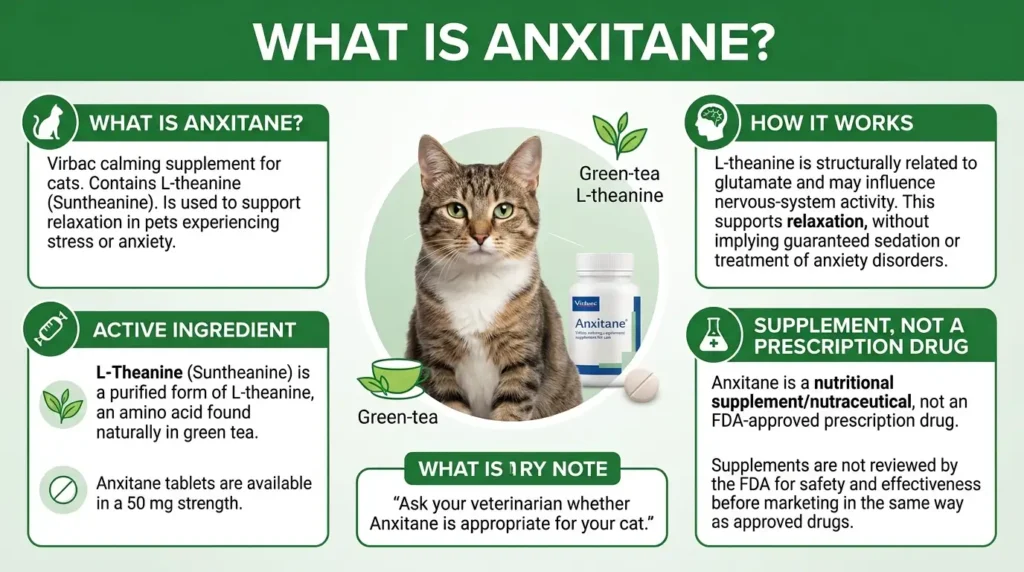
Anxitane Dosage For Cats is also a Virbac chewable calming supplement. It is an amino acid that is present in the leaves of a green tea and is its active ingredient, which is used to alleviate anxiety in dogs and cats. It is available under the ANXITANE brand name, and is used specifically to induce relaxation in nervous, anxious, or stress-responding pets.
The Active Ingredient: L-Theanine (Suntheanine)
Anxitane is packaged in 50mg pills (10 tablets) of L-theanine in a purified form known as Suntheanine and packaged as a single bottle of 10 pills. The L-theanine in the brain is a structural analog of glutamate, a neurotransmitter, and is a binding specificity which appears to inhibit the activity of the nervous system without necessarily sedating the animal. It is chicken-liver flavored, and Virbac says that it is easily accepted by most cats and dogs.
Is Anxitane a Drug or a Supplement?
This is more than meets the eye. Anxitane is a health supplement (nutraceutical), rather than a drug that has FDA approval. Non-drug health supplements are not reviewed by the FDA concerning safety or efficacy prior to being stocked in stores, it is the responsibility of manufacturers to determine that their products are safe and labeled appropriately.
It does not imply that Anxitane is unsafe; it simply means that the evidence bar is not the same as a prescription drug, and even your vet is the most qualified person to decide whether or not it is right in your particular cat.
Anxitane Dosage for Cats
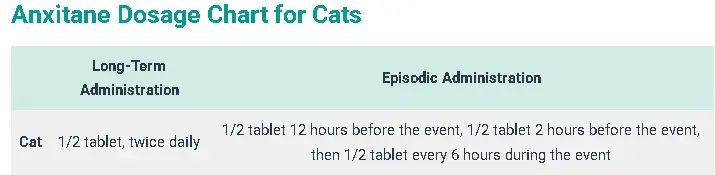
Anxitane for cats dosage is available in a single strength Anxitane S, 50 mg of L-theanine per tablet, no matter the size of your cat. The dosage as per the directions given by Virbac on how to use it is:
| Long-Term Administration | Episodic Administration | |
| Cat | 1/2 tablet, twice daily | 1/2 tablet 12 hours before the event, 1/2 tablet 2 hours before the event, then 1/2 tablet every 6 hours during the event |
That’s 25 mg per half-tablet, or 50 mg total per day for ongoing use.
Why the Dose Isn’t Based on Your Cat’s Weight
This confuses most owners who are accustomed to weight-based pet medications, as there is no formulaic “X mg/lb of cat” here, and it’s not a blank where the label fails to be read. Virbac has two tablet potencies, a 50mg (Small) tablet to be given to all cats and dogs less than 22 lbs, and a 100mg (Medium and Large) to larger dogs only.
All cats take the same tablet and the same dose since virtually all cats weigh less than 22 lbs. A 6-lb cat and a 20-lb cat receive 1/2 tablet twice a day – the dose was established based on the species and weight bracket, not individual cat.
Anxitane Dosage Chart for Cats
Print it out and use as a fast guide. (You can skip the math and go up the page and use the calculator on the top of this page–it will construct the precise schedule you want to follow.)
| Situation | Dose | Timing |
| Ongoing daily use | 1/2 tablet (25 mg) | Morning |
| Ongoing daily use | 1/2 tablet (25 mg) | Evening (~12 hrs after morning dose) |
| Before a known stressful event | 1/2 tablet (25 mg) | 12 hours before the event |
| Before a known stressful event | 1/2 tablet (25 mg) | 2 hours before the event |
| During an ongoing event | 1/2 tablet (25 mg) | Every 6 hours until the event ends |
Daily dosing either side: 1 complete tablet (50mg) divided into doses either when you are dosing daily or on or near an occasion.
Long-Term vs. Episodic Administration: What’s the Difference?
Anxitane dose is given in varying doses according to the reason why you are taking it; on a daily basis or a stressful situation. The amount of tablet taken is the same and the amount of 1/2-tablet taken is also the same; the only difference is the schedule.
Long-Term Administration
This is in the case of cats that have recurring anxiety, chronic stress-related behaviours (such as inappropriate urination outside the litter box) or they are just generally nervous and it is not related to a particular incidence. It is a dose that is easy to remember, 1/2 tablet in the morning, 1/2 tablet in the evening, daily, about 12 hours between doses.
Virbac writes Anxitane for cats dosage may be administered throughout the life of the pet, and in conjunction with other drugs, but you must always check with your vet first.
Episodic (Event-Based) Administration
This is related to a particular, familiar stressor a vet visit, grooming appointment, car ride, move, or fireworks. Instead of taking a daily dose, you can front-load by taking two doses before the event, and then continue top-up dosing every 6 hours as long as the stressful event persists:
- 1/2 tablet, 12 hours before the event
- 1/2 tablet, 2 hours before the event
- 1/2 tablet every 6 hours while the event is ongoing
Step-by-Step: Giving an Episodic Dose Before a Stressful Event
You are having a 2 p.m. appointment with the vet tomorrow with your cat:
- Today at 2 a.m. (12 hours before): Give 1/2 tablet. (Most owners would actually round this into the night before – the evening before will be good enough in most situations; consult your vet on whether a strict time schedule is necessary with your cat).
- Tomorrow at 12 p.m. (2 hours before): Give 1/2 tablet.
- When the stressful event is prolonged (a complete traveling day, a several-hour grooming session, a fireworks night), administer another 1/2 tablet at every 6 hours until the event ends.
- You should no longer use episodic dosing and get your cat back to its normal routine (or get cat on long-term dosing again, independently).
What Is Anxitane Used For? (Uses & Benefits)
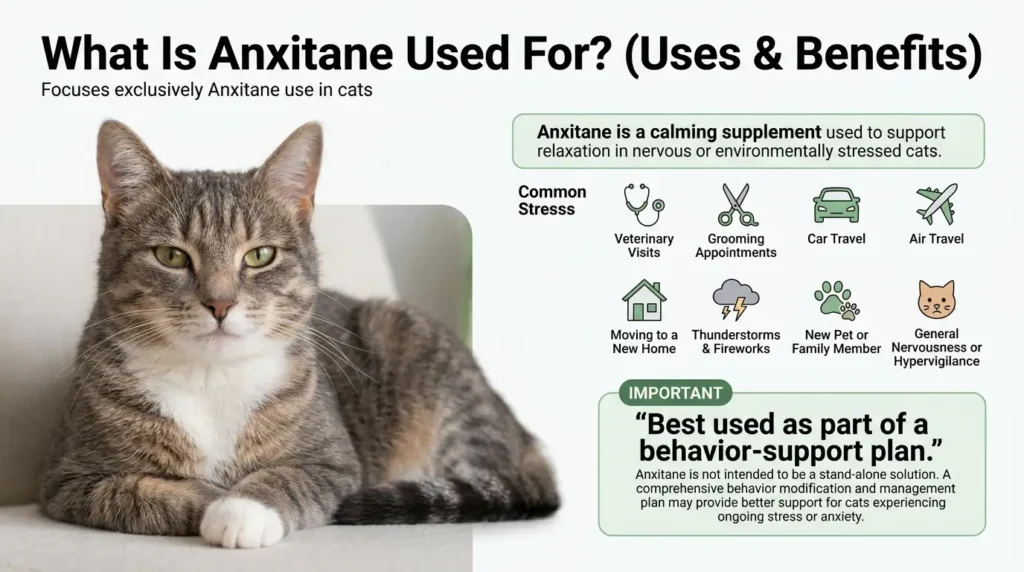
Anxitane is used to induce relaxation in cats that are nervous, or are stressed due to the environment. The typical real-life triggers employed by the pet owners are:
- Veterinary visits
- Grooming appointments
- Carmobile or airliners.
- Going to a new house.
- Thunderstorms and fireworks
- Bringing in a new pet or family member.
- General hypervigilance or nervousness.
It is not intended to be a stand-alone solution but rather in combination with a behavior modification plan- Virbac is clear that an all-inclusive behavior program is most effective.
How Long Does Anxitane Take to Work in Cats?
When taking it long-term, do not anticipate immediate results. The L-theanine can require days to become effective and any change can be slow and not rapid. To use episodically, the 12-hour and 2-hour pre-event dose are scheduled such that the supplement is in your cat system when the stressful event begins.
Its effects also have a short duration of action as a supplement; it should cease action within 24 hours but again, in cats with liver or kidney disease, the effect can be prolonged, as these organs process it more slowly.
Anxitane Side Effects in Cats
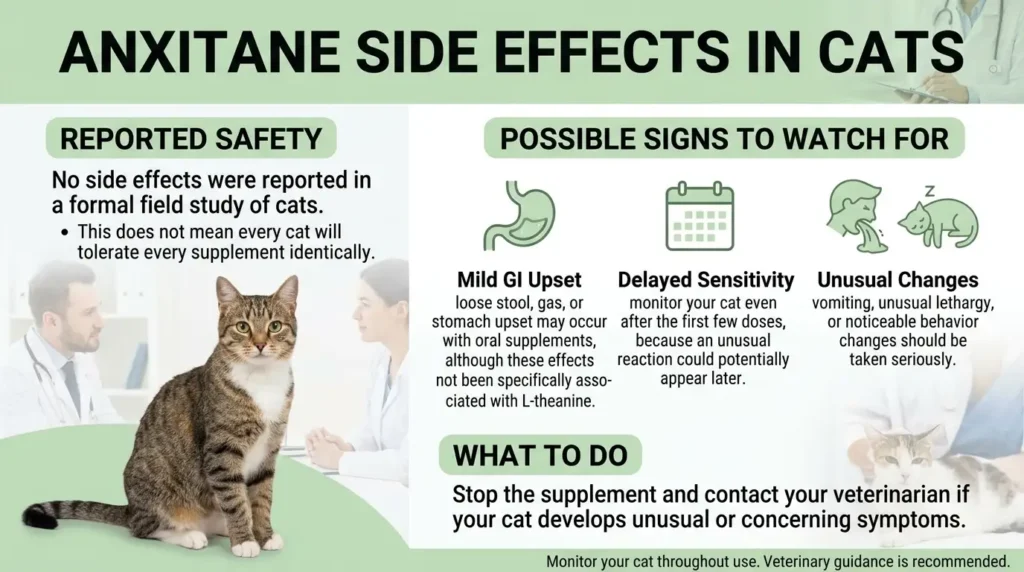
The encouraging news first: no side effects were reported in a formal field study of cats (more about that study below) and one supplier reports it having no known adverse interaction with other therapeutics. However, all supplements are not safe, and the handout prepared by VCA, which is reviewed by a veterinarian, gives an idea of what to be aware of:
- GI mild-GI upset – Loose stool, gas or an upset stomach may occur with any oral supplement although this has not been particularly reported with L-theanine.
- Delayed sensitivity – a cat can take the first few doses without any trouble, but will later have a reaction, hence continue to watch out and see if anything out of the ordinary is going on, not just during the first few days of treatment.
- Something unusual – should you notice vomiting, some strange lethargy, changes in behavior, discontinue the supplement and contact your vet.
Anxitane Safety: Warnings, Contraindications & Drug Interactions
Do Not Use Anxitane In These Cats
Both Virbac label and clinical guidance of VCA recommend that Anxitane should not be used in cats that:
- Allergic to L-theanine or any other inactive ingredient of the tablet
- Have severe phobias
- Have separation anxiety
- Possesses a history of aggression.
Anxitane medicine is designed to deal with daily nervousness and situational stress, not these more serious behavioral disorders, which may require a treatment regimen guided by a vet, perhaps with a prescription drug.
Pregnant cats or cats to be bred have not been proved to be safe and that is why they should not be used unless otherwise advised by your vet. And when the symptoms of your cat do not improve (or even deteriorate) after 60 days of taking it, both Virbac and VCA suggest to discontinue the supplement and to visit your veterinarian instead of taking it forever.
Medications That Need Caution
VCA veterinary-reviewed drug interaction notes recommend that you use these combinations with caution and only under veterinary advice:
- Antihypertensive drugs – L-theanine has the potential to reduce blood pressure and combining L-theanine with blood-pressure medication may be an additive effect.
- D-theanine or D,L-theanine – these analogs have the potential to decrease the absorption of the L-theanine in Anxitane.
Before starting Anxitane, always inform your vet about all medications, supplements or herbal products that your cat is taking.
What If I Miss a Dose or Give Too Much?
Missed dose: Take immediately. In case it is nearly time to take the next scheduled dose, but the last dose has been missed, do not take it again and resume normal schedule – do not take two doses to play catch-up.
Suspected Overdose: Call your veterinarian or an emergency animal poison control line. Prepare the product packaging and the weight and symptoms of your cat. This is no wait and see situation – consider any suspected overdose as an emergency.
Does Anxitane Actually Work? What the Research Says
That is where most articles choose to exaggerate the evidence or turn a blind eye to it, so now we will see what actually exists.
The primary cat-specific trial is an open-label field trial carried out in 2018 in the Irish Veterinary Journal. The scientists treated 33 privately owned cats exhibiting stress symptoms (such as inappropriate elimination, fear-induced aggression or hypervigilance) with L-theanine (25 mg twice a day) over 30 days, the same dose as the standard half-tablet.
At day 30, 30 of 33 cats (91% of animals) had a lower overall stress score, and 21 of those had a greater than 50% decrease. Inappropriate elimination was the area that was most improved by owners.
It is a really good encouraging outcome – however there are practical constraints to be aware of:
- It was open-label, i.e. owners and vets were aware that the cats were being provided with the supplement. That leaves open the possibility of the placebo effect, as individuals (and consequently, their impressions of their pets) are more likely to be optimistic when they are being treated.
- No control group – no group of cats was administered a placebo pill to compare to.
- It was small – 33 cats is a small sample size.
- This line of research has been funded and author affiliations have had links to Virbac, which does not nullify the information, but is worth considering when considering the extent to which the evidence is independent.
In simple words: there is actual, published, peer-reviewed evidence that L-theanine can reduce stress behaviors in cats, though, as yet, it has not been proven using an act of blindness and placebo-controlled trial that would definitively answer the question. When your cat turns anxious and this is life-threatening (aggression, self-mutilation, excessive phobia), do not use Anxitane by itself, have a chat with your vet.
Anxitane Reviews: What Real Cat Owners Say
The reviews of owners are truly both positive and negative, and it is worth presenting you with both sorts of reviews instead of just the positive ones. Throughout Chewys product listing of the cat/small-dog formula, the product has an average rating of 4.3 out of 78 reviews, which is fairly good, though not universal.
What users say is good: cats and dogs appear more relaxed and less responsive, a previously stressed dog has an easier time bowel-moving, and one user reports that it lasted longer than per-pound calming pills they had already used but only a half-to-whole size was required.
What the critical reviews say: a small number of owners observed no difference whatsoever, even after completing a course; some were unable to afford the cost without apparent outcomes; some cat owners stated that their cat simply did not like the smell or the size of the tablet and would not eat it, even in crunchy food form.
The plain truth: Anxitane may be effective in a significant proportion of cats, but not all, and a practical obstacle to some owners is that it is not palatable (getting a fussy cat to actually take it).
Anxitane vs. Other Calming Options for Cats
| Option | How it works | Best for |
| Anxitane (L-theanine) | Oral amino acid supplement, taken daily or around events | Everyday nervousness, situational stress, owners who want an oral option |
| Pheromone diffusers/sprays | Mimic natural feline facial pheromones in the environment | Household-wide stress, multi-cat tension, litter box issues tied to territory |
| Prescription anti-anxiety medication | Vet-prescribed, often for more severe or diagnosed anxiety disorders | Severe phobias, separation anxiety, aggression — situations Anxitane’s label excludes |
| Behavior modification | Training, environmental changes, routine adjustments | The foundation for any anxiety plan — works best combined with any of the above |
Anxitane occupies a particular niche: a low-effort, over-the-counter, non-prescription drug to use on daily or situational stress. It is specifically not aimed at being a substitute to prescription intervention at the more severe end of the anxiety spectrum.
Myth vs. Fact
Myth: Bigger cats require bigger dose.
Fact: Cat dosing is not weight based. All cats, large and small, receive half of the same 50 mg pill.
Myth: Anxitane Will sooth my cat.
Fact: It is made to help you relax without feeling drowsy or sedated – it is not a tranquilizer.
Myth: “It is okay to extreme separation anxiety because it is natural.
Fact: Virbac label itself does not include severe phobias, separation anxiety, and cats with a history of aggression. Natural does not imply that it is suitable in all situations – consult your vet.
Myth: The first day it will work.
Fact: Significant enhancement may take days to manifest, even with long term use. Episodic dosing is not a daily accumulation, but a single event.
You May Also Like to Read:
- Barrier Dosage For Cats: Calculator, Chart & Safe Guide
- Advantage II Dosage For Cats: Calculator, Chart & Complete Guide
FAQs
Is Anxitane safe for cats?
Separation anxiety, no history of aggression, and generally healthy cats with no severe phobias generally tolerate Anxitane well, and no side effects were reported in the primary cat field study. Nevertheless, always consult your vet regarding pregnant cats, liver/kidney disease and other medication.
Is the dose variable to the weight of my cat?
No. All cats take the same 50 mg “Small” tablet at the same dose of 1/2-tablet, irrespective of size.
The time of action in cats with Anxitane?
To use daily, take a few days to determine the assistance. In the case of event use, the 12-hour and 2-hour pre-doses are set in such a way that its activity is present during event commencement.
Is it possible to administer my cat Anxitane daily?
Yes – Virbac says it can be used as long as the pet lives to continue with the anxiety. In case of no improvement in 60 days, cease and visit your vet.
What should I do in case of a missed dose?
Take it as soon as you think of it, unless it is too close to the next dose, when you can skip it and go on with the usual schedule. Don’t double up.
Will I administer excess Anxitane?
Take as label dosing. In case of an overdose, you should call your vet or an animal poison control phone line with the product information and the weight and symptoms of your cat.
Can Anxitane be given with other medications?
Virbac says it may be administered concomitantly with other drugs, however, it should be used with care when taking antihypertensives (may act as an additive effect, and thereby lower blood-pressure) and with D-theanine/ D,L-theanine (may reduce absorption). Always inform your vet on all that your cat is taking.
Does Anxitane resemble calming treats or chews?
No. Calming therapies are usually administered on a per pound body weight basis and may contain varying active ingredients. Anxitane is an L-theanine tablet that does not increase in weight with the content of cats.
What is Anxitane made of?
L-theanine (as Suntheanine) 50 mg/ tablet is the active ingredient in the cat/small-dog formula. Colloidal silica, magnesium stearate, microcrystalline cellulose, and a chicken-liver or poultry flavoring are all inactive ingredients.
Is it possible to treat my cat with Anxitane because of separation anxiety?
No – Virbac label specifically excludes cats that have separation anxiety. Such anxiety usually requires a treatment plan that is guided by veterinarians.
What is the name of the cat Anxitane?
It can be found in the veterinary clinics and online pet pharmacies, usually in 30-count packages of the “Small” (cat/small dog) formula.
Final Thoughts
The dosing of cats actually is easier than the packaging is made to appear once you sort out the two cases it discusses: a constant (1/2) tablet two times a day to maintain a certain amount of stress or a time-based regimen of 1/2-tablet doses surrounding a certain stressful event. The fact that causes people to stumble, the bigger the cat should be fed, is not the case; all cats take the same pill and in the same dosage.
The place where it is not easy is deciding whether or not it is the right tool to your cat in the first place. It has supporting research (although limited) which is real, it has a history of good tolerability and there are many happy owners, as well as a significant number who have seen no improvement. It is also clearly not designed to the more serious end of cat anxiety.
Provided that stress in the cat is mild-to-moderate, and situational, Anxitane is a fair, low-risk treatment to consider with your vet. Should it be aggression, extreme phobia or actual separation anxiety, then that discussion with your vet must precede any supplement.