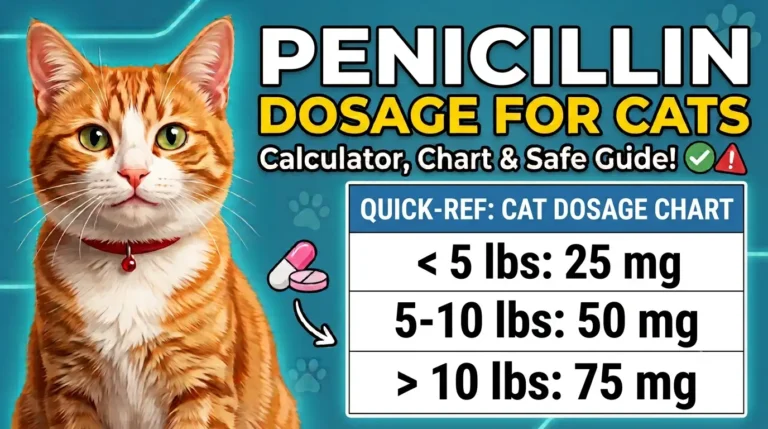
Amoxicillin Dosage For Cats: Calculator, Chart & Safe Guide
When it comes to the dose, there’s only one question with amoxicillin and your cat and that is what is your cat’s weight? Amoxicillin is typically prescribed to cats at 11 to 22 mg per kg of body weight (5 to 10 mg per lb) every 12 hours, though the quantity your cat will require — and the amount this equals in pills or milliliters of liquid — will vary based on the product and concentration prescribed by the veterinarian.
This guide will guide you through the math and provide a quick-reference chart, as well as advice on what’s normal, what may be cause for a call to the vet, and what constitutes a true emergency.
The calculator on this page and this article is a reference only. They are not a substitute for a prescription or for your veterinarian’s advice. When administering medication to your cat, always check with your veterinarian to be sure of the correct dosage.
Amoxicillin Dosage Calculator for Cats
Estimate a starting liquid amoxicillin dose based on your cat’s weight. This tool is a reference aid only — always confirm with your veterinarian.
Recommended Dosage
Standard range for this cat’s weight (11–22 mg/kg, every 12 hours):
—
Important Notes
- Shake liquid amoxicillin well before each use and store it in the refrigerator.
- Treatment typically lasts 3 to 5 days, and sometimes up to a few weeks, depending on the infection — always complete the full course your veterinarian prescribes, even if your cat seems better.
- Always verify your cat’s exact weight and your medication’s exact concentration with a veterinarian before dosing.
- This calculator is for informational and reference purposes only and does not replace professional veterinary guidance. Never start, stop, or adjust a medication without consulting your veterinarian.
© medscat.com
What Is Amoxicillin for Cats?
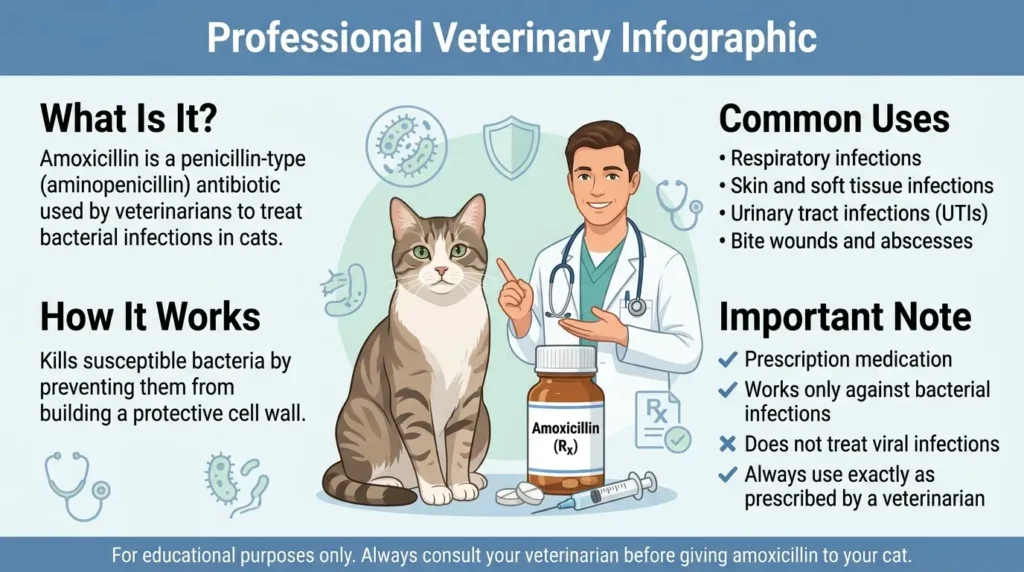
Amoxicillin Dosage For Cats belongs to a group of drugs known as penicillin called "bactericidal, aminopenicillin antibiotics", which are sold under brand names such as Amoxil, Amoxi-Tabs, Amoxi-Drop, Bimox, Moxatag, and Novamoxin. Its use is to treat some bacterial infections in cats by inhibiting and interfering with the bacteria's ability to construct cell walls, causing the bacteria to perish.
Amoxicillin for cats is only effective against bacteria that do not produce an enzyme called beta-lactamase and the bacteria that do produce it are resistant to amoxicillin. Amoxicillin can be used in combination with clavulanate potassium or clavulanic acid (Clavamox) to overcome the resistance of beta-lactamase-producing bacteria. Amoxicillin is more readily absorbed by cats than plain penicillin, and is more persistent in the body.
Amoxicillin is FDA approved for use in some bacterial infections in cats, such as respiratory infections, urinary tract infections, skin infections, soft tissue infections and intestinal infections. It can also be used for other bacterial infections in cats, dogs, ferrets, birds and reptiles, but this is "off-label" (extra-label) use. “Off-label” refers to the fact that this is not how the product is generally used and has not been evaluated or approved by the FDA or Health Canada, so your veterinarian's instructions may vary from the label instructions.
Amoxicillin for Cats at a Glance
| Category | Details |
|---|---|
| Brand Names | Amoxicillin (Amoxi-Drops, Amoxi-Tabs, Bimox, Amoxil, Trimox, Moxatag) |
| What It Treats | Bacterial infections |
| Available Forms | Tablets, capsules, liquid suspension, and injection (injection typically administered by a veterinarian only) |
| Standard Dosage | 10–25 mg per kg of body weight, every 12 hours — exact amount depends on your cat's weight and the medication form used |
| Common Side Effects | Diarrhea, vomiting, loss of appetite, allergic reactions |
| Cost | Around $10 for a 15 mL bottle of oral liquid |
What Is the Standard Amoxicillin Dosage for Cats?
For cats, the typical veterinary dose of amoxicillin is 11 to 22 mg/kg (5 to 10 mg/lb) every 12 hours. This is the range which the calculator at this page is based upon.
Other vet-approved websites will also have slightly different dosages up to 25 mg/kg, and some will state the dosing times as every 8, 12, or 24 hours instead of just every 12 hours. This is not a contradiction, but rather a representation of the true variation in amoxicillin dosing that is reasonable and varies depending on the type and extent of infection; different formularies round the dose ranges slightly differently. Always follow the prescription from your vet, even if it is outside of the range listed here.
Dosage in mg/kg and mg/lb
Most vets are thinking in mg/kg, but most of the owners of cats in the U.S. are thinking in pounds. The same range back and forth:
- Low end: 11 mg/kg = 5 mg/lb
- High end: 22 mg/kg = 10 mg/lb
Cats can be weighed in pounds and then the weight in pounds can be converted to kilograms by dividing by 2.2. A 10 lb cat weighs about 4.5 kg.
Why Vets Give a Range, Not One Fixed Number
There is a dosage range because "the right dose" is not only based on weight:
- Type of bacteria. Many gram-positive bacteria are susceptible to amoxicillin; however, some gram-negative bacteria are not as susceptible, and vets occasionally administer the higher dose for more stubborn infections.
- Location and severity of the infection. A mild skin infection might require the lower end of the range, or perhaps a higher end, even a different antibiotic.
- The function of the kidneys and the liver. This drug is excreted by the kidneys, so cats with decreased organ function may require adjustment of the dosage.
- Age and other health issues. Special consideration may need to be given to kittens, senior cats and cats taking other medications.
That's why you can only use a calculator or chart to get a starting point: the number that appears on your cat's prescription label is for your cat only.
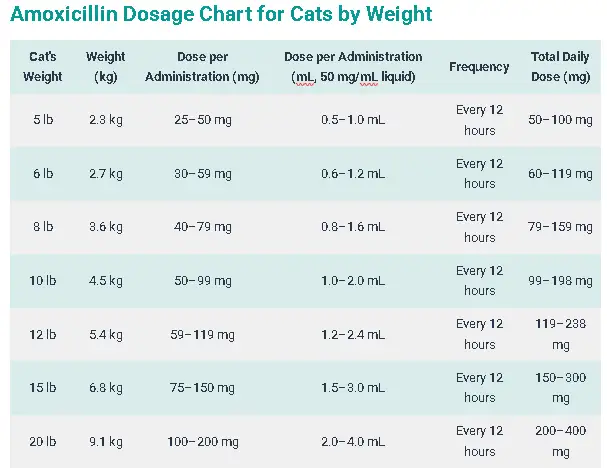
Amoxicillin Dosage Chart for Cats by Weight
This chart lists the calculated dose range for common cat weights at a standard 50mg/mL liquid concentration, which is 11-22mg/kg. If your product is a different concentration, use the calculator above instead of this chart.
| Cat's Weight | Weight (kg) | Dose per Administration (mg) | Dose per Administration (mL, 50 mg/mL liquid) | Frequency | Total Daily Dose (mg) |
|---|---|---|---|---|---|
| 5 lb | 2.3 kg | 25–50 mg | 0.5–1.0 mL | Every 12 hours | 50–100 mg |
| 6 lb | 2.7 kg | 30–59 mg | 0.6–1.2 mL | Every 12 hours | 60–119 mg |
| 8 lb | 3.6 kg | 40–79 mg | 0.8–1.6 mL | Every 12 hours | 79–159 mg |
| 10 lb | 4.5 kg | 50–99 mg | 1.0–2.0 mL | Every 12 hours | 99–198 mg |
| 12 lb | 5.4 kg | 59–119 mg | 1.2–2.4 mL | Every 12 hours | 119–238 mg |
| 15 lb | 6.8 kg | 75–150 mg | 1.5–3.0 mL | Every 12 hours | 150–300 mg |
| 20 lb | 9.1 kg | 100–200 mg | 2.0–4.0 mL | Every 12 hours | 200–400 mg |
These numbers represent a mathematical range only and should not be considered as a replacement for the actual prescription given by your veterinarian which may lie anywhere within (or sometimes outside) the range depending on the diagnosis given your cat.
How to Calculate Your Cat's Amoxicillin Dose by Hand
If you prefer not to use the calculator to do the calculations, the precise formula for liquid doses for 50mg/mL concentration liquid medication using the lower limit of the recommended range (11mg/kg) is:
To convert weight to kilogram, divide the weight in lbs by 2.2: weight in lbs / 2.2 = weight in kg.
- Convert weight to kilograms: weight in lbs ÷ 2.2 = weight in kg
- Calculate total mg needed: weight in kg × 11 mg = total mg per dose
- Calculate the liquid volume: total mg ÷ 50 mg/mL = mL per dose
Worked example — a 10 lb cat:
- 10 ÷ 2.2 = 4.5 kg
- 4.5 × 11 = 50 mg
- 50 ÷ 50 mg/mL = 1.0 mL per dose, given every 12 hours
If your bottle is a different concentration (say, 25 mg/mL or 100 mg/mL), swap that number into step 3 — the first two steps don't change.
What Is Amoxicillin Used For in Cats?
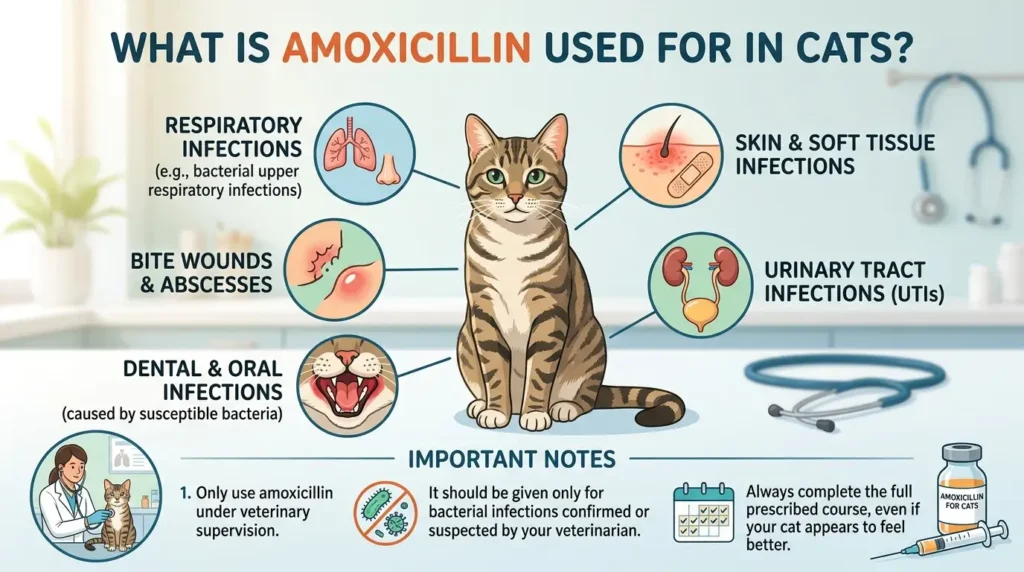
Amoxicillin cat dosage is a penicillin antibiotic commonly used by vets for a variety of bacterial infections including:
- Upper respiratory infections
- Urinary Tract Infections (cystitis)
- Infection of the skin and abscess.
- Ear infections
- Soft tissue infections
- Some dental infections
It acts by disrupting the ability of the bacteria to form their protective cell wall and thus weakening and killing the bacteria. It is only effective with bacterial infections, and will not have any effect on a viral illness (which most upper respiratory 'cat colds' are) or a parasitic one.
Amoxicillin medication for cats is usually given to cats for 3-5 days (or longer, depending on the type and severity of the infection). Always administer the entire course of therapy as prescribed by your veterinarian, even if your cat appears completely better after a few days as stopping treatment too soon allows any surviving bacteria to multiply again and it can also add to antibiotic resistance.
Liquid vs. Tablet Amoxicillin: Which Is Easier to Dose?
There are several types of Amoxicillin for cats:
- Liquid suspension (usually marketed as Amoxi-Drop) — the most frequently prescribed form for cats because it is more readily administered to the cat (who may be pill resistant) and easier to dose accurately by weight. Shake well before each use and store in the fridge.
- Tablets and capsules (Amoxi-Tabs) — are not used in cats as frequently as liquid, partly because it is more difficult to administer a small, fixed tablet dose to a cat of a specific weight, and partly because many cats are not easy to pill.
- Injected Amoxicillin (not an antibiotic that a person is taking at home, but rather is given by a veterinarian in a clinical environment).
- Compounded powder — compounded with water according to the pharmacist's directions and refrigerated; as per compounding guidelines, unused portions are typically to be thrown after 14 days (following your prescription label should be followed).
Can I Give My Cat Human Amoxicillin?
Only when your veterinarian has specifically advised you to use a human product and has informed you of the exact dosage – NOT on your own discretion. Some actual dangers of replacing human amoxycillin on your own as a vet:
- Wrong concentration. Human liquid formulations or capsule strengths are designed for adults – these are too concentrated to use on cats without being carefully diluted (under veterinary supervision) or split.
- Inactive ingredients. Some human liquids may contain ingredients which are not suitable for use on a cat, such as flavorings or sweeteners; be sure to consult your veterinarian or pharmacist about the suitability of a given human medication prior to using it on a cat.
- No prescription-matched instructions. A veterinary prescription will take into consideration your cat's weight, the treatment you are using, and the proper dose interval; a human bottle's label will not.
If it is because of cost or availability, consult with your veterinarian about them rather than assuming that a human product will work.
Amoxicillin Side Effects in Cats
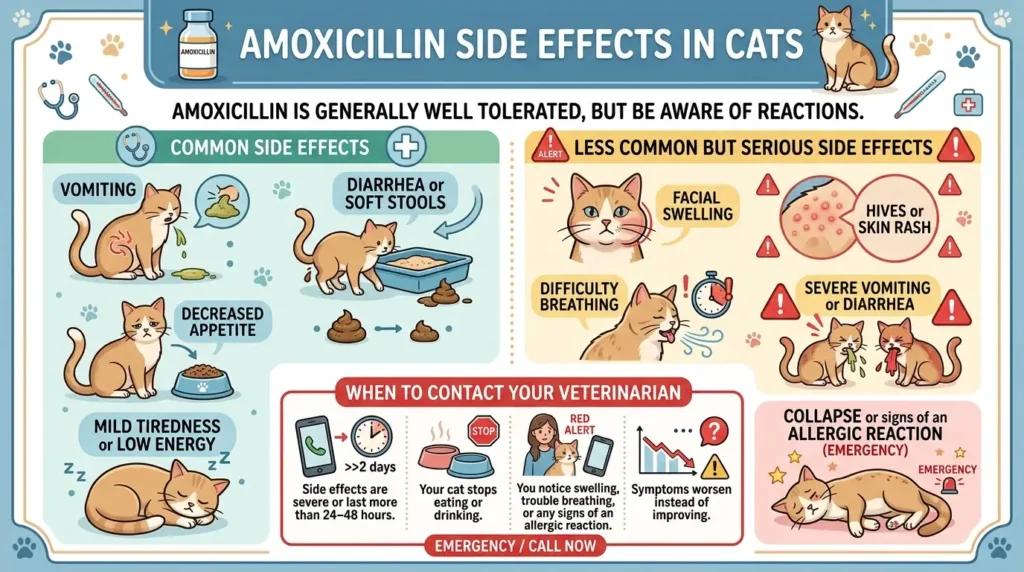
Amoxicillin medication for cats is well tolerated by most cats. If side effects do occur, they are typically mild and gastrointestinal. A handy way to distinguish between the "keep an eye on it" and "call now" situations.
Normal, Mild Side Effects
- The vomit is mild (once or twice)
- Loose stools or slight diarrhoea
- Slightly reduced appetite
- Mild lethargy
If your cat vomits when its tummy is empty, you may want to mix the dose with a small amount of food.
Signs That Need a Same-Day Call to Your Vet
- Repeated vomiting or diarrhea
- Avoids food more than 24 hours
- Lethargy that is not typical or does not get better
- New rash, hives, or itchiness
Emergency Signs (Go to the Vet Now)
- Facial swelling
- Difficulty breathing
- Collapse or sudden weakness.
- Symptoms that get worse fast (of any kind)
Although allergic reactions to amoxicillin are rare in cats, it is possible for them to have a reaction to it even if they have previously taken it without any problems, so be sure to monitor your cat for the duration of the treatment, not just after the first dose.
What Are the Most Serious Risks of Amoxicillin for Cats?
Serious Side Effects: Rare overall. Cats which are allergic to penicillin antibiotics react the worst.
Symptoms of Cat Penicillin Allergy:
- Extreme vomiting and diarrhea
- Swollen face
- Bumps all over the body (hives)
- Itchy rash on the ears, forehead or tummy
- Watery eyes
- Fever
- Anaphylaxis is an extreme allergic reaction which may lead to breathing problems and collapse.
What to Do: If your cat experiences any of these signs after taking amoxicillin, discontinue the drug and contact your veterinarian or nearby emergency veterinary clinic right away.
Do Not Use Amoxicillin In:
- Pets which are allergic to it or to other penicillins, cephalosporins or other beta-lactam antibiotics.
- Rabbit, guinea pig, chinchilla, hamster or other small mammal.
- Pets with a blood infection, shock or other serious diseases that are administered orally, because it is unlikely to be useful in these situations.
With Caution In: Pregnant or lactating pets, but use of this medication may be safe.
What If My Cat Misses a Dose or Gets Too Much?
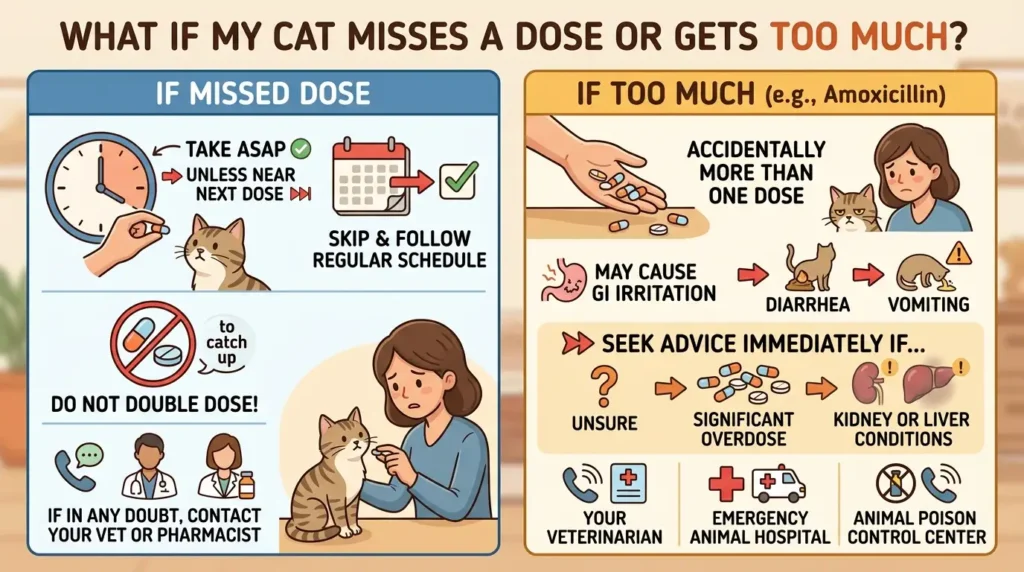
Missed dose: Take as soon as possible unless it is near the time of the next dose; then skip and follow the regular schedule. Do not double dose to "catch up. If in any doubt, contact your veterinarian or pharmacist for advice on your cat's prescription.
Too much amoxicillin: If the dose is accidentally taken more than once, it is not likely to be life-threatening, but may cause irritation of the gastrointestinal tract (GI tract) causing diarrhea or vomiting. If you are not sure, or your cat has had a significant overdose, or you are worried about your cat having any kidney or liver conditions, seek advice from your veterinarian, an emergency animal hospital, or an animal poison control center.
How Long Does Amoxicillin Take to Work in Cats?
You will begin to see improvement within a few days after beginning amoxicillin, depending on what is being treated. Complete the entire course of the antibiotic as prescribed, even if your cat appears to be feeling better, which is one of the most important directives for your cat when on any antibiotic — and one of the most common errors owners make.
Does Amoxicillin Interact With Other Cat Medications?
Amoxicillin drug for cats can interact with a number of other drugs and other substances administered to cats:
- Tetracycline antibiotics: Amoxicillin may not be used at the same time as tetracycline antibiotics because these antibiotics decrease the effectiveness of amoxicillin.
- Mycophenolate (for some autoimmune disorders): Amoxicillin decreases the effectiveness of this medication, and should not be used in cats that are on Mycophenolate.
- Bacteriostatic antimicrobials, methotrexate, and probenecid: Should be used with caution when given alongside amoxicillin.
- Vitamins, supplements and herbal therapies: Nonprescription products can interact with amoxicillin or have side effects; be sure to let your veterinarian know if your cat is taking anything.
Lab Test Interference: Amoxicillin may interfere with some urine glucose tests and may cause a false positive result on the test.
To summarize: When using amoxicillin with your cat, be sure to let your vet know about every medication, vitamin, supplement and herbal therapy your cat is taking so they can formulate the safest and best treatment plan.
Amoxicillin Myths vs. Facts
| Myth | Fact |
| "Human amoxicillin is the same, so I can just use what's in my medicine cabinet." | The active drug is the same, but strength, form, and inactive ingredients differ — only use a human product if your vet specifically directs you to and tells you the dose. |
| "I can stop the medication once my cat looks better." | Stopping early can let the infection return and lets surviving bacteria develop resistance. Finish the full course. |
| "More medication will clear the infection faster." | Giving more than prescribed doesn't speed up recovery — it raises the risk of digestive upset and other side effects. |
| "A skin rash from amoxicillin is nothing to worry about." | Any new rash, hives, or itchiness during treatment should prompt a same-day call to your vet, since it can signal a developing allergic reaction. |
Key Takeaways
- Standard dose: 11–22 mg/kg (5–10 mg/lb) of body weight, every 12 hours.
- Some veterinarians may prescribe a slightly broader dose range (up to 25mg/kg) or use a dose frequency of every 8-24 hours rather than 12 hours, depending on the type of infection -be sure to follow your veterinarian's instructions on the label, not this chart.
- Typically, liquid amoxicillin will be 50 mg/mL (check your bottle as it may vary between pharmacies).
- Under no circumstances use human amoxicillin for a prescription for a cat.
- The most common side effect is mild upset stomach (vomiting, loose stool, loss of appetite). If the face is swollen, hives, or trouble breathing occur, it is an emergency.
- Even if your cat appears better after a day or two, complete the entire course.
You May Also Like to Read:
- Penicillin Dosage For Cats: Calculator, Chart & Safe Guide
- Clonazepam Dosage for Cats: Calculator, Chart & Safe Dosing Guide
FAQs
What is the maximum amount of Amoxicillin I can give my cat?
The standard dose is 11-22 mg/kg (5-10 mg/lb) of body weight to be administered every 12 hours, although the exact dose prescribed by your veterinarian should always be followed and not a general range.
What time of day do you give a cat amoxicillin dose?
Typically, they are given every 12 hours, some prescriptions may require every 8 or every 24 hours, depending on the infection. Do as directed by your vet.
I want to give my cat amoxicillin but he refused to visit a veterinarian, is it OK?
Amoxicillin is a prescription-only drug in cats; without veterinary advice, it's possible to administer the wrong dosage, the wrong medication, or treat a condition for which it isn't effective.
For what is amoxicillin prescribed to cats?
It is used to treat bacterial infections such as respiratory infections, urinary tract infections, skin infections, ear infections and some dental infections. Does not cure viral or parasitic diseases.
Is it okay to give my cat human antibiotics (amoxicillin)?
Only if directed to and provided an exact dose by your veterinarian. Human products are differently sized and formulated, and should not be replaced at your own discretion.
What are some side effects of Amoxicillin for cats?
Most common are mild digestive problems, such as vomiting, loose stools, and loss of appetite. Signs of possible allergy include facial swelling, hives, or difficulty breathing, and should be treated by a veterinarian right away.
Amoxicillin is active in cats in how many days?
Many cats improve in a couple of days, however, always run the entire course of treatment, even if symptoms have abated.
If my cat misses a dose, what will happen?
Give if remembered; if nearly time for dose, skip and resume as scheduled. Don't double up.
My cat took too much amoxicillin dosage, what should I do?
It's not typically severe, but may lead to vomiting, diarrhea or a loss of appetite. If you are unsure call your veterinarian or animal poison control center.
Can kittens take Amoxicillin?
In some situations, amoxicillin may be prescribed for kittens; however, the dosage and whether or not it is appropriate will depend on the age, weight and health of the kitten, which the veterinarian will decide, not something you can figure out yourself at home for an extremely tiny kitten.
What is the difference between liquid and tablets amox for cats?
Liquid (Amoxi-Drop) is dosed on a volume basis and is usually the form that is easier to dose accurately and administer to cats, hence is the form used more frequently.
Is there a need to refrigerate amoxicillin?
Liquid Amoxicillin usually requires refrigeration, and should be shaken thoroughly before each dose, as directed on your particular prescription label.
Is amoxicillin an appropriate antibiotic for a cat's UTI?
It may be prescribed for some bacterial urinary tract infections but the correct antibiotic will vary depending on the bacteria present in your cat's urine, which can be confirmed by testing prescribed by your vet.
Is amoxicillin the same or equivalent medication as Clavamox for cats?
No. The addition of clavulanic acid to amoxicillin increases its activity against certain bacteria that amoxicillin alone is ineffective against. They are similar but should not be used interchangeably without veterinary advice.
Why is the dosage my veterinarian prescribes different than the amount recommended on an online dosage chart?
General charts are a mathematical range using only weight. The type of infection, your cat's health history and organ function are all taken into account with your vet's dose, so always go with the prescription, not a general chart.
Final Thoughts
One of the most widely used antibiotics in cats is amoxicillin, as it is effective and generally well tolerated, but, of course, "generally well tolerated" does not imply proper dosage and close monitoring. The typical dose is 11-22 mg/kg once every 12 hours, which is a good starting point as a reference, and you can use the calculator on this page to convert the dose into millilitres or milligrams. However, the one that is most important is always the one that is on your cat's prescription label.
When in doubt, do what you always do: contact your veterinarian if you have any concerns regarding your cat's dose, product, or symptoms. They can also ensure that the dosage is correct for your particular feline and detect the items which a general guideline such as this one can not.