Barrier Dosage For Cats: Calculator, Chart & Complete Guide
Barrier Dosage Calculator For Cats
Imidacloprid & Moxidectin topical tube dose by body weightOne of the most popular mistakes cat owners make is giving the incorrect dose of a flea/tick/heartworm prevention product. When used properly, Barrier Dosage for Cats is effective, but it’s effectiveness depends on the correct dose for your cat and this guide explains precisely how the dose is applied, straight off the FDA approved label.
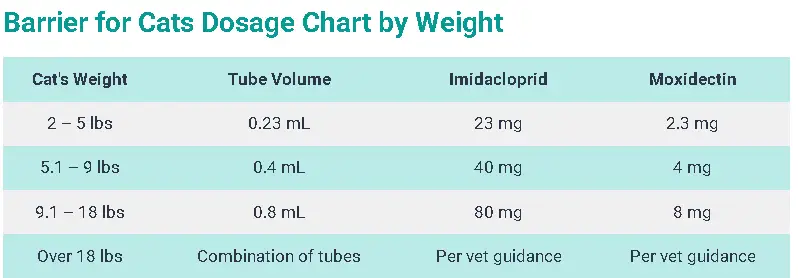
Quick answer: Barrier for Cats is dosed by weight bracket, not by age or breed. A cat between 2 and 5 lbs gets a 0.23 mL tube, 5.1–9 lbs gets 0.4 mL, and 9.1–18 lbs gets 0.8 mL, applied once a month. Cats over 18 lbs need a combination of tubes, which your veterinarian should confirm.
What is Barrier for Cats?
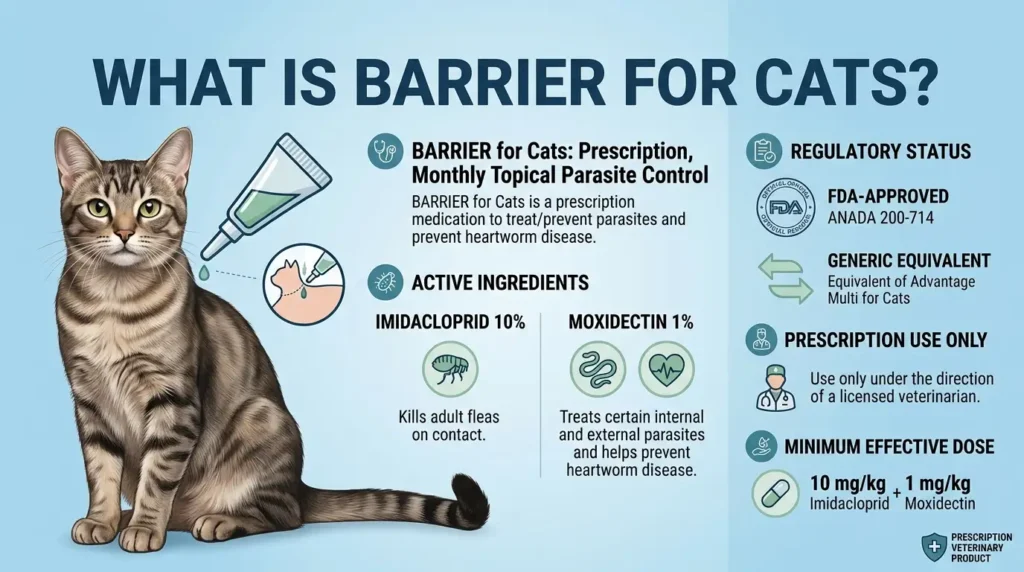
Barrier for Cats is a prescription topical (spot on) once a month parasite control product. It is FDA-approved, under ANADA 200-714, and is a generic of Advantage Multi for Cats — that is, it contains the same two active ingredients, in the same strengths, in the same kind of applicator.
It is a prescription product and under federal law must only be used by or on the prescription of a licensed veterinarian.
Active Ingredients: Imidacloprid + Moxidectin
Each tube combines:
- Imidacloprid (10%) — an insecticide which kills adult fleas on contact.
- Moxidectin (1%) — treats some internal and external parasites and is an endectocide to prevent heartworm disease.
The label features minimum effective Barrier dosage for cats is 4.5 mg/lb (10.0 mg/kg) imidacloprid and 0.45 mg/lb (1.0 mg/kg) moxidectin per lb of cat body weight.
Barrier for Cats Dosage Chart by Weight
This is the FDA approved dosage chart. Each row is a whole tube – you don’t split a tube or give half a dose.
| Cat’s Weight | Tube Volume | Imidacloprid | Moxidectin |
| 2 – 5 lbs | 0.23 mL | 23 mg | 2.3 mg |
| 5.1 – 9 lbs | 0.4 mL | 40 mg | 4 mg |
| 9.1 – 18 lbs | 0.8 mL | 80 mg | 8 mg |
| Over 18 lbs | Combination of tubes | Per vet guidance | Per vet guidance |
Before selecting a tube, make sure to weigh your cat before buying one. One of the most common dosing mistakes is to guess by eye – if a cat “looks like” 9 lbs, but is actually 9.4 lbs, he will need the next size tube, not the smaller one.
Cats Over 18 lbs
It’s written on the label that for cats over 18 lbs use “the appropriate combination of Barrier for Cats tubes,” but it doesn’t explain what combination to use for each possible weight. To avoid guessing, consult your veterinarian about which tube combination is best for your cat’s exact weight to ensure the correct dose of both imidacloprid (4.5 mg/lb) and moxidectin (0.45 mg/lb), the range which the label has been built around.
How to Apply Barrier for Cats, Step by Step
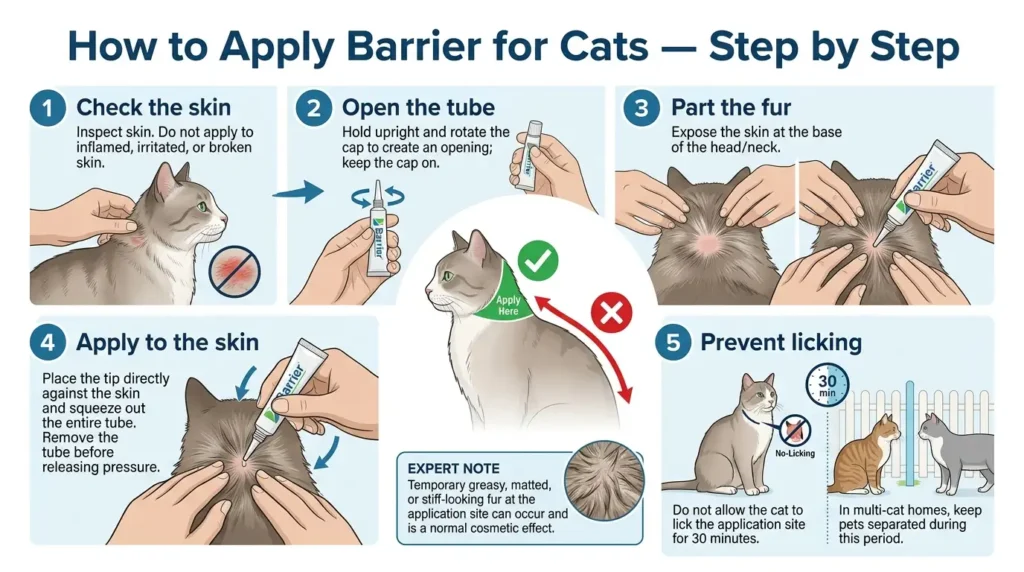
Always check the skin first. Avoid using on inflamed, irritated, or broken skin.
- Open the tube. Turn it upright, then rotate the cap to create an opening in the cap. The cap stays on.
- Part the fur. Shave or comb between your cat’s head/neck until skin is exposed.
- Topically apply directly to skin. Press tip against skin and squeeze all the tube out. Remove the tube before releasing the pressure, to prevent a suction back.
- Do not allow the spot to be licked. Avoid allowing your cat to lick for 30 minutes and, in multi-cat homes, keep your pets apart for that period of time.
This is done at the base of the head and not along the backbone as it is the area the cat cannot clean up with grooming and therefore reduces the likelihood of ingestion.
Expert advice: If the cat’s coat is slightly greasy, matted or stiff at the application site, this is normal and temporary cosmetic effect, and does not mean that the product is ineffective or harmful.
How Often Do You Give Barrier for Cats?
Barrier Dosage for Cats is once a month when used on all three applications:
- Heartworm prevention: once a month, all year round or at least one month before and after mosquito season.
- Flea treatment — treat once a month (flea pupae may still be in the house and continue to hatch for up to 6 weeks after treatment starts, so seeing the odd flea early is not a sign that it is not working).
- Ear mites and intestinal parasites (hookworms/roundworms) – one dose can cure the current infestation and repeated monthly treatment can prevent re-infestation of ear mites;
What If You Miss a Dose?
In the event that more than 30 days have elapsed since giving a dose, treat Barrier for Cats immediately after you remember and resume regular monthly treatment from the date of the second application.
When changing from another brand of heartworm control, administer the first Barrier dose within 30 days of the last dose of the other product to ensure continuous heartworm protection.
Side Effects and Warnings
No parasite-control product is entirely risk-free, and Barrier for Cats’ label contains actual safety information from Barrier’s approval studies — which you should read before using for the first time.
Common Side Effects
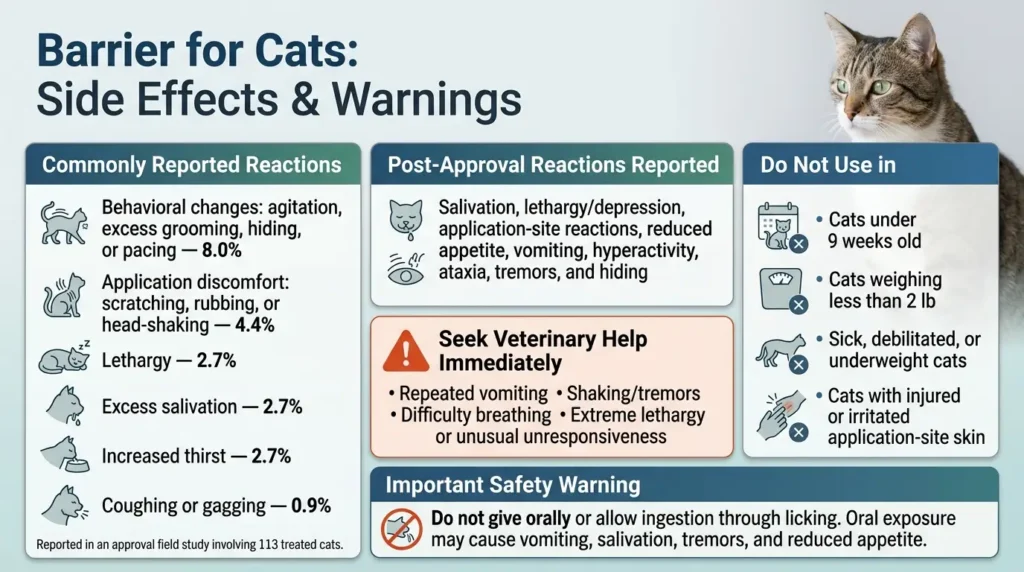
Owners reported the following in the field study submitted for approval (113 cats treated, 38 cats not treated):
| Reaction | Treated cats | Control cats |
| Behavioral changes (agitation, excess grooming, hiding, pacing) | 8.0% | 2.6% |
| Discomfort (scratching, rubbing, head-shaking) | 4.4% | None observed |
| Lethargy (protracted sleeping, poor responsiveness) | 2.7% | None observed |
| Hypersalivation (within 1 hour of treatment) | 2.7% | None observed |
| Polydipsia (excess thirst) | 2.7% | None observed |
| Coughing/gagging | 0.9% | None observed |
These reactions, reported from post-approval use (after the product was approved), occur in decreasing order of frequency: salivation, depression/lethargy, reactions at the site of application (alopecia, pruritus, erythema, lesions), anorectia, vomiting, hyperactivity, ataxia, tremor, and hiding.
Serious Reactions to Watch For
In a very few post-approval cases, death has been reported, and in a few of the pre-approval tests, some cats have become seriously ill or died during the tests, but in some of these cases a different disease (such as panleukopenia or a respiratory infection) was suspected to be the more probable cause of illness or death.
If your cat is vomiting repeatedly, shaking, short of breath, extraordinarily lethargic or does not wake up as usual after you have applied, please call your veterinarian immediately.
Who Should Not Use Barrier for Cats
The label explicitly states not to use Barrier for Cats on:
- Cats that are younger than 9 weeks or less than 2 lbs.
- Cats who are sick, debilitated or underweight
- Cats with an injury or irritation at the application site.
However, it has not been determined to be safe for breeding, pregnant or lactating cats and there have been no specific studies of its efficacy in regularly bathed cats or against heartworm in cats. The label also notes that some healthy, thin, older cats were lethargic and sleepy for extended periods of time following treatment — which is something to consider with your veterinarian if your cat is senior.
Do not administer this product to the cat orally, either on purpose or by accident via licking. Oral exposure in the safety testing resulted in vomiting, salivation, tremors, and inappetence.
Human Safety Precautions
For animal use only. Avoid eye contact with children and do not allow children to touch the application site for 30 minutes after application. Rinse with water for 15 minutes if in eyes and contact a doctor if eye irritation persists. Call poison control in case of ingestion. Wash your hands with soap and water after use, and a reported reaction is a headache, dizziness or tingling/burning sensation of the skin after handling the product — rinse it off and contact your physician if it persists.
Barrier for Cats vs. Advantage Multi
Cats Barrier dosage is a generic version of Advantage Multi for Cats: both products use 10% imidacloprid and 1% moxidectin at the same dosage rate. It is the difference in pricing and packaging and not necessarily in the medicine itself, as the active ingredient and the dosage labelings are the same for most owners. If using both in alternation, use the same weight dose chart above.
Common Dosing Mistakes to Avoid
- Weight estimates rather than weight measurements. It can be easy to guess a pound or more, putting a cat in the wrong bracket.
- A tube that is split “to make it last. Tubes are complete doses only and a “partial” dose (under-tube) will not consistently be effective in preventing heartworm and not be effective in killing fleas.
- Application on an inflamed skin. This can lead to discomfort at the site and decreased absorption.
- One month the cat is, “It looks fine, so why bother? When it comes to heartworm prevention, it’s about consistent, monthly administration, not symptoms.
- Trying to guess combinations for cats that are more than 18 lbs. Don’t guess which tubes to double; consult your veterinarian to be sure.
Storage and Handling
Store Barrier for Cats medicine between 39°F and 77°F (4°C to 25°C), away from excess heat or cold. It’s supplied in three package sizes — a 3-count carton of 0.23 mL tubes, and 6-count cartons of either the 0.4 mL or 0.8 mL tubes — so you can match your purchase to your cat’s weight bracket and dosing schedule.
You May Also Like to Read:
- Advantage II Dosage For Cats: Calculator, Chart & Complete Guide
- Methigel Dosage For Cats: Calculator, Chart & Safe Guide
FAQs
What is Barrier for Cats used for?
A monthly topical drug that can prevent heartworm disease, kill adult fleas and treat flea infestations, and treat/control ear mites, hookworms and roundworms in cats.
What size Barrier does my cat need?
Weigh your cat, then match that weight to the official chart: 2–5 lbs uses the 0.23 mL tube, 5.1–9 lbs uses 0.4 mL, and 9.1–18 lbs uses 0.8 mL. Alternatively, you could put the weight into the calculator above, and get an instant answer.
Is it ok to use Barrier for Cats on kittens?
Yes, as long as the kitten is not younger than 9 weeks and is at least 2 lbs. No testing has been done in kittens younger or lighter than that!
If my cat is more than 18 lbs, what?
The label requires ‘an appropriate combination’ of tubes, not one tube. Do not assume the doses, but ask your veterinarian what the correct dosage is.
Can Barrier for Cats be used by pregnant or nursing cats?
Safety in breeding, pregnant and lactating cats has not been established and should only be used in these cats under veterinary supervision.
How long does it take Barrier for Cats to work on fleas?
While it will kill the fleas your cat is already infested with when you give it to your cat, it will not kill the pupa in your home that can continue to hatch for up to 6 weeks or longer, so you might still see the occasional flea in the weeks following the initial treatment. However, that doesn’t imply that the product is ineffective.
May Barrier for Cats be administered to a sick or underweight cat?
No. In particular, it says to avoid using on sick, debilitated or underweight cats.
Does Barrier for Cats work like Advantage Multi for Cats?
Same active ingredients (10% imidacloprid, 1% moxidectin) and same labeled dose rate, it is indeed a generic equivalent.
If I forget to take one of the doses each month, what should I do?
When you remember to apply it, do so and then follow your regular monthly schedule from that point.
Can I use Barrier dose for Cats on my ferret?
The only labeled tube is the 0.4 mL tube (for ferrets 2 lbs. or more). A tube of 0.23 mL is not an effective dose and a tube of 0.8 mL can overdose a ferret. Never calculate a cat dose according to the ferret’s weight.
Will baths interfere with the effectiveness of Barrier medicine for Cats?
Heartworm efficacy has not been specifically studied in cats that are bathed frequently and this should be discussed with your veterinarian if your cat is bathed frequently.
Where to apply the product?
On the skin of the base of the head/neck – NOT on fur, NOT where your cat can reach to lick.
Can you buy Barrier dosage for Cats without a prescription?
No, it must only be used by a licensed veterinarian or on the prescription of a licensed veterinarian.
Final Thoughts
Barrier dosage for Cats calculation are not difficult to follow, once you have your cat’s actual weight in hand—the entire system is based on three simple brackets, each corresponding to one complete tube. Real errors that cause problems are almost always errors of process, not math: Guessing weight instead of checking it, splitting tubes, or skipping a month.
Follow the chart (or use the calculator above) to apply the entire tube to bare skin on the base of the head, and repeat monthly. Once your cat’s weight is at a bracket line, or if he or she is over 18 lbs, it’s time to call the vet and not guess.